

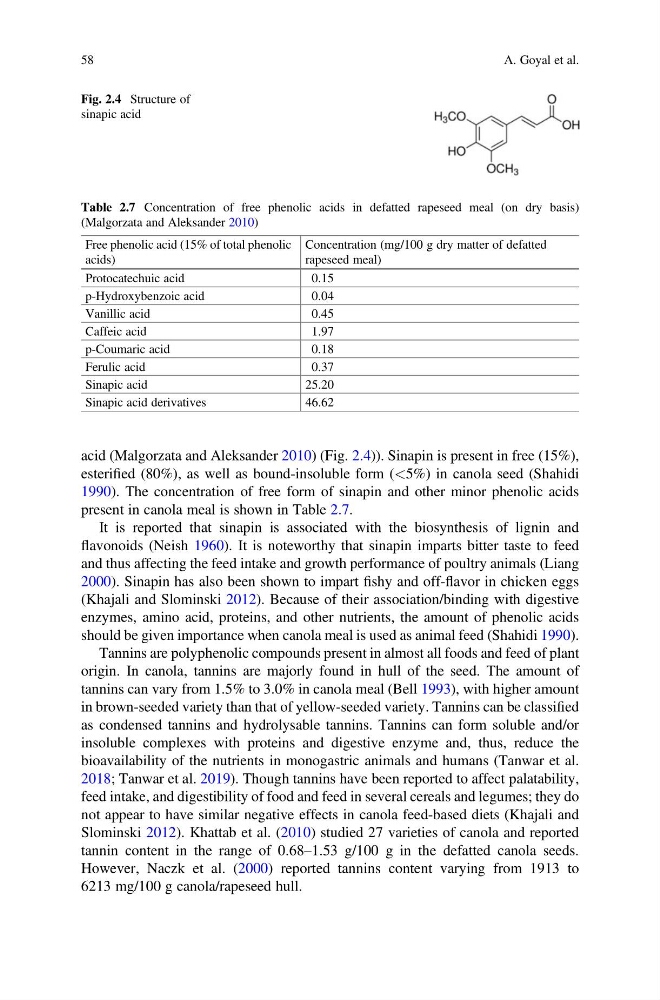
acid (Malgorzata and Aleksander 2010) (Fig. 2.4)). Sinapin is present in free (15%),
esterified (80%), as well as bound-insoluble form (<5%) in canola seed (Shahidi
1990). The concentration of free form of sinapin and other minor phenolic acids
present in canola meal is shown in Table 2.7.
It is reported that sinapin is associated with the biosynthesis of lignin and
flavonoids (Neish 1960). It is noteworthy that sinapin imparts bitter taste to feed
and thus affecting the feed intake and growth performance of poultry animals (Liang
2000). Sinapin has also been shown to impart fishy and off-flavor in chicken eggs
(Khajali and Slominski 2012). Because of their association/binding with digestive
enzymes, amino acid, proteins, and other nutrients, the amount of phenolic acids
should be given importance when canola meal is used as animal feed (Shahidi 1990).
Tannins are polyphenolic compounds present in almost all foods and feed of plant
origin. In canola, tannins are majorly found in hull of the seed. The amount of
tannins can vary from 1.5% to 3.0% in canola meal (Bell 1993), with higher amount
in brown-seeded variety than that of yellow-seeded variety. Tannins can be classified
as condensed tannins and hydrolysable tannins. Tannins can form soluble and/or
insoluble complexes with proteins and digestive enzyme and, thus, reduce the
bioavailability of the nutrients in monogastric animals and humans (Tanwar et al.
2018; Tanwar et al. 2019). Though tannins have been reported to affect palatability,
feed intake, and digestibility of food and feed in several cereals and legumes; they do
not appear to have similar negative effects in canola feed-based diets (Khajali and
Slominski 2012). Khattab et al. (2010) studied 27 varieties of canola and reported
tannin content in the range of 0.68–1.53 g/100 g in the defatted canola seeds.
However, Naczk et al. (2000) reported tannins content varying from 1913 to
6213 mg/100 g canola/rapeseed hull.
Fig. 2.4 Structure of
sinapic acid
Table 2.7 Concentration of free phenolic acids in defatted rapeseed meal (on dry basis)
(Malgorzata and Aleksander 2010)
Free phenolic acid (15% of total phenolic
acids)
Concentration (mg/100 g dry matter of defatted
rapeseed meal)
Protocatechuic acid
0.15
p-Hydroxybenzoic acid
0.04
Vanillic acid
0.45
Caffeic acid
1.97
p-Coumaric acid
0.18
Ferulic acid
0.37
Sinapic acid
25.20
Sinapic acid derivatives
46.62
58
A. Goyal et al.
esterified (80%), as well as bound-insoluble form (<5%) in canola seed (Shahidi
1990). The concentration of free form of sinapin and other minor phenolic acids
present in canola meal is shown in Table 2.7.
It is reported that sinapin is associated with the biosynthesis of lignin and
flavonoids (Neish 1960). It is noteworthy that sinapin imparts bitter taste to feed
and thus affecting the feed intake and growth performance of poultry animals (Liang
2000). Sinapin has also been shown to impart fishy and off-flavor in chicken eggs
(Khajali and Slominski 2012). Because of their association/binding with digestive
enzymes, amino acid, proteins, and other nutrients, the amount of phenolic acids
should be given importance when canola meal is used as animal feed (Shahidi 1990).
Tannins are polyphenolic compounds present in almost all foods and feed of plant
origin. In canola, tannins are majorly found in hull of the seed. The amount of
tannins can vary from 1.5% to 3.0% in canola meal (Bell 1993), with higher amount
in brown-seeded variety than that of yellow-seeded variety. Tannins can be classified
as condensed tannins and hydrolysable tannins. Tannins can form soluble and/or
insoluble complexes with proteins and digestive enzyme and, thus, reduce the
bioavailability of the nutrients in monogastric animals and humans (Tanwar et al.
2018; Tanwar et al. 2019). Though tannins have been reported to affect palatability,
feed intake, and digestibility of food and feed in several cereals and legumes; they do
not appear to have similar negative effects in canola feed-based diets (Khajali and
Slominski 2012). Khattab et al. (2010) studied 27 varieties of canola and reported
tannin content in the range of 0.68–1.53 g/100 g in the defatted canola seeds.
However, Naczk et al. (2000) reported tannins content varying from 1913 to
6213 mg/100 g canola/rapeseed hull.
Fig. 2.4 Structure of
sinapic acid
Table 2.7 Concentration of free phenolic acids in defatted rapeseed meal (on dry basis)
(Malgorzata and Aleksander 2010)
Free phenolic acid (15% of total phenolic
acids)
Concentration (mg/100 g dry matter of defatted
rapeseed meal)
Protocatechuic acid
0.15
p-Hydroxybenzoic acid
0.04
Vanillic acid
0.45
Caffeic acid
1.97
p-Coumaric acid
0.18
Ferulic acid
0.37
Sinapic acid
25.20
Sinapic acid derivatives
46.62
58
A. Goyal et al.