

the GRAS (generally recognized as safe) status by Food and Agriculture Administration (FAO) in 1986. It is important to note that traditional high erucic acid
rapeseed (HEAR) varieties are still produced for the industrial use in plastics,
lubricants, lacquers, and detergents. In the recent times, HEAR varieties with low
glucosinolate content are being produced by plant breeders so that de-oiled meal can
be marketed as animal feed.
2.2 Production
Canola/rapeseed grows well under low temperature and moderate humidity conditions. Therefore, temperate zone is most appropriate environment for the growth of
canola crop, where soybean and sunflower may not be able to survive. It can grow on
a wide range of soil types, but clay loam soils are best suited.
Canola is one of the most important oilseed crops all over the world as its
production has increased at much faster rate [approximately 50% in the last
10 years (2007–2017)] than any other oilseed crop. According to the Food and
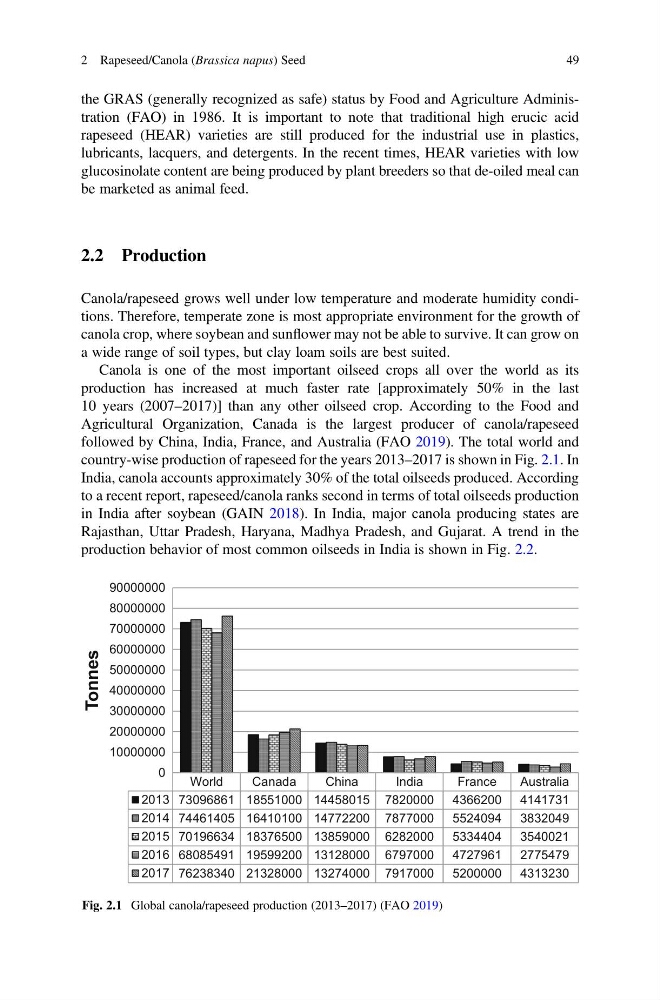
Agricultural Organization, Canada is the largest producer of canola/rapeseed
followed by China, India, France, and Australia (FAO 2019). The total world and
country-wise production of rapeseed for the years 2013–2017 is shown in Fig. 2.1. In
India, canola accounts approximately 30% of the total oilseeds produced. According
to a recent report, rapeseed/canola ranks second in terms of total oilseeds production
in India after soybean (GAIN 2018). In India, major canola producing states are
Rajasthan, Uttar Pradesh, Haryana, Madhya Pradesh, and Gujarat. A trend in the
production behavior of most common oilseeds in India is shown in Fig. 2.2.
World
Canada
China
India
France
Australia
2013 73096861 18551000 14458015 7820000 4366200 4141731
2014 74461405 16410100 14772200 7877000 5524094 3832049
2015 70196634 18376500 13859000 6282000 5334404 3540021
2016 68085491 19599200 13128000 6797000 4727961 2775479
2017 76238340 21328000 13274000 7917000 5200000 4313230
0
10000000
20000000
30000000
40000000
50000000
60000000
70000000
80000000
90000000
Tonnes
Fig. 2.1 Global canola/rapeseed production (2013–2017) (FAO 2019)
2 Rapeseed/Canola (Brassica napus) Seed
49
rapeseed (HEAR) varieties are still produced for the industrial use in plastics,
lubricants, lacquers, and detergents. In the recent times, HEAR varieties with low
glucosinolate content are being produced by plant breeders so that de-oiled meal can
be marketed as animal feed.
2.2 Production
Canola/rapeseed grows well under low temperature and moderate humidity conditions. Therefore, temperate zone is most appropriate environment for the growth of
canola crop, where soybean and sunflower may not be able to survive. It can grow on
a wide range of soil types, but clay loam soils are best suited.
Canola is one of the most important oilseed crops all over the world as its
production has increased at much faster rate [approximately 50% in the last
10 years (2007–2017)] than any other oilseed crop. According to the Food and
Agricultural Organization, Canada is the largest producer of canola/rapeseed
followed by China, India, France, and Australia (FAO 2019). The total world and
country-wise production of rapeseed for the years 2013–2017 is shown in Fig. 2.1. In
India, canola accounts approximately 30% of the total oilseeds produced. According
to a recent report, rapeseed/canola ranks second in terms of total oilseeds production
in India after soybean (GAIN 2018). In India, major canola producing states are
Rajasthan, Uttar Pradesh, Haryana, Madhya Pradesh, and Gujarat. A trend in the
production behavior of most common oilseeds in India is shown in Fig. 2.2.
World
Canada
China
India
France
Australia
2013 73096861 18551000 14458015 7820000 4366200 4141731
2014 74461405 16410100 14772200 7877000 5524094 3832049
2015 70196634 18376500 13859000 6282000 5334404 3540021
2016 68085491 19599200 13128000 6797000 4727961 2775479
2017 76238340 21328000 13274000 7917000 5200000 4313230
0
10000000
20000000
30000000
40000000
50000000
60000000
70000000
80000000
90000000
Tonnes
Fig. 2.1 Global canola/rapeseed production (2013–2017) (FAO 2019)
2 Rapeseed/Canola (Brassica napus) Seed
49