

Elinge et al. (2012) reported the presence of oxalates, phytate, hydrocyanic acid,
and nitrate in pumpkin (Cucurbita pepo seeds). The values stated for these ANFs
were oxalates: 0.023 Æ 0.02 mg, phytate: 35.06 Æ 1.10 mg, hydrocyanic acid:
0.22 Æ 0.02 mg, and nitrate: 2.27 Æ 0.03 mg per 100 g of sample. The concentration
of these ANFs was below the safe level for human consumption.
19.6 Phytonutrients/Phenolics
Phytonutrients are the bioactive components with specific biological actions that
help to maintain human health. The common examples of phytonutrients are phytosterols, polyphenols, glucosinolates, phytoestrogens, flavonoids, carotenoids, and
terpenoids. Several pharmacological studies have revealed their antioxidant,
antimicrobial, anticancer, antiaging, antidiabetic, hypolipidemic, hypotensive, and
anti-inflammatory effects (Gupta and Prakash 2014). Mandl et al. (1999) isolated
Δ
7 -sterols as major sterols component from pumpkin seed oil which comprised of
Δ
7,22.25
-stigmasatrienol (326 mg/kg), Δ
7,22 -stigmastadien3ß-ol (spinasterol)
(300 mg/kg), Δ
7 ,
25 -stigmastadienol plus Δ
7 -stigmastenol (310 mg/kg), Δ
7 -
avenasterol (164 mg/kg), and β-sitosterol (58 mg/kg). Generally, β-sitosterol is the
major phytosterol contributing 75.7–87.3% followed by campesterol
(22.60 Æ 3.90 mg/100 g) and stigmasterol (18.02 Æ 1.18 mg/100 g). Ergosterol
and squalene content in pumpkin seed oil were observed to be 22.40 Æ 1.46 and
590.69 Æ 26.58 mg/100 g, respectively (Nyam et al. 2009). Rabrenović et al. (2014)
reported the squalene concentration in pumpkin seed oil ranging from 583.2 Æ 23.6
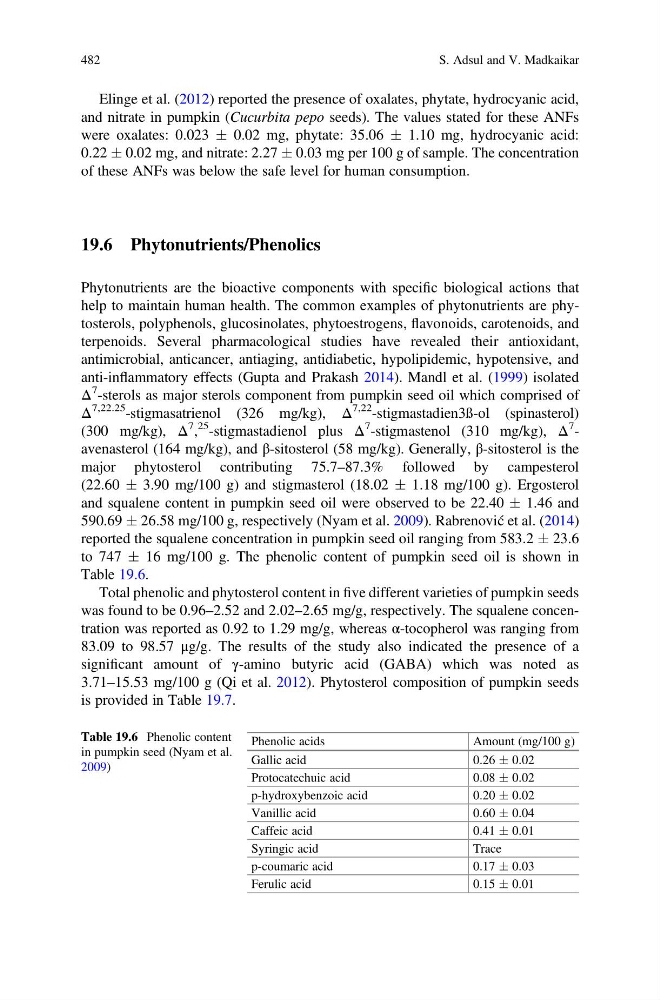
to 747 Æ 16 mg/100 g. The phenolic content of pumpkin seed oil is shown in
Table 19.6.
Total phenolic and phytosterol content in five different varieties of pumpkin seeds
was found to be 0.96–2.52 and 2.02–2.65 mg/g, respectively. The squalene concentration was reported as 0.92 to 1.29 mg/g, whereas α-tocopherol was ranging from
83.09 to 98.57 μg/g. The results of the study also indicated the presence of a
significant amount of γ-amino butyric acid (GABA) which was noted as
3.71–15.53 mg/100 g (Qi et al. 2012). Phytosterol composition of pumpkin seeds
is provided in Table 19.7.
Table 19.6 Phenolic content
in pumpkin seed (Nyam et al.
2009)
Phenolic acids
Amount (mg/100 g)
Gallic acid
0.26 Æ 0.02
Protocatechuic acid
0.08 Æ 0.02
p-hydroxybenzoic acid
0.20 Æ 0.02
Vanillic acid
0.60 Æ 0.04
Caffeic acid
0.41 Æ 0.01
Syringic acid
Trace
p-coumaric acid
0.17 Æ 0.03
Ferulic acid
0.15 Æ 0.01
482
S. Adsul and V. Madkaikar
and nitrate in pumpkin (Cucurbita pepo seeds). The values stated for these ANFs
were oxalates: 0.023 Æ 0.02 mg, phytate: 35.06 Æ 1.10 mg, hydrocyanic acid:
0.22 Æ 0.02 mg, and nitrate: 2.27 Æ 0.03 mg per 100 g of sample. The concentration
of these ANFs was below the safe level for human consumption.
19.6 Phytonutrients/Phenolics
Phytonutrients are the bioactive components with specific biological actions that
help to maintain human health. The common examples of phytonutrients are phytosterols, polyphenols, glucosinolates, phytoestrogens, flavonoids, carotenoids, and
terpenoids. Several pharmacological studies have revealed their antioxidant,
antimicrobial, anticancer, antiaging, antidiabetic, hypolipidemic, hypotensive, and
anti-inflammatory effects (Gupta and Prakash 2014). Mandl et al. (1999) isolated
Δ
7 -sterols as major sterols component from pumpkin seed oil which comprised of
Δ
7,22.25
-stigmasatrienol (326 mg/kg), Δ
7,22 -stigmastadien3ß-ol (spinasterol)
(300 mg/kg), Δ
7 ,
25 -stigmastadienol plus Δ
7 -stigmastenol (310 mg/kg), Δ
7 -
avenasterol (164 mg/kg), and β-sitosterol (58 mg/kg). Generally, β-sitosterol is the
major phytosterol contributing 75.7–87.3% followed by campesterol
(22.60 Æ 3.90 mg/100 g) and stigmasterol (18.02 Æ 1.18 mg/100 g). Ergosterol
and squalene content in pumpkin seed oil were observed to be 22.40 Æ 1.46 and
590.69 Æ 26.58 mg/100 g, respectively (Nyam et al. 2009). Rabrenović et al. (2014)
reported the squalene concentration in pumpkin seed oil ranging from 583.2 Æ 23.6
to 747 Æ 16 mg/100 g. The phenolic content of pumpkin seed oil is shown in
Table 19.6.
Total phenolic and phytosterol content in five different varieties of pumpkin seeds
was found to be 0.96–2.52 and 2.02–2.65 mg/g, respectively. The squalene concentration was reported as 0.92 to 1.29 mg/g, whereas α-tocopherol was ranging from
83.09 to 98.57 μg/g. The results of the study also indicated the presence of a
significant amount of γ-amino butyric acid (GABA) which was noted as
3.71–15.53 mg/100 g (Qi et al. 2012). Phytosterol composition of pumpkin seeds
is provided in Table 19.7.
Table 19.6 Phenolic content
in pumpkin seed (Nyam et al.
2009)
Phenolic acids
Amount (mg/100 g)
Gallic acid
0.26 Æ 0.02
Protocatechuic acid
0.08 Æ 0.02
p-hydroxybenzoic acid
0.20 Æ 0.02
Vanillic acid
0.60 Æ 0.04
Caffeic acid
0.41 Æ 0.01
Syringic acid
Trace
p-coumaric acid
0.17 Æ 0.03
Ferulic acid
0.15 Æ 0.01
482
S. Adsul and V. Madkaikar