

presses. The organic solvent extraction method utilizes organic solvents like hexane.
High pressure and temperature with ethanol can also be utilized as greener alternatives. Solvent extraction results in a powdered meal that has less than 1% residual
oil. Mechanical extraction may leave as much as 15% residual oil in seed meal
(Berhow et al. 2014). The method has a higher extraction efficiency as compared to
cold mechanical pressing and thus gained popularity for industrial-scale oil extraction. The supercritical-CO 2 extraction method has also been studied for oil extraction
(Moslavac et al. 2014). CO 2 is an economical solvent that is readily available and
can be easily removed from the products. However, a disadvantage with this method
is the high equipment cost. The enzymatic extraction method is time-consuming, but
it does not produce harmful solvents or chemicals (Popa et al., 2017). The cold
mechanical pressing of camelina seed results in oil and a by-product called seed
meal. Chemical composition of camelina seed and oil has been discussed in the
following sections.
18.3.2 Camelina Oil Composition
The oil content in camelina seed ranges from 300 to 490 g kg
À1 (Berti et al. 2016).
The camelina oil has two major fractions: the unsaponifiable includes tocopherols
and sterols, and the saponifiable includes fatty acids. The major fatty acids are oleic
(18:1, 14–16%), linoleic (LA) (18:2, 15–23%), alpha-linolenic (ALA) (18:3,
31–40%), and eicosenoic (20:1, 12–15%) acid. The minor fatty acids are palmitic
(16:0), stearic (18:0), and erucic (22:1) acids (Berti et al. 2016). The fatty acid
composition of camelina oil obtained from several literature sources (Moser and
Vaughn 2010; Budin et al. 1995; Leonard 1998; Zubr and Matthaus 2002; Fröhlich
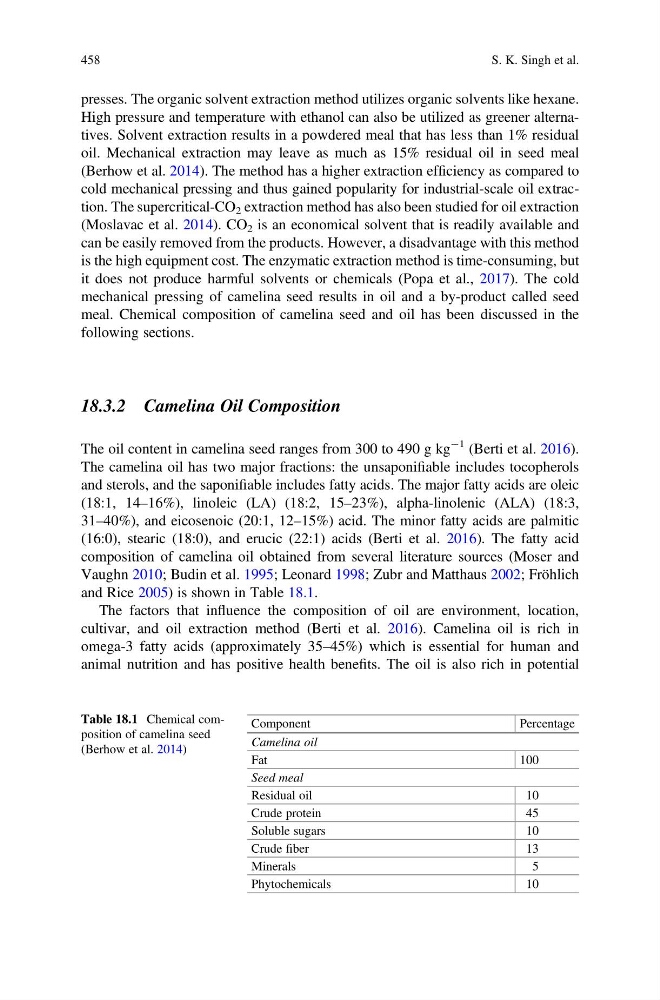
and Rice 2005) is shown in Table 18.1.
The factors that influence the composition of oil are environment, location,
cultivar, and oil extraction method (Berti et al. 2016). Camelina oil is rich in
omega-3 fatty acids (approximately 35–45%) which is essential for human and
animal nutrition and has positive health benefits. The oil is also rich in potential
Table 18.1 Chemical composition of camelina seed
(Berhow et al. 2014)
Component
Percentage
Camelina oil
Fat
100
Seed meal
Residual oil
10
Crude protein
45
Soluble sugars
10
Crude fiber
13
Minerals
5
Phytochemicals
10
458
S. K. Singh et al.
High pressure and temperature with ethanol can also be utilized as greener alternatives. Solvent extraction results in a powdered meal that has less than 1% residual
oil. Mechanical extraction may leave as much as 15% residual oil in seed meal
(Berhow et al. 2014). The method has a higher extraction efficiency as compared to
cold mechanical pressing and thus gained popularity for industrial-scale oil extraction. The supercritical-CO 2 extraction method has also been studied for oil extraction
(Moslavac et al. 2014). CO 2 is an economical solvent that is readily available and
can be easily removed from the products. However, a disadvantage with this method
is the high equipment cost. The enzymatic extraction method is time-consuming, but
it does not produce harmful solvents or chemicals (Popa et al., 2017). The cold
mechanical pressing of camelina seed results in oil and a by-product called seed
meal. Chemical composition of camelina seed and oil has been discussed in the
following sections.
18.3.2 Camelina Oil Composition
The oil content in camelina seed ranges from 300 to 490 g kg
À1 (Berti et al. 2016).
The camelina oil has two major fractions: the unsaponifiable includes tocopherols
and sterols, and the saponifiable includes fatty acids. The major fatty acids are oleic
(18:1, 14–16%), linoleic (LA) (18:2, 15–23%), alpha-linolenic (ALA) (18:3,
31–40%), and eicosenoic (20:1, 12–15%) acid. The minor fatty acids are palmitic
(16:0), stearic (18:0), and erucic (22:1) acids (Berti et al. 2016). The fatty acid
composition of camelina oil obtained from several literature sources (Moser and
Vaughn 2010; Budin et al. 1995; Leonard 1998; Zubr and Matthaus 2002; Fröhlich
and Rice 2005) is shown in Table 18.1.
The factors that influence the composition of oil are environment, location,
cultivar, and oil extraction method (Berti et al. 2016). Camelina oil is rich in
omega-3 fatty acids (approximately 35–45%) which is essential for human and
animal nutrition and has positive health benefits. The oil is also rich in potential
Table 18.1 Chemical composition of camelina seed
(Berhow et al. 2014)
Component
Percentage
Camelina oil
Fat
100
Seed meal
Residual oil
10
Crude protein
45
Soluble sugars
10
Crude fiber
13
Minerals
5
Phytochemicals
10
458
S. K. Singh et al.