

therapeutic benefits, which has subsequently led to increased functionality of rice
bran to be used as a food additive to develop functional foods (Luh and Liu 1980).
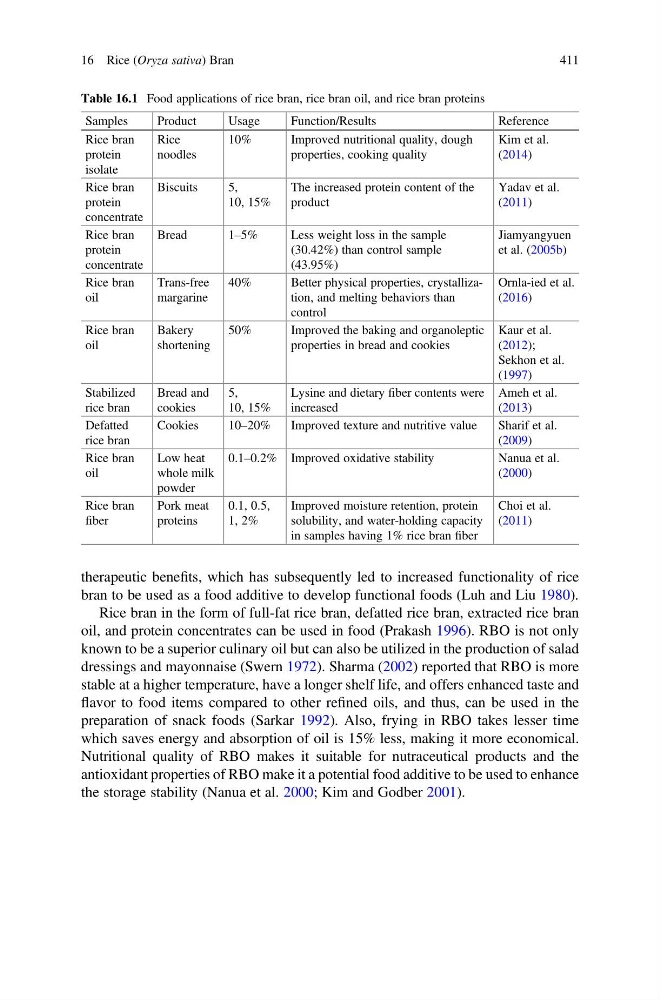
Rice bran in the form of full-fat rice bran, defatted rice bran, extracted rice bran
oil, and protein concentrates can be used in food (Prakash 1996). RBO is not only
known to be a superior culinary oil but can also be utilized in the production of salad
dressings and mayonnaise (Swern 1972). Sharma (2002) reported that RBO is more
stable at a higher temperature, have a longer shelf life, and offers enhanced taste and
flavor to food items compared to other refined oils, and thus, can be used in the
preparation of snack foods (Sarkar 1992). Also, frying in RBO takes lesser time
which saves energy and absorption of oil is 15% less, making it more economical.
Nutritional quality of RBO makes it suitable for nutraceutical products and the
antioxidant properties of RBO make it a potential food additive to be used to enhance
the storage stability (Nanua et al. 2000; Kim and Godber 2001).
Table 16.1 Food applications of rice bran, rice bran oil, and rice bran proteins
Samples
Product
Usage
Function/Results
Reference
Rice bran
protein
isolate
Rice
noodles
10%
Improved nutritional quality, dough
properties, cooking quality
Kim et al.
(2014)
Rice bran
protein
concentrate
Biscuits
5,
10, 15%
The increased protein content of the
product
Yadav et al.
(2011)
Rice bran
protein
concentrate
Bread
1–5%
Less weight loss in the sample
(30.42%) than control sample
(43.95%)
Jiamyangyuen
et al. (2005b)
Rice bran
oil
Trans-free
margarine
40%
Better physical properties, crystallization, and melting behaviors than
control
Ornla-ied et al.
(2016)
Rice bran
oil
Bakery
shortening
50%
Improved the baking and organoleptic
properties in bread and cookies
Kaur et al.
(2012);
Sekhon et al.
(1997)
Stabilized
rice bran
Bread and
cookies
5,
10, 15%
Lysine and dietary fiber contents were
increased
Ameh et al.
(2013)
Defatted
rice bran
Cookies
10–20%
Improved texture and nutritive value
Sharif et al.
(2009)
Rice bran
oil
Low heat
whole milk
powder
0.1–0.2% Improved oxidative stability
Nanua et al.
(2000)
Rice bran
fiber
Pork meat
proteins
0.1, 0.5,
1, 2%
Improved moisture retention, protein
solubility, and water-holding capacity
in samples having 1% rice bran fiber
Choi et al.
(2011)
16 Rice (Oryza sativa) Bran
411
bran to be used as a food additive to develop functional foods (Luh and Liu 1980).
Rice bran in the form of full-fat rice bran, defatted rice bran, extracted rice bran
oil, and protein concentrates can be used in food (Prakash 1996). RBO is not only
known to be a superior culinary oil but can also be utilized in the production of salad
dressings and mayonnaise (Swern 1972). Sharma (2002) reported that RBO is more
stable at a higher temperature, have a longer shelf life, and offers enhanced taste and
flavor to food items compared to other refined oils, and thus, can be used in the
preparation of snack foods (Sarkar 1992). Also, frying in RBO takes lesser time
which saves energy and absorption of oil is 15% less, making it more economical.
Nutritional quality of RBO makes it suitable for nutraceutical products and the
antioxidant properties of RBO make it a potential food additive to be used to enhance
the storage stability (Nanua et al. 2000; Kim and Godber 2001).
Table 16.1 Food applications of rice bran, rice bran oil, and rice bran proteins
Samples
Product
Usage
Function/Results
Reference
Rice bran
protein
isolate
Rice
noodles
10%
Improved nutritional quality, dough
properties, cooking quality
Kim et al.
(2014)
Rice bran
protein
concentrate
Biscuits
5,
10, 15%
The increased protein content of the
product
Yadav et al.
(2011)
Rice bran
protein
concentrate
Bread
1–5%
Less weight loss in the sample
(30.42%) than control sample
(43.95%)
Jiamyangyuen
et al. (2005b)
Rice bran
oil
Trans-free
margarine
40%
Better physical properties, crystallization, and melting behaviors than
control
Ornla-ied et al.
(2016)
Rice bran
oil
Bakery
shortening
50%
Improved the baking and organoleptic
properties in bread and cookies
Kaur et al.
(2012);
Sekhon et al.
(1997)
Stabilized
rice bran
Bread and
cookies
5,
10, 15%
Lysine and dietary fiber contents were
increased
Ameh et al.
(2013)
Defatted
rice bran
Cookies
10–20%
Improved texture and nutritive value
Sharif et al.
(2009)
Rice bran
oil
Low heat
whole milk
powder
0.1–0.2% Improved oxidative stability
Nanua et al.
(2000)
Rice bran
fiber
Pork meat
proteins
0.1, 0.5,
1, 2%
Improved moisture retention, protein
solubility, and water-holding capacity
in samples having 1% rice bran fiber
Choi et al.
(2011)
16 Rice (Oryza sativa) Bran
411