

14.9 Antinutrients/Toxic Components
The members of Boraginaceae family are well known for their content of
pyrrolizidine alkaloids (PAs), which are plants’ secondary metabolites (Herrmann
et al. 2002). Dodson and Stermitz (1986) have reported 0.03% crude alkaloids with
thesinine [(+)-thesinine-4
0 -O-β-D-glucoside] (0.02%) and amabiline (0.002%) as
major and minor alkaloids, respectively. The researchers also analyzed the borage
seed oil samples, but no alkaloids were detected at any concentration when estimated
by TLC and/or capillary GLC technique (Dodson and Stermitz 1986). The toxic
effects of PAs depend on the structure and/or position of unsaturation. PAs having
one double bond at 1–2 position in necine base are considered as hepatotoxic and
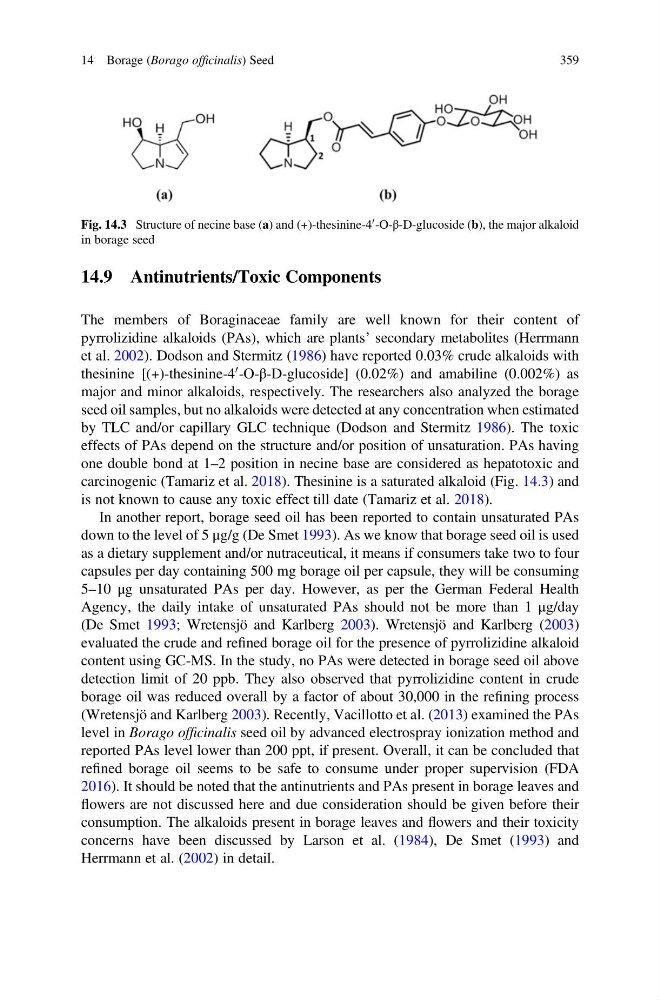
carcinogenic (Tamariz et al. 2018). Thesinine is a saturated alkaloid (Fig. 14.3) and
is not known to cause any toxic effect till date (Tamariz et al. 2018).
In another report, borage seed oil has been reported to contain unsaturated PAs
down to the level of 5 μg/g (De Smet 1993). As we know that borage seed oil is used
as a dietary supplement and/or nutraceutical, it means if consumers take two to four
capsules per day containing 500 mg borage oil per capsule, they will be consuming
5–10 μg unsaturated PAs per day. However, as per the German Federal Health
Agency, the daily intake of unsaturated PAs should not be more than 1 μg/day
(De Smet 1993; Wretensjö and Karlberg 2003). Wretensjö and Karlberg (2003)
evaluated the crude and refined borage oil for the presence of pyrrolizidine alkaloid
content using GC-MS. In the study, no PAs were detected in borage seed oil above
detection limit of 20 ppb. They also observed that pyrrolizidine content in crude
borage oil was reduced overall by a factor of about 30,000 in the refining process
(Wretensjö and Karlberg 2003). Recently, Vacillotto et al. (2013) examined the PAs
level in Borago officinalis seed oil by advanced electrospray ionization method and
reported PAs level lower than 200 ppt, if present. Overall, it can be concluded that
refined borage oil seems to be safe to consume under proper supervision (FDA
2016). It should be noted that the antinutrients and PAs present in borage leaves and
flowers are not discussed here and due consideration should be given before their
consumption. The alkaloids present in borage leaves and flowers and their toxicity
concerns have been discussed by Larson et al. (1984), De Smet (1993) and
Herrmann et al. (2002) in detail.
Fig. 14.3 Structure of necine base (a) and (+)-thesinine-4
0 -O-β-D-glucoside (b), the major alkaloid
in borage seed
14 Borage (Borago officinalis) Seed
359
The members of Boraginaceae family are well known for their content of
pyrrolizidine alkaloids (PAs), which are plants’ secondary metabolites (Herrmann
et al. 2002). Dodson and Stermitz (1986) have reported 0.03% crude alkaloids with
thesinine [(+)-thesinine-4
0 -O-β-D-glucoside] (0.02%) and amabiline (0.002%) as
major and minor alkaloids, respectively. The researchers also analyzed the borage
seed oil samples, but no alkaloids were detected at any concentration when estimated
by TLC and/or capillary GLC technique (Dodson and Stermitz 1986). The toxic
effects of PAs depend on the structure and/or position of unsaturation. PAs having
one double bond at 1–2 position in necine base are considered as hepatotoxic and
carcinogenic (Tamariz et al. 2018). Thesinine is a saturated alkaloid (Fig. 14.3) and
is not known to cause any toxic effect till date (Tamariz et al. 2018).
In another report, borage seed oil has been reported to contain unsaturated PAs
down to the level of 5 μg/g (De Smet 1993). As we know that borage seed oil is used
as a dietary supplement and/or nutraceutical, it means if consumers take two to four
capsules per day containing 500 mg borage oil per capsule, they will be consuming
5–10 μg unsaturated PAs per day. However, as per the German Federal Health
Agency, the daily intake of unsaturated PAs should not be more than 1 μg/day
(De Smet 1993; Wretensjö and Karlberg 2003). Wretensjö and Karlberg (2003)
evaluated the crude and refined borage oil for the presence of pyrrolizidine alkaloid
content using GC-MS. In the study, no PAs were detected in borage seed oil above
detection limit of 20 ppb. They also observed that pyrrolizidine content in crude
borage oil was reduced overall by a factor of about 30,000 in the refining process
(Wretensjö and Karlberg 2003). Recently, Vacillotto et al. (2013) examined the PAs
level in Borago officinalis seed oil by advanced electrospray ionization method and
reported PAs level lower than 200 ppt, if present. Overall, it can be concluded that
refined borage oil seems to be safe to consume under proper supervision (FDA
2016). It should be noted that the antinutrients and PAs present in borage leaves and
flowers are not discussed here and due consideration should be given before their
consumption. The alkaloids present in borage leaves and flowers and their toxicity
concerns have been discussed by Larson et al. (1984), De Smet (1993) and
Herrmann et al. (2002) in detail.
Fig. 14.3 Structure of necine base (a) and (+)-thesinine-4
0 -O-β-D-glucoside (b), the major alkaloid
in borage seed
14 Borage (Borago officinalis) Seed
359