

L. (27.4 Æ 0.6 mg/100 g oil) than that of farmed variety (19.7 Æ 0.3 mg/100 g oil).
When crude borage oil was compared with crude primrose oil, the former showed
approximately half (365.5 mg/100 g oil) the content of phytosterols present in the
latter (720.4 mg/100 g oil) (Szterk et al. 2010).
14.8 Phenolic Acids
Phenolic acids are the secondary metabolites in plants, which have shown
antioxidative, antimutagenic, anti-inflammatory, antibacterial and antiviral activities
(Mhamdi et al. 2009; Robbins 2003; Zadernowski et al. 2002; Godos et al. 2017).
Wettasinghe et al. (2001) evaluated the phenolic acids in borage seed meal using
thin-layer chromatography and observed 0.383, 0.113 and 0.121% rosmarinic acid,
syringic acid and sinapic acid, respectively. Rosmarinic acid is a phenolic compound
and ester of caffeic acid. It is commonly found in species of the Boraginaceae and
Lamiaceae. Rosmarinic acid has been reported to show antiallergic, antioxidative
and anti-inflammatory activities (Rocha et al. 2015; Osakabe et al. 2004). On the
other hand, Zadernowski et al. (2002) reported hydroxycaffeic acid as a major
phenolic acid (65.43 Æ 3.95) in borage seed meal with 185.10 Æ 5.85 mg total
phenolic acids per kg. In another study, Mhamdi et al. (2009) reported total phenolic
compounds to the value of 6.39 mg GAE (gallic acid equivalent)/g dry weight of
defatted borage seed extract. The major phenolic acids reported by several authors
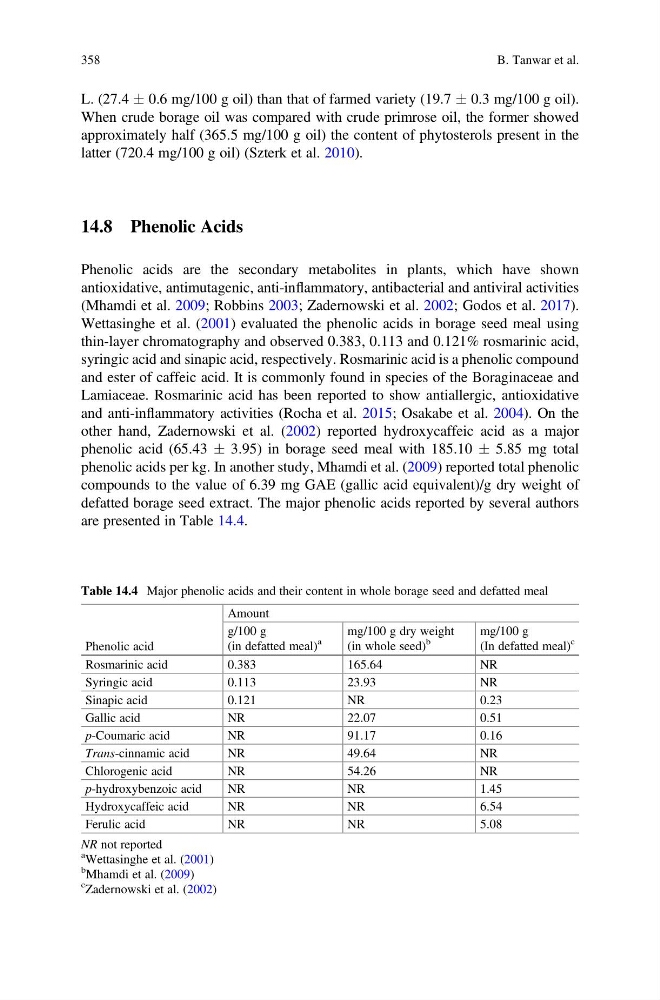
are presented in Table 14.4.
Table 14.4 Major phenolic acids and their content in whole borage seed and defatted meal
Phenolic acid
Amount
g/100 g
(in defatted meal)
a
mg/100 g dry weight
(in whole seed)
b
mg/100 g
(In defatted meal)
c
Rosmarinic acid
0.383
165.64
NR
Syringic acid
0.113
23.93
NR
Sinapic acid
0.121
NR
0.23
Gallic acid
NR
22.07
0.51
p-Coumaric acid
NR
91.17
0.16
Trans-cinnamic acid
NR
49.64
NR
Chlorogenic acid
NR
54.26
NR
p-hydroxybenzoic acid
NR
NR
1.45
Hydroxycaffeic acid
NR
NR
6.54
Ferulic acid
NR
NR
5.08
NR not reported
a Wettasinghe et al. (2001)
b
Mhamdi et al. (2009)
c Zadernowski et al. (2002)
358
B. Tanwar et al.
When crude borage oil was compared with crude primrose oil, the former showed
approximately half (365.5 mg/100 g oil) the content of phytosterols present in the
latter (720.4 mg/100 g oil) (Szterk et al. 2010).
14.8 Phenolic Acids
Phenolic acids are the secondary metabolites in plants, which have shown
antioxidative, antimutagenic, anti-inflammatory, antibacterial and antiviral activities
(Mhamdi et al. 2009; Robbins 2003; Zadernowski et al. 2002; Godos et al. 2017).
Wettasinghe et al. (2001) evaluated the phenolic acids in borage seed meal using
thin-layer chromatography and observed 0.383, 0.113 and 0.121% rosmarinic acid,
syringic acid and sinapic acid, respectively. Rosmarinic acid is a phenolic compound
and ester of caffeic acid. It is commonly found in species of the Boraginaceae and
Lamiaceae. Rosmarinic acid has been reported to show antiallergic, antioxidative
and anti-inflammatory activities (Rocha et al. 2015; Osakabe et al. 2004). On the
other hand, Zadernowski et al. (2002) reported hydroxycaffeic acid as a major
phenolic acid (65.43 Æ 3.95) in borage seed meal with 185.10 Æ 5.85 mg total
phenolic acids per kg. In another study, Mhamdi et al. (2009) reported total phenolic
compounds to the value of 6.39 mg GAE (gallic acid equivalent)/g dry weight of
defatted borage seed extract. The major phenolic acids reported by several authors
are presented in Table 14.4.
Table 14.4 Major phenolic acids and their content in whole borage seed and defatted meal
Phenolic acid
Amount
g/100 g
(in defatted meal)
a
mg/100 g dry weight
(in whole seed)
b
mg/100 g
(In defatted meal)
c
Rosmarinic acid
0.383
165.64
NR
Syringic acid
0.113
23.93
NR
Sinapic acid
0.121
NR
0.23
Gallic acid
NR
22.07
0.51
p-Coumaric acid
NR
91.17
0.16
Trans-cinnamic acid
NR
49.64
NR
Chlorogenic acid
NR
54.26
NR
p-hydroxybenzoic acid
NR
NR
1.45
Hydroxycaffeic acid
NR
NR
6.54
Ferulic acid
NR
NR
5.08
NR not reported
a Wettasinghe et al. (2001)
b
Mhamdi et al. (2009)
c Zadernowski et al. (2002)
358
B. Tanwar et al.