

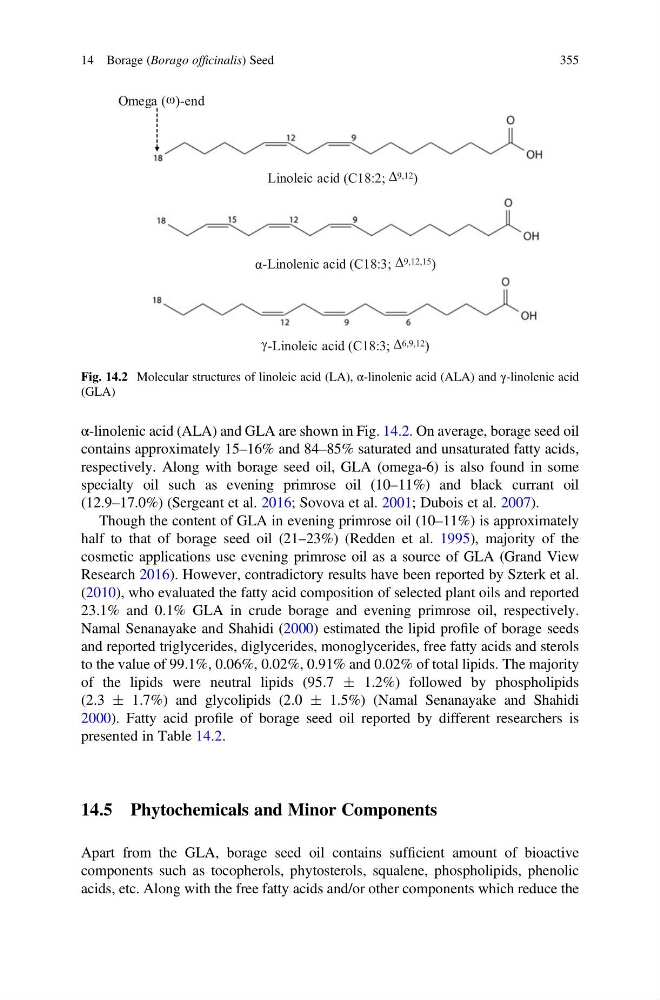
α-linolenic acid (ALA) and GLA are shown in Fig. 14.2. On average, borage seed oil
contains approximately 15–16% and 84–85% saturated and unsaturated fatty acids,
respectively. Along with borage seed oil, GLA (omega-6) is also found in some
specialty oil such as evening primrose oil (10–11%) and black currant oil
(12.9–17.0%) (Sergeant et al. 2016; Sovova et al. 2001; Dubois et al. 2007).
Though the content of GLA in evening primrose oil (10–11%) is approximately
half to that of borage seed oil (21–23%) (Redden et al. 1995), majority of the
cosmetic applications use evening primrose oil as a source of GLA (Grand View
Research 2016). However, contradictory results have been reported by Szterk et al.
(2010), who evaluated the fatty acid composition of selected plant oils and reported
23.1% and 0.1% GLA in crude borage and evening primrose oil, respectively.
Namal Senanayake and Shahidi (2000) estimated the lipid profile of borage seeds
and reported triglycerides, diglycerides, monoglycerides, free fatty acids and sterols
to the value of 99.1%, 0.06%, 0.02%, 0.91% and 0.02% of total lipids. The majority
of the lipids were neutral lipids (95.7 Æ 1.2%) followed by phospholipids
(2.3 Æ 1.7%) and glycolipids (2.0 Æ 1.5%) (Namal Senanayake and Shahidi
2000). Fatty acid profile of borage seed oil reported by different researchers is
presented in Table 14.2.
14.5 Phytochemicals and Minor Components
Apart from the GLA, borage seed oil contains sufficient amount of bioactive
components such as tocopherols, phytosterols, squalene, phospholipids, phenolic
acids, etc. Along with the free fatty acids and/or other components which reduce the
Linoleic acid (C18:2; 9,12 )
-Linolenic acid (C18:3; 9,12,15 )
-Linoleic acid (C18:3; 6,9,12 )
Omega ( )-end
Fig. 14.2 Molecular structures of linoleic acid (LA), α-linolenic acid (ALA) and γ-linolenic acid
(GLA)
14 Borage (Borago officinalis) Seed
355
contains approximately 15–16% and 84–85% saturated and unsaturated fatty acids,
respectively. Along with borage seed oil, GLA (omega-6) is also found in some
specialty oil such as evening primrose oil (10–11%) and black currant oil
(12.9–17.0%) (Sergeant et al. 2016; Sovova et al. 2001; Dubois et al. 2007).
Though the content of GLA in evening primrose oil (10–11%) is approximately
half to that of borage seed oil (21–23%) (Redden et al. 1995), majority of the
cosmetic applications use evening primrose oil as a source of GLA (Grand View
Research 2016). However, contradictory results have been reported by Szterk et al.
(2010), who evaluated the fatty acid composition of selected plant oils and reported
23.1% and 0.1% GLA in crude borage and evening primrose oil, respectively.
Namal Senanayake and Shahidi (2000) estimated the lipid profile of borage seeds
and reported triglycerides, diglycerides, monoglycerides, free fatty acids and sterols
to the value of 99.1%, 0.06%, 0.02%, 0.91% and 0.02% of total lipids. The majority
of the lipids were neutral lipids (95.7 Æ 1.2%) followed by phospholipids
(2.3 Æ 1.7%) and glycolipids (2.0 Æ 1.5%) (Namal Senanayake and Shahidi
2000). Fatty acid profile of borage seed oil reported by different researchers is
presented in Table 14.2.
14.5 Phytochemicals and Minor Components
Apart from the GLA, borage seed oil contains sufficient amount of bioactive
components such as tocopherols, phytosterols, squalene, phospholipids, phenolic
acids, etc. Along with the free fatty acids and/or other components which reduce the
Linoleic acid (C18:2; 9,12 )
-Linolenic acid (C18:3; 9,12,15 )
-Linoleic acid (C18:3; 6,9,12 )
Omega ( )-end
Fig. 14.2 Molecular structures of linoleic acid (LA), α-linolenic acid (ALA) and γ-linolenic acid
(GLA)
14 Borage (Borago officinalis) Seed
355