

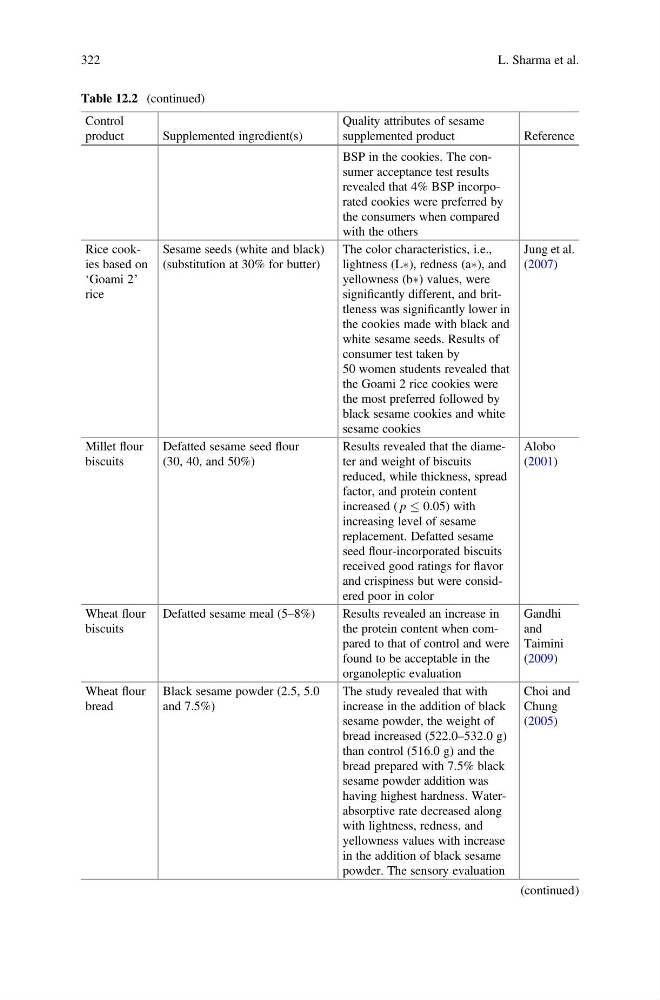
Table 12.2 (continued)
Control
product
Supplemented ingredient(s)
Quality attributes of sesame
supplemented product
Reference
BSP in the cookies. The consumer acceptance test results
revealed that 4% BSP incorporated cookies were preferred by
the consumers when compared
with the others
Rice cookies based on
‘Goami 2’
rice
Sesame seeds (white and black)
(substitution at 30% for butter)
The color characteristics, i.e.,
lightness (LÃ), redness (aÃ), and
yellowness (bÃ) values, were
significantly different, and brittleness was significantly lower in
the cookies made with black and
white sesame seeds. Results of
consumer test taken by
50 women students revealed that
the Goami 2 rice cookies were
the most preferred followed by
black sesame cookies and white
sesame cookies
Jung et al.
(2007)
Millet flour
biscuits
Defatted sesame seed flour
(30, 40, and 50%)
Results revealed that the diameter and weight of biscuits
reduced, while thickness, spread
factor, and protein content
increased ( p 0.05) with
increasing level of sesame
replacement. Defatted sesame
seed flour-incorporated biscuits
received good ratings for flavor
and crispiness but were considered poor in color
Alobo
(2001)
Wheat flour
biscuits
Defatted sesame meal (5–8%)
Results revealed an increase in
the protein content when compared to that of control and were
found to be acceptable in the
organoleptic evaluation
Gandhi
and
Taimini
(2009)
Wheat flour
bread
Black sesame powder (2.5, 5.0
and 7.5%)
The study revealed that with
increase in the addition of black
sesame powder, the weight of
bread increased (522.0–532.0 g)
than control (516.0 g) and the
bread prepared with 7.5% black
sesame powder addition was
having highest hardness. Waterabsorptive rate decreased along
with lightness, redness, and
yellowness values with increase
in the addition of black sesame
powder. The sensory evaluation
Choi and
Chung
(2005)
(continued)
322
L. Sharma et al.
Control
product
Supplemented ingredient(s)
Quality attributes of sesame
supplemented product
Reference
BSP in the cookies. The consumer acceptance test results
revealed that 4% BSP incorporated cookies were preferred by
the consumers when compared
with the others
Rice cookies based on
‘Goami 2’
rice
Sesame seeds (white and black)
(substitution at 30% for butter)
The color characteristics, i.e.,
lightness (LÃ), redness (aÃ), and
yellowness (bÃ) values, were
significantly different, and brittleness was significantly lower in
the cookies made with black and
white sesame seeds. Results of
consumer test taken by
50 women students revealed that
the Goami 2 rice cookies were
the most preferred followed by
black sesame cookies and white
sesame cookies
Jung et al.
(2007)
Millet flour
biscuits
Defatted sesame seed flour
(30, 40, and 50%)
Results revealed that the diameter and weight of biscuits
reduced, while thickness, spread
factor, and protein content
increased ( p 0.05) with
increasing level of sesame
replacement. Defatted sesame
seed flour-incorporated biscuits
received good ratings for flavor
and crispiness but were considered poor in color
Alobo
(2001)
Wheat flour
biscuits
Defatted sesame meal (5–8%)
Results revealed an increase in
the protein content when compared to that of control and were
found to be acceptable in the
organoleptic evaluation
Gandhi
and
Taimini
(2009)
Wheat flour
bread
Black sesame powder (2.5, 5.0
and 7.5%)
The study revealed that with
increase in the addition of black
sesame powder, the weight of
bread increased (522.0–532.0 g)
than control (516.0 g) and the
bread prepared with 7.5% black
sesame powder addition was
having highest hardness. Waterabsorptive rate decreased along
with lightness, redness, and
yellowness values with increase
in the addition of black sesame
powder. The sensory evaluation
Choi and
Chung
(2005)
(continued)
322
L. Sharma et al.