

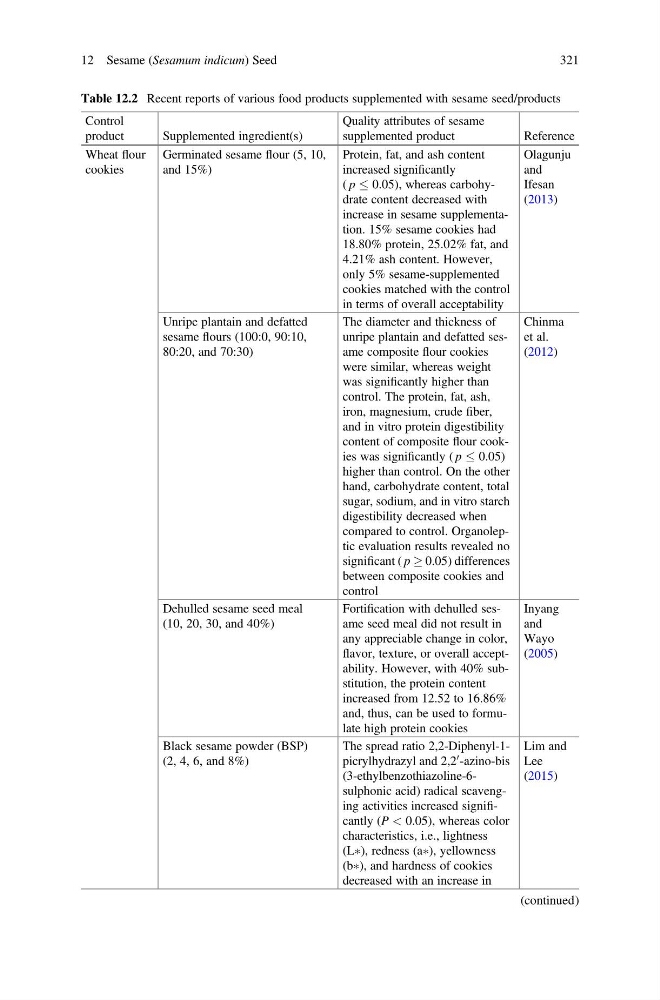
Table 12.2 Recent reports of various food products supplemented with sesame seed/products
Control
product
Supplemented ingredient(s)
Quality attributes of sesame
supplemented product
Reference
Wheat flour
cookies
Germinated sesame flour (5, 10,
and 15%)
Protein, fat, and ash content
increased significantly
( p 0.05), whereas carbohydrate content decreased with
increase in sesame supplementation. 15% sesame cookies had
18.80% protein, 25.02% fat, and
4.21% ash content. However,
only 5% sesame-supplemented
cookies matched with the control
in terms of overall acceptability
Olagunju
and
Ifesan
(2013)
Unripe plantain and defatted
sesame flours (100:0, 90:10,
80:20, and 70:30)
The diameter and thickness of
unripe plantain and defatted sesame composite flour cookies
were similar, whereas weight
was significantly higher than
control. The protein, fat, ash,
iron, magnesium, crude fiber,
and in vitro protein digestibility
content of composite flour cookies was significantly ( p 0.05)
higher than control. On the other
hand, carbohydrate content, total
sugar, sodium, and in vitro starch
digestibility decreased when
compared to control. Organoleptic evaluation results revealed no
significant ( p ! 0.05) differences
between composite cookies and
control
Chinma
et al.
(2012)
Dehulled sesame seed meal
(10, 20, 30, and 40%)
Fortification with dehulled sesame seed meal did not result in
any appreciable change in color,
flavor, texture, or overall acceptability. However, with 40% substitution, the protein content
increased from 12.52 to 16.86%
and, thus, can be used to formulate high protein cookies
Inyang
and
Wayo
(2005)
Black sesame powder (BSP)
(2, 4, 6, and 8%)
The spread ratio 2,2-Diphenyl-1picrylhydrazyl and 2,2
0 -azino-bis
(3-ethylbenzothiazoline-6sulphonic acid) radical scavenging activities increased significantly (P < 0.05), whereas color
characteristics, i.e., lightness
(LÃ), redness (aÃ), yellowness
(bÃ), and hardness of cookies
decreased with an increase in
Lim and
Lee
(2015)
(continued)
12 Sesame (Sesamum indicum) Seed
321
Control
product
Supplemented ingredient(s)
Quality attributes of sesame
supplemented product
Reference
Wheat flour
cookies
Germinated sesame flour (5, 10,
and 15%)
Protein, fat, and ash content
increased significantly
( p 0.05), whereas carbohydrate content decreased with
increase in sesame supplementation. 15% sesame cookies had
18.80% protein, 25.02% fat, and
4.21% ash content. However,
only 5% sesame-supplemented
cookies matched with the control
in terms of overall acceptability
Olagunju
and
Ifesan
(2013)
Unripe plantain and defatted
sesame flours (100:0, 90:10,
80:20, and 70:30)
The diameter and thickness of
unripe plantain and defatted sesame composite flour cookies
were similar, whereas weight
was significantly higher than
control. The protein, fat, ash,
iron, magnesium, crude fiber,
and in vitro protein digestibility
content of composite flour cookies was significantly ( p 0.05)
higher than control. On the other
hand, carbohydrate content, total
sugar, sodium, and in vitro starch
digestibility decreased when
compared to control. Organoleptic evaluation results revealed no
significant ( p ! 0.05) differences
between composite cookies and
control
Chinma
et al.
(2012)
Dehulled sesame seed meal
(10, 20, 30, and 40%)
Fortification with dehulled sesame seed meal did not result in
any appreciable change in color,
flavor, texture, or overall acceptability. However, with 40% substitution, the protein content
increased from 12.52 to 16.86%
and, thus, can be used to formulate high protein cookies
Inyang
and
Wayo
(2005)
Black sesame powder (BSP)
(2, 4, 6, and 8%)
The spread ratio 2,2-Diphenyl-1picrylhydrazyl and 2,2
0 -azino-bis
(3-ethylbenzothiazoline-6sulphonic acid) radical scavenging activities increased significantly (P < 0.05), whereas color
characteristics, i.e., lightness
(LÃ), redness (aÃ), yellowness
(bÃ), and hardness of cookies
decreased with an increase in
Lim and
Lee
(2015)
(continued)
12 Sesame (Sesamum indicum) Seed
321