

1.5.2 Soy Products
1.5.2.1 Soy Protein Products
Cereals form an important source of energy and nutrients in the majority of the world
population. However, the low protein quality due to imbalanced amino acid composition is a major concern. Hence, soybean protein in various forms, viz., flour and
grits (full fat, medium fat, low fat, defatted, and lecithinated), soy protein concentrate, soy protein isolate, and textured soy protein, is utilized by the food industry for
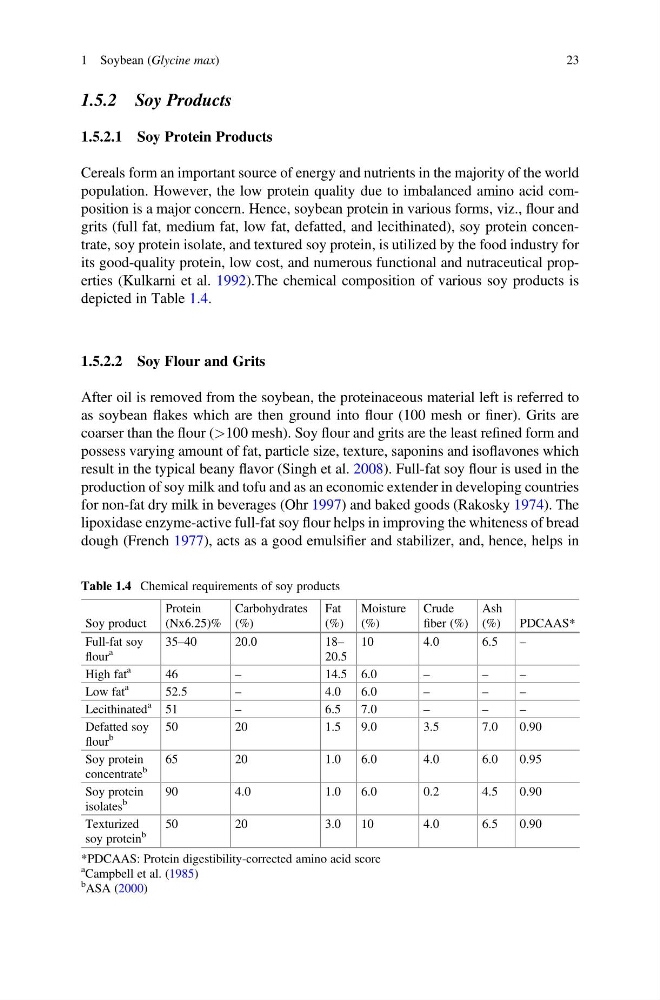
its good-quality protein, low cost, and numerous functional and nutraceutical properties (Kulkarni et al. 1992).The chemical composition of various soy products is
depicted in Table 1.4.
1.5.2.2 Soy Flour and Grits
After oil is removed from the soybean, the proteinaceous material left is referred to
as soybean flakes which are then ground into flour (100 mesh or finer). Grits are
coarser than the flour (>100 mesh). Soy flour and grits are the least refined form and
possess varying amount of fat, particle size, texture, saponins and isoflavones which
result in the typical beany flavor (Singh et al. 2008). Full-fat soy flour is used in the
production of soy milk and tofu and as an economic extender in developing countries
for non-fat dry milk in beverages (Ohr 1997) and baked goods (Rakosky 1974). The
lipoxidase enzyme-active full-fat soy flour helps in improving the whiteness of bread
dough (French 1977), acts as a good emulsifier and stabilizer, and, hence, helps in
Table 1.4 Chemical requirements of soy products
Soy product
Protein
(Nx6.25)%
Carbohydrates
(%)
Fat
(%)
Moisture
(%)
Crude
fiber (%)
Ash
(%)
PDCAAS*
Full-fat soy
flour
a
35–40
20.0
18–
20.5
10
4.0
6.5
–
High fat
a
46
–
14.5 6.0
–
–
–
Low fat
a
52.5
–
4.0
6.0
–
–
–
Lecithinated
a
51
–
6.5
7.0
–
–
–
Defatted soy
flour
b
50
20
1.5
9.0
3.5
7.0
0.90
Soy protein
concentrate
b
65
20
1.0
6.0
4.0
6.0
0.95
Soy protein
isolates
b
90
4.0
1.0
6.0
0.2
4.5
0.90
Texturized
soy protein
b
50
20
3.0
10
4.0
6.5
0.90
*PDCAAS: Protein digestibility-corrected amino acid score
a
Campbell et al. (1985)
b
ASA (2000)
1 Soybean (Glycine max)
2 3
1.5.2.1 Soy Protein Products
Cereals form an important source of energy and nutrients in the majority of the world
population. However, the low protein quality due to imbalanced amino acid composition is a major concern. Hence, soybean protein in various forms, viz., flour and
grits (full fat, medium fat, low fat, defatted, and lecithinated), soy protein concentrate, soy protein isolate, and textured soy protein, is utilized by the food industry for
its good-quality protein, low cost, and numerous functional and nutraceutical properties (Kulkarni et al. 1992).The chemical composition of various soy products is
depicted in Table 1.4.
1.5.2.2 Soy Flour and Grits
After oil is removed from the soybean, the proteinaceous material left is referred to
as soybean flakes which are then ground into flour (100 mesh or finer). Grits are
coarser than the flour (>100 mesh). Soy flour and grits are the least refined form and
possess varying amount of fat, particle size, texture, saponins and isoflavones which
result in the typical beany flavor (Singh et al. 2008). Full-fat soy flour is used in the
production of soy milk and tofu and as an economic extender in developing countries
for non-fat dry milk in beverages (Ohr 1997) and baked goods (Rakosky 1974). The
lipoxidase enzyme-active full-fat soy flour helps in improving the whiteness of bread
dough (French 1977), acts as a good emulsifier and stabilizer, and, hence, helps in
Table 1.4 Chemical requirements of soy products
Soy product
Protein
(Nx6.25)%
Carbohydrates
(%)
Fat
(%)
Moisture
(%)
Crude
fiber (%)
Ash
(%)
PDCAAS*
Full-fat soy
flour
a
35–40
20.0
18–
20.5
10
4.0
6.5
–
High fat
a
46
–
14.5 6.0
–
–
–
Low fat
a
52.5
–
4.0
6.0
–
–
–
Lecithinated
a
51
–
6.5
7.0
–
–
–
Defatted soy
flour
b
50
20
1.5
9.0
3.5
7.0
0.90
Soy protein
concentrate
b
65
20
1.0
6.0
4.0
6.0
0.95
Soy protein
isolates
b
90
4.0
1.0
6.0
0.2
4.5
0.90
Texturized
soy protein
b
50
20
3.0
10
4.0
6.5
0.90
*PDCAAS: Protein digestibility-corrected amino acid score
a
Campbell et al. (1985)
b
ASA (2000)
1 Soybean (Glycine max)
2 3