

12.3 Production
Until the mid-2000s, sesame production was around 35 million tons and thereafter
steadily increased to nearly 40 million tons in 2014 (FAO 2014). Till 2009, China
was the largest producer of sesame in the world accounting for more than 40% of the
global production, followed by India with about 15% share, but after 2012, Tanzania
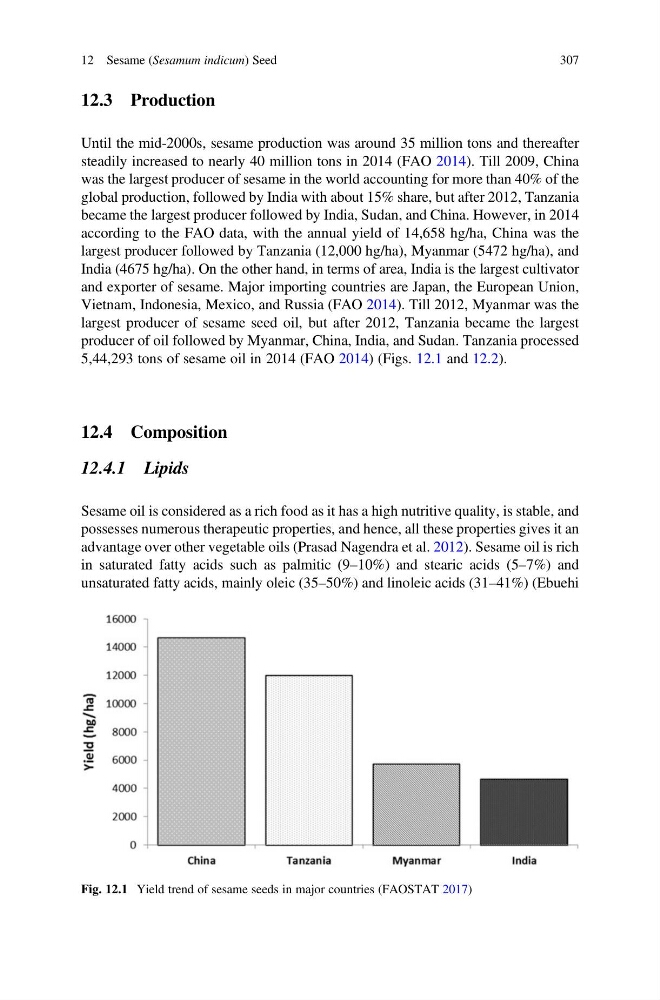
became the largest producer followed by India, Sudan, and China. However, in 2014
according to the FAO data, with the annual yield of 14,658 hg/ha, China was the
largest producer followed by Tanzania (12,000 hg/ha), Myanmar (5472 hg/ha), and
India (4675 hg/ha). On the other hand, in terms of area, India is the largest cultivator
and exporter of sesame. Major importing countries are Japan, the European Union,
Vietnam, Indonesia, Mexico, and Russia (FAO 2014). Till 2012, Myanmar was the
largest producer of sesame seed oil, but after 2012, Tanzania became the largest
producer of oil followed by Myanmar, China, India, and Sudan. Tanzania processed
5,44,293 tons of sesame oil in 2014 (FAO 2014) (Figs. 12.1 and 12.2).
12.4 Composition
12.4.1 Lipids
Sesame oil is considered as a rich food as it has a high nutritive quality, is stable, and
possesses numerous therapeutic properties, and hence, all these properties gives it an
advantage over other vegetable oils (Prasad Nagendra et al. 2012). Sesame oil is rich
in saturated fatty acids such as palmitic (9–10%) and stearic acids (5–7%) and
unsaturated fatty acids, mainly oleic (35–50%) and linoleic acids (31–41%) (Ebuehi
Fig. 12.1 Yield trend of sesame seeds in major countries (FAOSTAT 2017)
12 Sesame (Sesamum indicum) Seed
307
Until the mid-2000s, sesame production was around 35 million tons and thereafter
steadily increased to nearly 40 million tons in 2014 (FAO 2014). Till 2009, China
was the largest producer of sesame in the world accounting for more than 40% of the
global production, followed by India with about 15% share, but after 2012, Tanzania
became the largest producer followed by India, Sudan, and China. However, in 2014
according to the FAO data, with the annual yield of 14,658 hg/ha, China was the
largest producer followed by Tanzania (12,000 hg/ha), Myanmar (5472 hg/ha), and
India (4675 hg/ha). On the other hand, in terms of area, India is the largest cultivator
and exporter of sesame. Major importing countries are Japan, the European Union,
Vietnam, Indonesia, Mexico, and Russia (FAO 2014). Till 2012, Myanmar was the
largest producer of sesame seed oil, but after 2012, Tanzania became the largest
producer of oil followed by Myanmar, China, India, and Sudan. Tanzania processed
5,44,293 tons of sesame oil in 2014 (FAO 2014) (Figs. 12.1 and 12.2).
12.4 Composition
12.4.1 Lipids
Sesame oil is considered as a rich food as it has a high nutritive quality, is stable, and
possesses numerous therapeutic properties, and hence, all these properties gives it an
advantage over other vegetable oils (Prasad Nagendra et al. 2012). Sesame oil is rich
in saturated fatty acids such as palmitic (9–10%) and stearic acids (5–7%) and
unsaturated fatty acids, mainly oleic (35–50%) and linoleic acids (31–41%) (Ebuehi
Fig. 12.1 Yield trend of sesame seeds in major countries (FAOSTAT 2017)
12 Sesame (Sesamum indicum) Seed
307