

10.3 Production of Flaxseed
With an annual total annual production of about 2.92 million tons, flaxseed is
produced in more than 50 countries (FAO 2016). The major flaxseed-producing
countries are Canada, India, China, the USA, and Ethiopia (Singh et al. 2011) with
Canada being the world’s largest producer and exporter (Oomah 2001).
10.4 Composition of Flaxseed
Flaxseed contains approximately 41% fat, 20% protein, 28% dietary fiber, and 4%
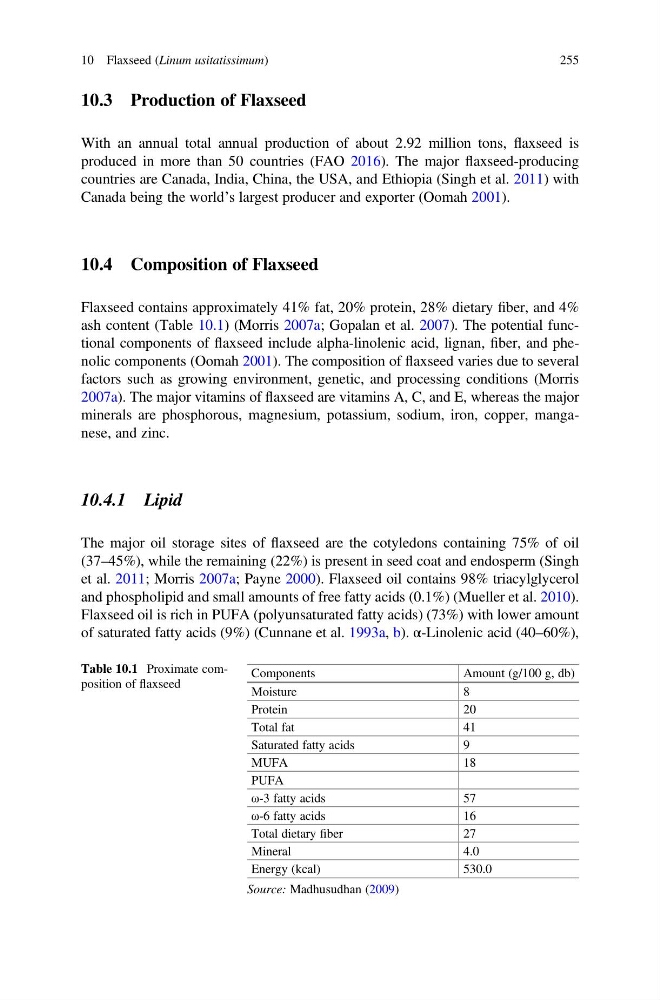
ash content (Table 10.1) (Morris 2007a; Gopalan et al. 2007). The potential functional components of flaxseed include alpha-linolenic acid, lignan, fiber, and phenolic components (Oomah 2001). The composition of flaxseed varies due to several
factors such as growing environment, genetic, and processing conditions (Morris
2007a). The major vitamins of flaxseed are vitamins A, C, and E, whereas the major
minerals are phosphorous, magnesium, potassium, sodium, iron, copper, manganese, and zinc.
10.4.1 Lipid
The major oil storage sites of flaxseed are the cotyledons containing 75% of oil
(37–45%), while the remaining (22%) is present in seed coat and endosperm (Singh
et al. 2011; Morris 2007a; Payne 2000). Flaxseed oil contains 98% triacylglycerol
and phospholipid and small amounts of free fatty acids (0.1%) (Mueller et al. 2010).
Flaxseed oil is rich in PUFA (polyunsaturated fatty acids) (73%) with lower amount
of saturated fatty acids (9%) (Cunnane et al. 1993a, b). α-Linolenic acid (40–60%),
Table 10.1 Proximate composition of flaxseed
Components
Amount (g/100 g, db)
Moisture
8
Protein
20
Total fat
41
Saturated fatty acids
9
MUFA
18
PUFA
ω-3 fatty acids
57
ω-6 fatty acids
16
Total dietary fiber
27
Mineral
4.0
Energy (kcal)
530.0
Source: Madhusudhan (2009)
10 Flaxseed (Linum usitatissimum)
255
With an annual total annual production of about 2.92 million tons, flaxseed is
produced in more than 50 countries (FAO 2016). The major flaxseed-producing
countries are Canada, India, China, the USA, and Ethiopia (Singh et al. 2011) with
Canada being the world’s largest producer and exporter (Oomah 2001).
10.4 Composition of Flaxseed
Flaxseed contains approximately 41% fat, 20% protein, 28% dietary fiber, and 4%
ash content (Table 10.1) (Morris 2007a; Gopalan et al. 2007). The potential functional components of flaxseed include alpha-linolenic acid, lignan, fiber, and phenolic components (Oomah 2001). The composition of flaxseed varies due to several
factors such as growing environment, genetic, and processing conditions (Morris
2007a). The major vitamins of flaxseed are vitamins A, C, and E, whereas the major
minerals are phosphorous, magnesium, potassium, sodium, iron, copper, manganese, and zinc.
10.4.1 Lipid
The major oil storage sites of flaxseed are the cotyledons containing 75% of oil
(37–45%), while the remaining (22%) is present in seed coat and endosperm (Singh
et al. 2011; Morris 2007a; Payne 2000). Flaxseed oil contains 98% triacylglycerol
and phospholipid and small amounts of free fatty acids (0.1%) (Mueller et al. 2010).
Flaxseed oil is rich in PUFA (polyunsaturated fatty acids) (73%) with lower amount
of saturated fatty acids (9%) (Cunnane et al. 1993a, b). α-Linolenic acid (40–60%),
Table 10.1 Proximate composition of flaxseed
Components
Amount (g/100 g, db)
Moisture
8
Protein
20
Total fat
41
Saturated fatty acids
9
MUFA
18
PUFA
ω-3 fatty acids
57
ω-6 fatty acids
16
Total dietary fiber
27
Mineral
4.0
Energy (kcal)
530.0
Source: Madhusudhan (2009)
10 Flaxseed (Linum usitatissimum)
255