

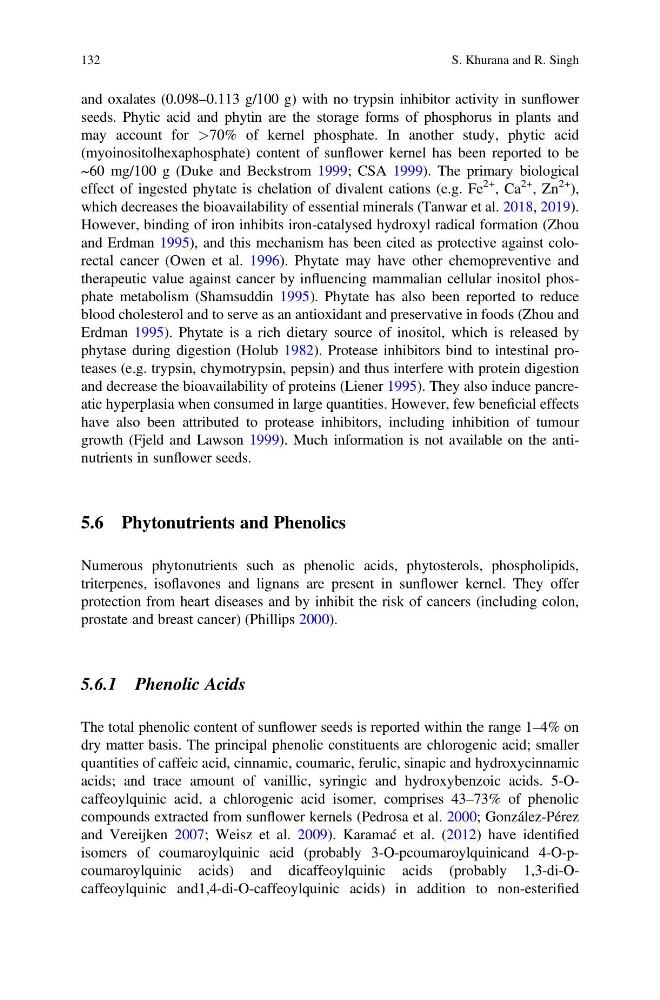
and oxalates (0.098–0.113 g/100 g) with no trypsin inhibitor activity in sunflower
seeds. Phytic acid and phytin are the storage forms of phosphorus in plants and
may account for >70% of kernel phosphate. In another study, phytic acid
(myoinositolhexaphosphate) content of sunflower kernel has been reported to be
~60 mg/100 g (Duke and Beckstrom 1999; CSA 1999). The primary biological
effect of ingested phytate is chelation of divalent cations (e.g. Fe
2+ , Ca
2+ , Zn
2+ ),
which decreases the bioavailability of essential minerals (Tanwar et al. 2018, 2019).
However, binding of iron inhibits iron-catalysed hydroxyl radical formation (Zhou
and Erdman 1995), and this mechanism has been cited as protective against colorectal cancer (Owen et al. 1996). Phytate may have other chemopreventive and
therapeutic value against cancer by influencing mammalian cellular inositol phosphate metabolism (Shamsuddin 1995). Phytate has also been reported to reduce
blood cholesterol and to serve as an antioxidant and preservative in foods (Zhou and
Erdman 1995). Phytate is a rich dietary source of inositol, which is released by
phytase during digestion (Holub 1982). Protease inhibitors bind to intestinal proteases (e.g. trypsin, chymotrypsin, pepsin) and thus interfere with protein digestion
and decrease the bioavailability of proteins (Liener 1995). They also induce pancreatic hyperplasia when consumed in large quantities. However, few beneficial effects
have also been attributed to protease inhibitors, including inhibition of tumour
growth (Fjeld and Lawson 1999). Much information is not available on the antinutrients in sunflower seeds.
5.6 Phytonutrients and Phenolics
Numerous phytonutrients such as phenolic acids, phytosterols, phospholipids,
triterpenes, isoflavones and lignans are present in sunflower kernel. They offer
protection from heart diseases and by inhibit the risk of cancers (including colon,
prostate and breast cancer) (Phillips 2000).
5.6.1 Phenolic Acids
The total phenolic content of sunflower seeds is reported within the range 1–4% on
dry matter basis. The principal phenolic constituents are chlorogenic acid; smaller
quantities of caffeic acid, cinnamic, coumaric, ferulic, sinapic and hydroxycinnamic
acids; and trace amount of vanillic, syringic and hydroxybenzoic acids. 5-Ocaffeoylquinic acid, a chlorogenic acid isomer, comprises 43–73% of phenolic
compounds extracted from sunflower kernels (Pedrosa et al. 2000; González-Pérez
and Vereijken 2007; Weisz et al. 2009). Karamać et al. (2012) have identified
isomers of coumaroylquinic acid (probably 3-O-pcoumaroylquinicand 4-O-pcoumaroylquinic acids) and dicaffeoylquinic acids (probably 1,3-di-Ocaffeoylquinic and1,4-di-O-caffeoylquinic acids) in addition to non-esterified
132
S. Khurana and R. Singh
seeds. Phytic acid and phytin are the storage forms of phosphorus in plants and
may account for >70% of kernel phosphate. In another study, phytic acid
(myoinositolhexaphosphate) content of sunflower kernel has been reported to be
~60 mg/100 g (Duke and Beckstrom 1999; CSA 1999). The primary biological
effect of ingested phytate is chelation of divalent cations (e.g. Fe
2+ , Ca
2+ , Zn
2+ ),
which decreases the bioavailability of essential minerals (Tanwar et al. 2018, 2019).
However, binding of iron inhibits iron-catalysed hydroxyl radical formation (Zhou
and Erdman 1995), and this mechanism has been cited as protective against colorectal cancer (Owen et al. 1996). Phytate may have other chemopreventive and
therapeutic value against cancer by influencing mammalian cellular inositol phosphate metabolism (Shamsuddin 1995). Phytate has also been reported to reduce
blood cholesterol and to serve as an antioxidant and preservative in foods (Zhou and
Erdman 1995). Phytate is a rich dietary source of inositol, which is released by
phytase during digestion (Holub 1982). Protease inhibitors bind to intestinal proteases (e.g. trypsin, chymotrypsin, pepsin) and thus interfere with protein digestion
and decrease the bioavailability of proteins (Liener 1995). They also induce pancreatic hyperplasia when consumed in large quantities. However, few beneficial effects
have also been attributed to protease inhibitors, including inhibition of tumour
growth (Fjeld and Lawson 1999). Much information is not available on the antinutrients in sunflower seeds.
5.6 Phytonutrients and Phenolics
Numerous phytonutrients such as phenolic acids, phytosterols, phospholipids,
triterpenes, isoflavones and lignans are present in sunflower kernel. They offer
protection from heart diseases and by inhibit the risk of cancers (including colon,
prostate and breast cancer) (Phillips 2000).
5.6.1 Phenolic Acids
The total phenolic content of sunflower seeds is reported within the range 1–4% on
dry matter basis. The principal phenolic constituents are chlorogenic acid; smaller
quantities of caffeic acid, cinnamic, coumaric, ferulic, sinapic and hydroxycinnamic
acids; and trace amount of vanillic, syringic and hydroxybenzoic acids. 5-Ocaffeoylquinic acid, a chlorogenic acid isomer, comprises 43–73% of phenolic
compounds extracted from sunflower kernels (Pedrosa et al. 2000; González-Pérez
and Vereijken 2007; Weisz et al. 2009). Karamać et al. (2012) have identified
isomers of coumaroylquinic acid (probably 3-O-pcoumaroylquinicand 4-O-pcoumaroylquinic acids) and dicaffeoylquinic acids (probably 1,3-di-Ocaffeoylquinic and1,4-di-O-caffeoylquinic acids) in addition to non-esterified
132
S. Khurana and R. Singh