

4.1.5.4 Stilbenes
Stilbenes are phenolic compounds consisting of two phenyl molecules connected via
a methylene bridge at carbon number 2 (Likhtenshtein 2009). These compounds are
synthesized by a limited number of plant species; therefore, they are somewhat rare
in nature. Their structure and biological activity are similar to isoflavonoids and are,
thus, classified among phytoestrogens. Stilbenes are part of an immune response and
produced as a response to infection or injury and are also known as phytoalexins due
to their antifungal properties especially against Penicillium, Aspergillus, and
Cladosporium species (Strange and Rao 2017). The most commonly studied stilbene
is resveratrol (3,5,4
0 -tri-hydroxy-stilbene). It occurs as two isoforms, cis and transresveratrol; however only the trans-isomer has estrogenic potential (Aires et al.
2014; Baur and Sinclair 2006).
Phytoalexins are produced in peanut as a response to fungal infection of the plant
tissue. Peanut contain three major types of phytoalexins, including resveratrol,
isopentadyl resveratrol, and arachidins (Sanders et al. 2000). Resveratrol was
detected in significant quantities in the roots, leaves, and shells (1.2–2.6 μg/g).
The developing seeds and testa had low levels of resveratrol (0.05–0.06 μg/g).
However, as the seed develops, resveratrol levels increase, especially during germination when there is chance of an infection (Chung et al. 2003). Mechanical
processing such as harvesting, threshing, drying, and UV exposure can also contribute to phytoalexin production in peanuts. This is because phytoalexins are
produced as a response to stress (Tang et al. 2010). Similarly, resveratrol production
can artificially be induced in peanuts by soaking them for approximately 20 h,
followed by drying for 66 h. This process increases resveratrol levels up to 45- to
65-fold (Tang et al. 2010; Chung et al. 2003). Piceatannol (3,4,3
0 ,5
0 -tetrahydroxytrans-stilbene) is another stilbene that occurs in peanuts; however its level is lower
than resveratrol. Similar to resveratrol induction, piceatannol can be induced via UV
exposure in peanut calluses. One gram of plant calluses produced 2.17–5.31 μg
piceatannol and 0.25–11.97 μg resveratrol, upon UV exposure (Ku et al. 2005).
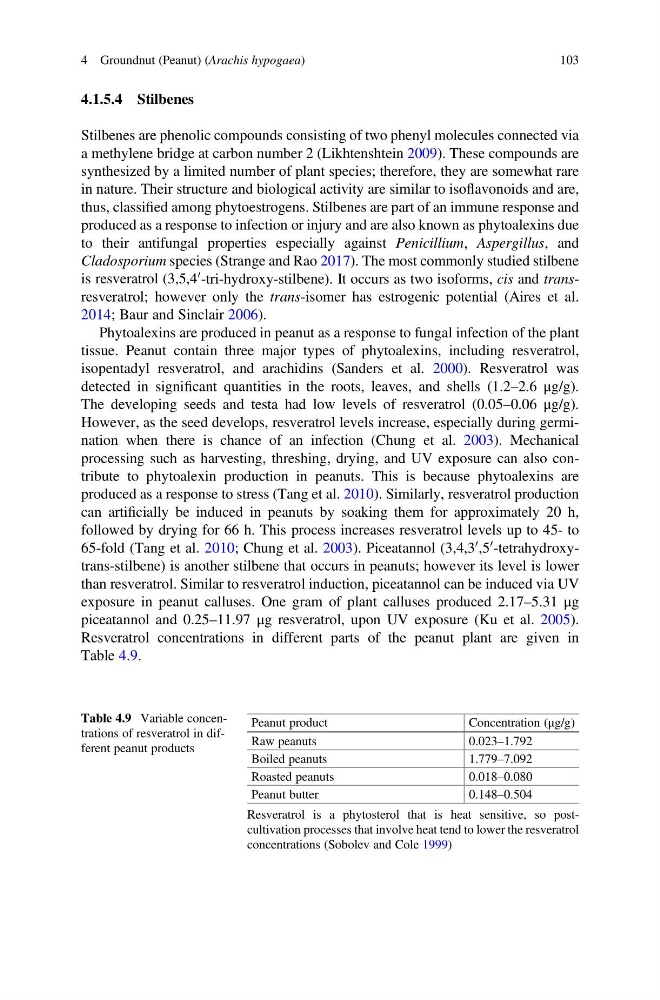
Resveratrol concentrations in different parts of the peanut plant are given in
Table 4.9.
Table 4.9 Variable concentrations of resveratrol in different peanut products
Peanut product
Concentration (μg/g)
Raw peanuts
0.023–1.792
Boiled peanuts
1.779–7.092
Roasted peanuts
0.018–0.080
Peanut butter
0.148–0.504
Resveratrol is a phytosterol that is heat sensitive, so postcultivation processes that involve heat tend to lower the resveratrol
concentrations (Sobolev and Cole 1999)
4 Groundnut (Peanut) (Arachis hypogaea)
103
Stilbenes are phenolic compounds consisting of two phenyl molecules connected via
a methylene bridge at carbon number 2 (Likhtenshtein 2009). These compounds are
synthesized by a limited number of plant species; therefore, they are somewhat rare
in nature. Their structure and biological activity are similar to isoflavonoids and are,
thus, classified among phytoestrogens. Stilbenes are part of an immune response and
produced as a response to infection or injury and are also known as phytoalexins due
to their antifungal properties especially against Penicillium, Aspergillus, and
Cladosporium species (Strange and Rao 2017). The most commonly studied stilbene
is resveratrol (3,5,4
0 -tri-hydroxy-stilbene). It occurs as two isoforms, cis and transresveratrol; however only the trans-isomer has estrogenic potential (Aires et al.
2014; Baur and Sinclair 2006).
Phytoalexins are produced in peanut as a response to fungal infection of the plant
tissue. Peanut contain three major types of phytoalexins, including resveratrol,
isopentadyl resveratrol, and arachidins (Sanders et al. 2000). Resveratrol was
detected in significant quantities in the roots, leaves, and shells (1.2–2.6 μg/g).
The developing seeds and testa had low levels of resveratrol (0.05–0.06 μg/g).
However, as the seed develops, resveratrol levels increase, especially during germination when there is chance of an infection (Chung et al. 2003). Mechanical
processing such as harvesting, threshing, drying, and UV exposure can also contribute to phytoalexin production in peanuts. This is because phytoalexins are
produced as a response to stress (Tang et al. 2010). Similarly, resveratrol production
can artificially be induced in peanuts by soaking them for approximately 20 h,
followed by drying for 66 h. This process increases resveratrol levels up to 45- to
65-fold (Tang et al. 2010; Chung et al. 2003). Piceatannol (3,4,3
0 ,5
0 -tetrahydroxytrans-stilbene) is another stilbene that occurs in peanuts; however its level is lower
than resveratrol. Similar to resveratrol induction, piceatannol can be induced via UV
exposure in peanut calluses. One gram of plant calluses produced 2.17–5.31 μg
piceatannol and 0.25–11.97 μg resveratrol, upon UV exposure (Ku et al. 2005).
Resveratrol concentrations in different parts of the peanut plant are given in
Table 4.9.
Table 4.9 Variable concentrations of resveratrol in different peanut products
Peanut product
Concentration (μg/g)
Raw peanuts
0.023–1.792
Boiled peanuts
1.779–7.092
Roasted peanuts
0.018–0.080
Peanut butter
0.148–0.504
Resveratrol is a phytosterol that is heat sensitive, so postcultivation processes that involve heat tend to lower the resveratrol
concentrations (Sobolev and Cole 1999)
4 Groundnut (Peanut) (Arachis hypogaea)
103