

bleaching). The phytosterols being sensitive to degradation because of the refining
process (Bortolomeazzi et al. 2003). Commercially available peanut oil contains
20 mg of sterols per 100 g of oil. When compared to pure olive oil, peanut oil has
more phytosterols (38%) that make peanut oil more attracted toward healthconscious people (Bortolomeazzi et al. 2003).
4.1.5.3 Essential Amino Acids
Amino acids are building blocks for proteins necessary for healthy development of
skin, bones, and joints. In addition to this, amino acids regulate metabolism and are
required for a healthy immune system. A total of 18 essential amino acids are found
in peanuts, of which 9 are abundant than the others (Settaluri et al. 2012). Details of
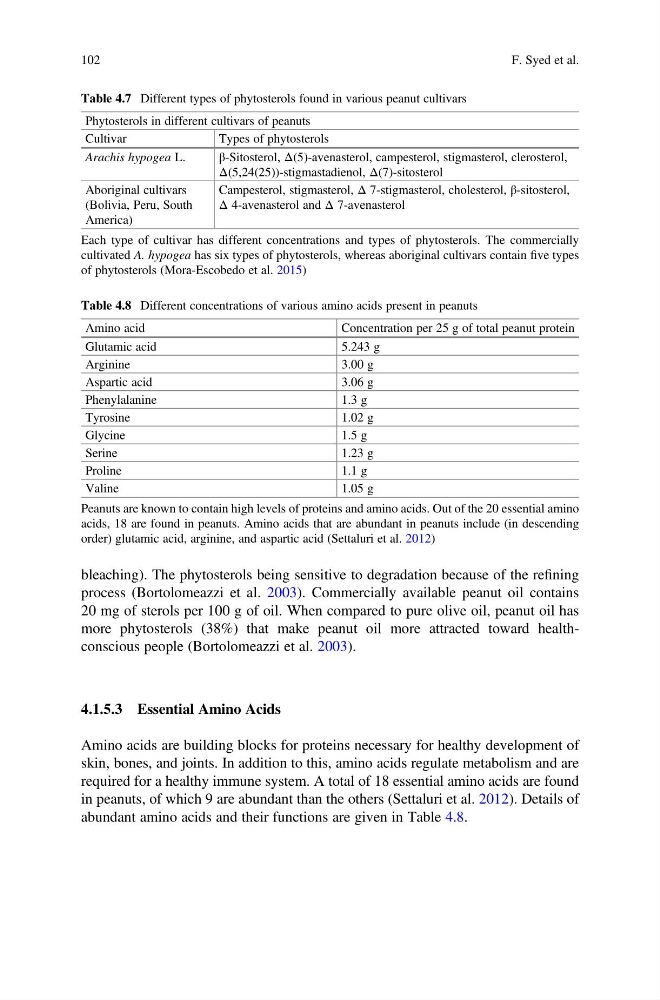
abundant amino acids and their functions are given in Table 4.8.
Table 4.7 Different types of phytosterols found in various peanut cultivars
Phytosterols in different cultivars of peanuts
Cultivar
Types of phytosterols
Arachis hypogea L.
β-Sitosterol, Δ(5)-avenasterol, campesterol, stigmasterol, clerosterol,
Δ(5,24(25))-stigmastadienol, Δ(7)-sitosterol
Aboriginal cultivars
(Bolivia, Peru, South
America)
Campesterol, stigmasterol, Δ 7-stigmasterol, cholesterol, β-sitosterol,
Δ 4-avenasterol and Δ 7-avenasterol
Each type of cultivar has different concentrations and types of phytosterols. The commercially
cultivated A. hypogea has six types of phytosterols, whereas aboriginal cultivars contain five types
of phytosterols (Mora-Escobedo et al. 2015)
Table 4.8 Different concentrations of various amino acids present in peanuts
Amino acid
Concentration per 25 g of total peanut protein
Glutamic acid
5.243 g
Arginine
3.00 g
Aspartic acid
3.06 g
Phenylalanine
1.3 g
Tyrosine
1.02 g
Glycine
1.5 g
Serine
1.23 g
Proline
1.1 g
Valine
1.05 g
Peanuts are known to contain high levels of proteins and amino acids. Out of the 20 essential amino
acids, 18 are found in peanuts. Amino acids that are abundant in peanuts include (in descending
order) glutamic acid, arginine, and aspartic acid (Settaluri et al. 2012)
102
F. Syed et al.
process (Bortolomeazzi et al. 2003). Commercially available peanut oil contains
20 mg of sterols per 100 g of oil. When compared to pure olive oil, peanut oil has
more phytosterols (38%) that make peanut oil more attracted toward healthconscious people (Bortolomeazzi et al. 2003).
4.1.5.3 Essential Amino Acids
Amino acids are building blocks for proteins necessary for healthy development of
skin, bones, and joints. In addition to this, amino acids regulate metabolism and are
required for a healthy immune system. A total of 18 essential amino acids are found
in peanuts, of which 9 are abundant than the others (Settaluri et al. 2012). Details of
abundant amino acids and their functions are given in Table 4.8.
Table 4.7 Different types of phytosterols found in various peanut cultivars
Phytosterols in different cultivars of peanuts
Cultivar
Types of phytosterols
Arachis hypogea L.
β-Sitosterol, Δ(5)-avenasterol, campesterol, stigmasterol, clerosterol,
Δ(5,24(25))-stigmastadienol, Δ(7)-sitosterol
Aboriginal cultivars
(Bolivia, Peru, South
America)
Campesterol, stigmasterol, Δ 7-stigmasterol, cholesterol, β-sitosterol,
Δ 4-avenasterol and Δ 7-avenasterol
Each type of cultivar has different concentrations and types of phytosterols. The commercially
cultivated A. hypogea has six types of phytosterols, whereas aboriginal cultivars contain five types
of phytosterols (Mora-Escobedo et al. 2015)
Table 4.8 Different concentrations of various amino acids present in peanuts
Amino acid
Concentration per 25 g of total peanut protein
Glutamic acid
5.243 g
Arginine
3.00 g
Aspartic acid
3.06 g
Phenylalanine
1.3 g
Tyrosine
1.02 g
Glycine
1.5 g
Serine
1.23 g
Proline
1.1 g
Valine
1.05 g
Peanuts are known to contain high levels of proteins and amino acids. Out of the 20 essential amino
acids, 18 are found in peanuts. Amino acids that are abundant in peanuts include (in descending
order) glutamic acid, arginine, and aspartic acid (Settaluri et al. 2012)
102
F. Syed et al.