

4.1.3.3 Lipids
A. hypogea has sufficient quantities of fatty acids including saturated fatty acids
(6.89 g), mono-unsaturated fatty acids (24.6 g), and PUFAs (15.69 g) which are
contained within 100 g of roasted peanuts (Francisco and Resurreccion 2008). 100 g
of unroasted peanuts contain a total of 48 g of lipids, of which 7 g are saturated, 24 g
mono-unsaturated, and 16 g PUFAs (Campos-Mondragón et al. 2009).
4.1.3.4 Vitamins
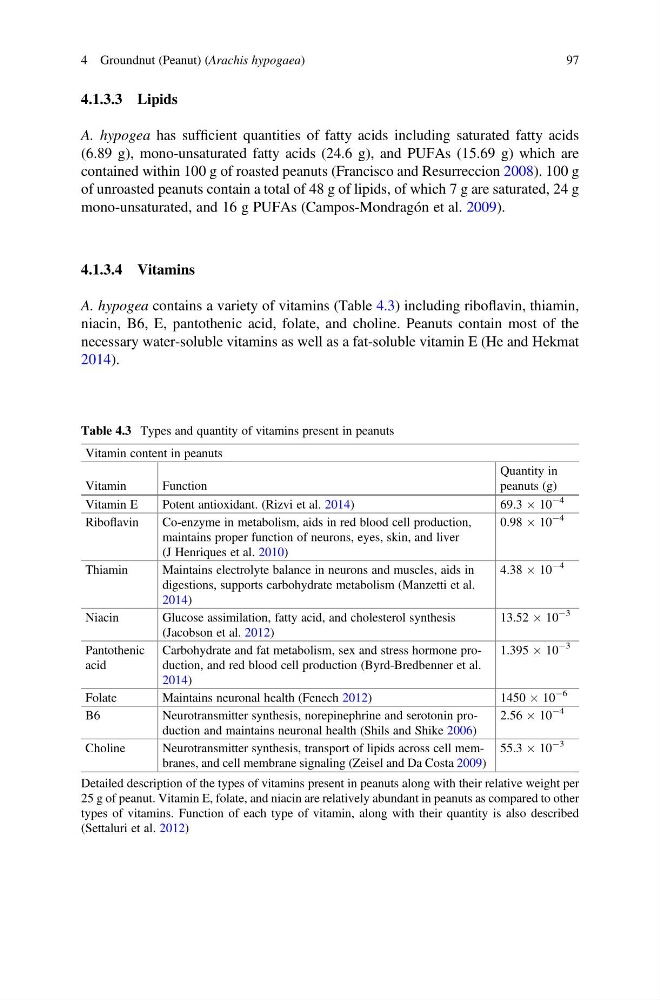
A. hypogea contains a variety of vitamins (Table 4.3) including riboflavin, thiamin,
niacin, B6, E, pantothenic acid, folate, and choline. Peanuts contain most of the
necessary water-soluble vitamins as well as a fat-soluble vitamin E (He and Hekmat
2014).
Table 4.3 Types and quantity of vitamins present in peanuts
Vitamin content in peanuts
Vitamin
Function
Quantity in
peanuts (g)
Vitamin E
Potent antioxidant. (Rizvi et al. 2014)
69.3 Â 10
À4
Riboflavin
Co-enzyme in metabolism, aids in red blood cell production,
maintains proper function of neurons, eyes, skin, and liver
(J Henriques et al. 2010)
0.98 Â 10
À4
Thiamin
Maintains electrolyte balance in neurons and muscles, aids in
digestions, supports carbohydrate metabolism (Manzetti et al.
2014)
4.38 Â 10
À4
Niacin
Glucose assimilation, fatty acid, and cholesterol synthesis
(Jacobson et al. 2012)
13.52 Â 10
À3
Pantothenic
acid
Carbohydrate and fat metabolism, sex and stress hormone production, and red blood cell production (Byrd-Bredbenner et al.
2014)
1.395 Â 10
À3
Folate
Maintains neuronal health (Fenech 2012)
1450 Â 10
À6
B6
Neurotransmitter synthesis, norepinephrine and serotonin production and maintains neuronal health (Shils and Shike 2006)
2.56 Â 10
À4
Choline
Neurotransmitter synthesis, transport of lipids across cell membranes, and cell membrane signaling (Zeisel and Da Costa 2009)
55.3 Â 10
À3
Detailed description of the types of vitamins present in peanuts along with their relative weight per
25 g of peanut. Vitamin E, folate, and niacin are relatively abundant in peanuts as compared to other
types of vitamins. Function of each type of vitamin, along with their quantity is also described
(Settaluri et al. 2012)
4 Groundnut (Peanut) (Arachis hypogaea)
9 7
A. hypogea has sufficient quantities of fatty acids including saturated fatty acids
(6.89 g), mono-unsaturated fatty acids (24.6 g), and PUFAs (15.69 g) which are
contained within 100 g of roasted peanuts (Francisco and Resurreccion 2008). 100 g
of unroasted peanuts contain a total of 48 g of lipids, of which 7 g are saturated, 24 g
mono-unsaturated, and 16 g PUFAs (Campos-Mondragón et al. 2009).
4.1.3.4 Vitamins
A. hypogea contains a variety of vitamins (Table 4.3) including riboflavin, thiamin,
niacin, B6, E, pantothenic acid, folate, and choline. Peanuts contain most of the
necessary water-soluble vitamins as well as a fat-soluble vitamin E (He and Hekmat
2014).
Table 4.3 Types and quantity of vitamins present in peanuts
Vitamin content in peanuts
Vitamin
Function
Quantity in
peanuts (g)
Vitamin E
Potent antioxidant. (Rizvi et al. 2014)
69.3 Â 10
À4
Riboflavin
Co-enzyme in metabolism, aids in red blood cell production,
maintains proper function of neurons, eyes, skin, and liver
(J Henriques et al. 2010)
0.98 Â 10
À4
Thiamin
Maintains electrolyte balance in neurons and muscles, aids in
digestions, supports carbohydrate metabolism (Manzetti et al.
2014)
4.38 Â 10
À4
Niacin
Glucose assimilation, fatty acid, and cholesterol synthesis
(Jacobson et al. 2012)
13.52 Â 10
À3
Pantothenic
acid
Carbohydrate and fat metabolism, sex and stress hormone production, and red blood cell production (Byrd-Bredbenner et al.
2014)
1.395 Â 10
À3
Folate
Maintains neuronal health (Fenech 2012)
1450 Â 10
À6
B6
Neurotransmitter synthesis, norepinephrine and serotonin production and maintains neuronal health (Shils and Shike 2006)
2.56 Â 10
À4
Choline
Neurotransmitter synthesis, transport of lipids across cell membranes, and cell membrane signaling (Zeisel and Da Costa 2009)
55.3 Â 10
À3
Detailed description of the types of vitamins present in peanuts along with their relative weight per
25 g of peanut. Vitamin E, folate, and niacin are relatively abundant in peanuts as compared to other
types of vitamins. Function of each type of vitamin, along with their quantity is also described
(Settaluri et al. 2012)
4 Groundnut (Peanut) (Arachis hypogaea)
9 7