

92
3 The Challenges of Energy Supply
3.5 Impediments to Electricity Generation
3.5.1 Hydropower
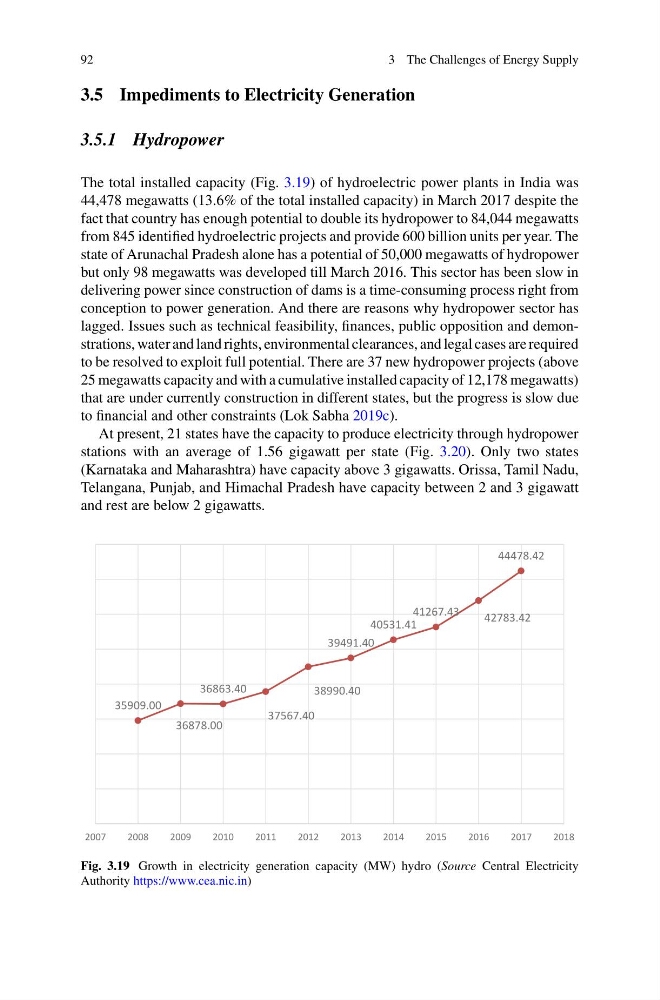
The total installed capacity (Fig. 3.19) of hydroelectric power plants in India was
44,478 megawatts (13.6% of the total installed capacity) in March 2017 despite the
fact that country has enough potential to double its hydropower to 84,044 megawatts
from 845 identified hydroelectric projects and provide 600 billion units per year. The
state of Arunachal Pradesh alone has a potential of 50,000 megawatts of hydropower
but only 98 megawatts was developed till March 2016. This sector has been slow in
delivering power since construction of dams is a time-consuming process right from
conception to power generation. And there are reasons why hydropower sector has
lagged. Issues such as technical feasibility, finances, public opposition and demonstrations, water and land rights, environmental clearances, and legal cases are required
to be resolved to exploit full potential. There are 37 new hydropower projects (above
25 megawatts capacity and with a cumulative installed capacity of 12,178 megawatts)
that are under currently construction in different states, but the progress is slow due
to financial and other constraints (Lok Sabha 2019c).
At present, 21 states have the capacity to produce electricity through hydropower
stations with an average of 1.56 gigawatt per state (Fig. 3.20). Only two states
(Karnataka and Maharashtra) have capacity above 3 gigawatts. Orissa, Tamil Nadu,
Telangana, Punjab, and Himachal Pradesh have capacity between 2 and 3 gigawatt
and rest are below 2 gigawatts.
35909.00
36878.00
36863.40
37567.40
38990.40
39491.40
40531.41
41267.43
42783.42
44478.42
2007
2008
2009
2010
2011
2012
2013
2014
2015
2016
2017
2018
Fig. 3.19 Growth in electricity generation capacity (MW) hydro (Source Central Electricity
Authority https://www.cea.nic.in)
3 The Challenges of Energy Supply
3.5 Impediments to Electricity Generation
3.5.1 Hydropower
The total installed capacity (Fig. 3.19) of hydroelectric power plants in India was
44,478 megawatts (13.6% of the total installed capacity) in March 2017 despite the
fact that country has enough potential to double its hydropower to 84,044 megawatts
from 845 identified hydroelectric projects and provide 600 billion units per year. The
state of Arunachal Pradesh alone has a potential of 50,000 megawatts of hydropower
but only 98 megawatts was developed till March 2016. This sector has been slow in
delivering power since construction of dams is a time-consuming process right from
conception to power generation. And there are reasons why hydropower sector has
lagged. Issues such as technical feasibility, finances, public opposition and demonstrations, water and land rights, environmental clearances, and legal cases are required
to be resolved to exploit full potential. There are 37 new hydropower projects (above
25 megawatts capacity and with a cumulative installed capacity of 12,178 megawatts)
that are under currently construction in different states, but the progress is slow due
to financial and other constraints (Lok Sabha 2019c).
At present, 21 states have the capacity to produce electricity through hydropower
stations with an average of 1.56 gigawatt per state (Fig. 3.20). Only two states
(Karnataka and Maharashtra) have capacity above 3 gigawatts. Orissa, Tamil Nadu,
Telangana, Punjab, and Himachal Pradesh have capacity between 2 and 3 gigawatt
and rest are below 2 gigawatts.
35909.00
36878.00
36863.40
37567.40
38990.40
39491.40
40531.41
41267.43
42783.42
44478.42
2007
2008
2009
2010
2011
2012
2013
2014
2015
2016
2017
2018
Fig. 3.19 Growth in electricity generation capacity (MW) hydro (Source Central Electricity
Authority https://www.cea.nic.in)