

86
3 The Challenges of Energy Supply
since 1997–1998) has been arrested with extraordinary performance after 2015–
2016.
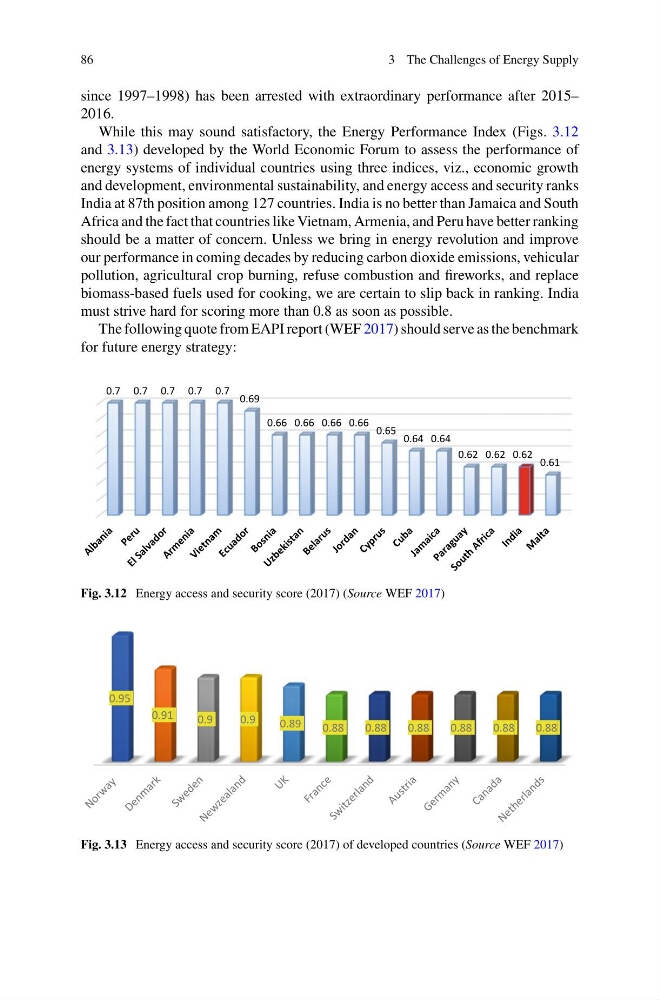
While this may sound satisfactory, the Energy Performance Index (Figs. 3.12
and 3.13) developed by the World Economic Forum to assess the performance of
energy systems of individual countries using three indices, viz., economic growth
and development, environmental sustainability, and energy access and security ranks
India at 87th position among 127 countries. India is no better than Jamaica and South
Africa and the fact that countries like Vietnam, Armenia, and Peru have better ranking
should be a matter of concern. Unless we bring in energy revolution and improve
our performance in coming decades by reducing carbon dioxide emissions, vehicular
pollution, agricultural crop burning, refuse combustion and fireworks, and replace
biomass-based fuels used for cooking, we are certain to slip back in ranking. India
must strive hard for scoring more than 0.8 as soon as possible.
The following quote from EAPI report (WEF 2017) should serve as the benchmark
for future energy strategy:
0.7 0.7 0.7 0.7 0.7 0.69
0.66 0.66 0.66 0.66 0.65 0.64 0.64
0.62 0.62 0.62 0.61
Fig. 3.12 Energy access and security score (2017) (Source WEF 2017)
0.95
0.91
0.9
0.9
0.89
0.88
0.88
0.88
0.88
0.88
0.88
Fig. 3.13 Energy access and security score (2017) of developed countries (Source WEF 2017)
3 The Challenges of Energy Supply
since 1997–1998) has been arrested with extraordinary performance after 2015–
2016.
While this may sound satisfactory, the Energy Performance Index (Figs. 3.12
and 3.13) developed by the World Economic Forum to assess the performance of
energy systems of individual countries using three indices, viz., economic growth
and development, environmental sustainability, and energy access and security ranks
India at 87th position among 127 countries. India is no better than Jamaica and South
Africa and the fact that countries like Vietnam, Armenia, and Peru have better ranking
should be a matter of concern. Unless we bring in energy revolution and improve
our performance in coming decades by reducing carbon dioxide emissions, vehicular
pollution, agricultural crop burning, refuse combustion and fireworks, and replace
biomass-based fuels used for cooking, we are certain to slip back in ranking. India
must strive hard for scoring more than 0.8 as soon as possible.
The following quote from EAPI report (WEF 2017) should serve as the benchmark
for future energy strategy:
0.7 0.7 0.7 0.7 0.7 0.69
0.66 0.66 0.66 0.66 0.65 0.64 0.64
0.62 0.62 0.62 0.61
Fig. 3.12 Energy access and security score (2017) (Source WEF 2017)
0.95
0.91
0.9
0.9
0.89
0.88
0.88
0.88
0.88
0.88
0.88
Fig. 3.13 Energy access and security score (2017) of developed countries (Source WEF 2017)