

42
2 Energy Sector Progression in India
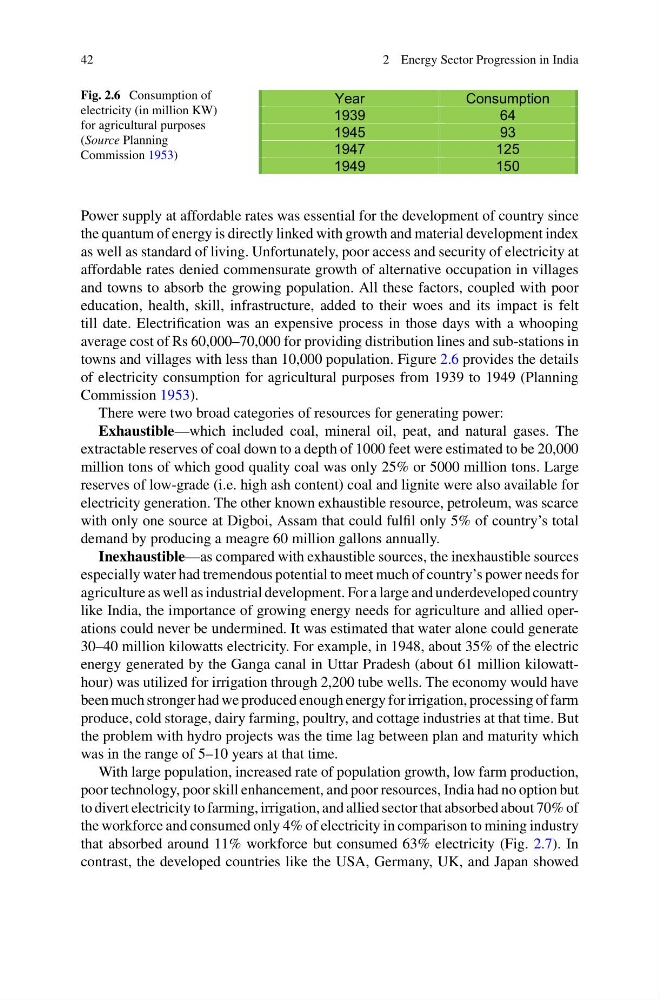
Fig. 2.6 Consumption of
electricity (in million KW)
for agricultural purposes
(Source Planning
Commission 1953)
Year
Consumption
1939
64
1945
93
1947
125
1949
150
Power supply at affordable rates was essential for the development of country since
the quantum of energy is directly linked with growth and material development index
as well as standard of living. Unfortunately, poor access and security of electricity at
affordable rates denied commensurate growth of alternative occupation in villages
and towns to absorb the growing population. All these factors, coupled with poor
education, health, skill, infrastructure, added to their woes and its impact is felt
till date. Electrification was an expensive process in those days with a whooping
average cost of Rs 60,000–70,000 for providing distribution lines and sub-stations in
towns and villages with less than 10,000 population. Figure 2.6 provides the details
of electricity consumption for agricultural purposes from 1939 to 1949 (Planning
Commission 1953).
There were two broad categories of resources for generating power:
Exhaustible—which included coal, mineral oil, peat, and natural gases. The
extractable reserves of coal down to a depth of 1000 feet were estimated to be 20,000
million tons of which good quality coal was only 25% or 5000 million tons. Large
reserves of low-grade (i.e. high ash content) coal and lignite were also available for
electricity generation. The other known exhaustible resource, petroleum, was scarce
with only one source at Digboi, Assam that could fulfil only 5% of country’s total
demand by producing a meagre 60 million gallons annually.
Inexhaustible—as compared with exhaustible sources, the inexhaustible sources
especially water had tremendous potential to meet much of country’s power needs for
agriculture as well as industrial development. For a large and underdeveloped country
like India, the importance of growing energy needs for agriculture and allied operations could never be undermined. It was estimated that water alone could generate
30–40 million kilowatts electricity. For example, in 1948, about 35% of the electric
energy generated by the Ganga canal in Uttar Pradesh (about 61 million kilowatthour) was utilized for irrigation through 2,200 tube wells. The economy would have
been much stronger had we produced enough energy for irrigation, processing of farm
produce, cold storage, dairy farming, poultry, and cottage industries at that time. But
the problem with hydro projects was the time lag between plan and maturity which
was in the range of 5–10 years at that time.
With large population, increased rate of population growth, low farm production,
poor technology, poor skill enhancement, and poor resources, India had no option but
to divert electricity to farming, irrigation, and allied sector that absorbed about 70% of
the workforce and consumed only 4% of electricity in comparison to mining industry
that absorbed around 11% workforce but consumed 63% electricity (Fig. 2.7). In
contrast, the developed countries like the USA, Germany, UK, and Japan showed
2 Energy Sector Progression in India
Fig. 2.6 Consumption of
electricity (in million KW)
for agricultural purposes
(Source Planning
Commission 1953)
Year
Consumption
1939
64
1945
93
1947
125
1949
150
Power supply at affordable rates was essential for the development of country since
the quantum of energy is directly linked with growth and material development index
as well as standard of living. Unfortunately, poor access and security of electricity at
affordable rates denied commensurate growth of alternative occupation in villages
and towns to absorb the growing population. All these factors, coupled with poor
education, health, skill, infrastructure, added to their woes and its impact is felt
till date. Electrification was an expensive process in those days with a whooping
average cost of Rs 60,000–70,000 for providing distribution lines and sub-stations in
towns and villages with less than 10,000 population. Figure 2.6 provides the details
of electricity consumption for agricultural purposes from 1939 to 1949 (Planning
Commission 1953).
There were two broad categories of resources for generating power:
Exhaustible—which included coal, mineral oil, peat, and natural gases. The
extractable reserves of coal down to a depth of 1000 feet were estimated to be 20,000
million tons of which good quality coal was only 25% or 5000 million tons. Large
reserves of low-grade (i.e. high ash content) coal and lignite were also available for
electricity generation. The other known exhaustible resource, petroleum, was scarce
with only one source at Digboi, Assam that could fulfil only 5% of country’s total
demand by producing a meagre 60 million gallons annually.
Inexhaustible—as compared with exhaustible sources, the inexhaustible sources
especially water had tremendous potential to meet much of country’s power needs for
agriculture as well as industrial development. For a large and underdeveloped country
like India, the importance of growing energy needs for agriculture and allied operations could never be undermined. It was estimated that water alone could generate
30–40 million kilowatts electricity. For example, in 1948, about 35% of the electric
energy generated by the Ganga canal in Uttar Pradesh (about 61 million kilowatthour) was utilized for irrigation through 2,200 tube wells. The economy would have
been much stronger had we produced enough energy for irrigation, processing of farm
produce, cold storage, dairy farming, poultry, and cottage industries at that time. But
the problem with hydro projects was the time lag between plan and maturity which
was in the range of 5–10 years at that time.
With large population, increased rate of population growth, low farm production,
poor technology, poor skill enhancement, and poor resources, India had no option but
to divert electricity to farming, irrigation, and allied sector that absorbed about 70% of
the workforce and consumed only 4% of electricity in comparison to mining industry
that absorbed around 11% workforce but consumed 63% electricity (Fig. 2.7). In
contrast, the developed countries like the USA, Germany, UK, and Japan showed