

2.1 Energy as a Commercial Entity
39
Original Unit
MTCR
MTCE
One million ton of coal
1
1
One million ton of oil
6.5
2.6
One Terra watt hour
1
0.123
One million ton of firewood
(4750 Kcal/Kg)
0.95
0.95
One million ton of dry
animal dung
0.40
0.48
One
million
ton
of
agricultural waste (4200
Kcal/Kg)
0.95
0.84
Ref — [Planning Commission., 1979]
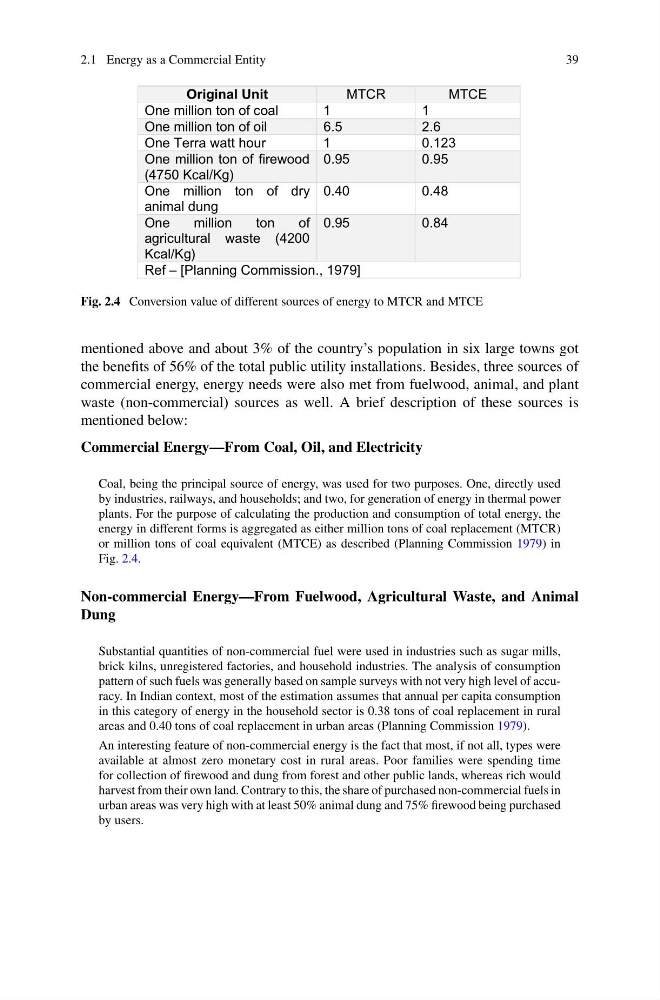
Fig. 2.4 Conversion value of different sources of energy to MTCR and MTCE
mentioned above and about 3% of the country’s population in six large towns got
the benefits of 56% of the total public utility installations. Besides, three sources of
commercial energy, energy needs were also met from fuelwood, animal, and plant
waste (non-commercial) sources as well. A brief description of these sources is
mentioned below:
Commercial Energy—From Coal, Oil, and Electricity
Coal, being the principal source of energy, was used for two purposes. One, directly used
by industries, railways, and households; and two, for generation of energy in thermal power
plants. For the purpose of calculating the production and consumption of total energy, the
energy in different forms is aggregated as either million tons of coal replacement (MTCR)
or million tons of coal equivalent (MTCE) as described (Planning Commission 1979) in
Fig. 2.4.
Non-commercial Energy—From Fuelwood, Agricultural Waste, and Animal
Dung
Substantial quantities of non-commercial fuel were used in industries such as sugar mills,
brick kilns, unregistered factories, and household industries. The analysis of consumption
pattern of such fuels was generally based on sample surveys with not very high level of accuracy. In Indian context, most of the estimation assumes that annual per capita consumption
in this category of energy in the household sector is 0.38 tons of coal replacement in rural
areas and 0.40 tons of coal replacement in urban areas (Planning Commission 1979).
An interesting feature of non-commercial energy is the fact that most, if not all, types were
available at almost zero monetary cost in rural areas. Poor families were spending time
for collection of firewood and dung from forest and other public lands, whereas rich would
harvest from their own land. Contrary to this, the share of purchased non-commercial fuels in
urban areas was very high with at least 50% animal dung and 75% firewood being purchased
by users.
39
Original Unit
MTCR
MTCE
One million ton of coal
1
1
One million ton of oil
6.5
2.6
One Terra watt hour
1
0.123
One million ton of firewood
(4750 Kcal/Kg)
0.95
0.95
One million ton of dry
animal dung
0.40
0.48
One
million
ton
of
agricultural waste (4200
Kcal/Kg)
0.95
0.84
Ref — [Planning Commission., 1979]
Fig. 2.4 Conversion value of different sources of energy to MTCR and MTCE
mentioned above and about 3% of the country’s population in six large towns got
the benefits of 56% of the total public utility installations. Besides, three sources of
commercial energy, energy needs were also met from fuelwood, animal, and plant
waste (non-commercial) sources as well. A brief description of these sources is
mentioned below:
Commercial Energy—From Coal, Oil, and Electricity
Coal, being the principal source of energy, was used for two purposes. One, directly used
by industries, railways, and households; and two, for generation of energy in thermal power
plants. For the purpose of calculating the production and consumption of total energy, the
energy in different forms is aggregated as either million tons of coal replacement (MTCR)
or million tons of coal equivalent (MTCE) as described (Planning Commission 1979) in
Fig. 2.4.
Non-commercial Energy—From Fuelwood, Agricultural Waste, and Animal
Dung
Substantial quantities of non-commercial fuel were used in industries such as sugar mills,
brick kilns, unregistered factories, and household industries. The analysis of consumption
pattern of such fuels was generally based on sample surveys with not very high level of accuracy. In Indian context, most of the estimation assumes that annual per capita consumption
in this category of energy in the household sector is 0.38 tons of coal replacement in rural
areas and 0.40 tons of coal replacement in urban areas (Planning Commission 1979).
An interesting feature of non-commercial energy is the fact that most, if not all, types were
available at almost zero monetary cost in rural areas. Poor families were spending time
for collection of firewood and dung from forest and other public lands, whereas rich would
harvest from their own land. Contrary to this, the share of purchased non-commercial fuels in
urban areas was very high with at least 50% animal dung and 75% firewood being purchased
by users.