

34
2 Energy Sector Progression in India
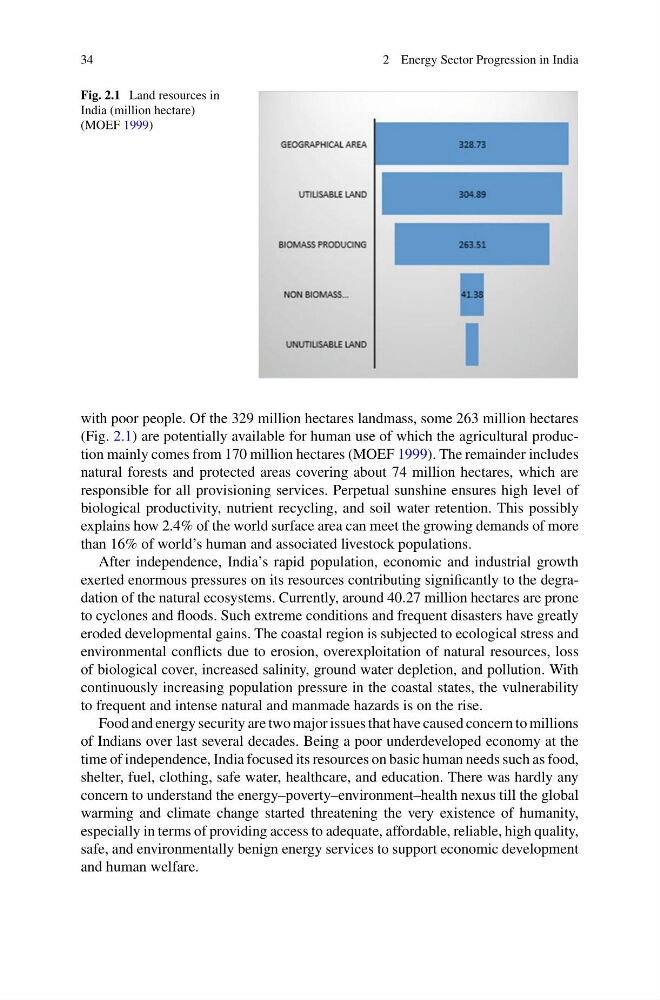
Fig. 2.1 Land resources in
India (million hectare)
(MOEF 1999)
with poor people. Of the 329 million hectares landmass, some 263 million hectares
(Fig. 2.1) are potentially available for human use of which the agricultural production mainly comes from 170 million hectares (MOEF 1999). The remainder includes
natural forests and protected areas covering about 74 million hectares, which are
responsible for all provisioning services. Perpetual sunshine ensures high level of
biological productivity, nutrient recycling, and soil water retention. This possibly
explains how 2.4% of the world surface area can meet the growing demands of more
than 16% of world’s human and associated livestock populations.
After independence, India’s rapid population, economic and industrial growth
exerted enormous pressures on its resources contributing significantly to the degradation of the natural ecosystems. Currently, around 40.27 million hectares are prone
to cyclones and floods. Such extreme conditions and frequent disasters have greatly
eroded developmental gains. The coastal region is subjected to ecological stress and
environmental conflicts due to erosion, overexploitation of natural resources, loss
of biological cover, increased salinity, ground water depletion, and pollution. With
continuously increasing population pressure in the coastal states, the vulnerability
to frequent and intense natural and manmade hazards is on the rise.
Food and energy security are two major issues that have caused concern to millions
of Indians over last several decades. Being a poor underdeveloped economy at the
time of independence, India focused its resources on basic human needs such as food,
shelter, fuel, clothing, safe water, healthcare, and education. There was hardly any
concern to understand the energy–poverty–environment–health nexus till the global
warming and climate change started threatening the very existence of humanity,
especially in terms of providing access to adequate, affordable, reliable, high quality,
safe, and environmentally benign energy services to support economic development
and human welfare.
2 Energy Sector Progression in India
Fig. 2.1 Land resources in
India (million hectare)
(MOEF 1999)
with poor people. Of the 329 million hectares landmass, some 263 million hectares
(Fig. 2.1) are potentially available for human use of which the agricultural production mainly comes from 170 million hectares (MOEF 1999). The remainder includes
natural forests and protected areas covering about 74 million hectares, which are
responsible for all provisioning services. Perpetual sunshine ensures high level of
biological productivity, nutrient recycling, and soil water retention. This possibly
explains how 2.4% of the world surface area can meet the growing demands of more
than 16% of world’s human and associated livestock populations.
After independence, India’s rapid population, economic and industrial growth
exerted enormous pressures on its resources contributing significantly to the degradation of the natural ecosystems. Currently, around 40.27 million hectares are prone
to cyclones and floods. Such extreme conditions and frequent disasters have greatly
eroded developmental gains. The coastal region is subjected to ecological stress and
environmental conflicts due to erosion, overexploitation of natural resources, loss
of biological cover, increased salinity, ground water depletion, and pollution. With
continuously increasing population pressure in the coastal states, the vulnerability
to frequent and intense natural and manmade hazards is on the rise.
Food and energy security are two major issues that have caused concern to millions
of Indians over last several decades. Being a poor underdeveloped economy at the
time of independence, India focused its resources on basic human needs such as food,
shelter, fuel, clothing, safe water, healthcare, and education. There was hardly any
concern to understand the energy–poverty–environment–health nexus till the global
warming and climate change started threatening the very existence of humanity,
especially in terms of providing access to adequate, affordable, reliable, high quality,
safe, and environmentally benign energy services to support economic development
and human welfare.