

5.6 Every Little Step Will Be a Great …
183
heaters, fuelwood, charcoal, which would ensure security and access, provided that
the cost is based on the calorific value and not market price. People have to be gradually dissuaded from using fuelwood and animal dung. Local entrepreneurs should
be involved in this process product design, engineering, manufacturing, marketing,
maintenance distribution, and sales.
Each unit of electricity that people consume globally releases 0.19 kilogram of
carbon di oxide. This is a conservative figure and actual release may vary with the
type of source and technology used for electricity generation. In case of India this
figure may be close to 1 kilogram of carbon dioxide. In comparison, release of carbon
dioxide will be insignificant if all thermal power stations are theoretically converted
into solar/wind/nuclear/hydropower or a combination of these. After examining the
past energy trend in India, one can safely presume that full decarbonization is a
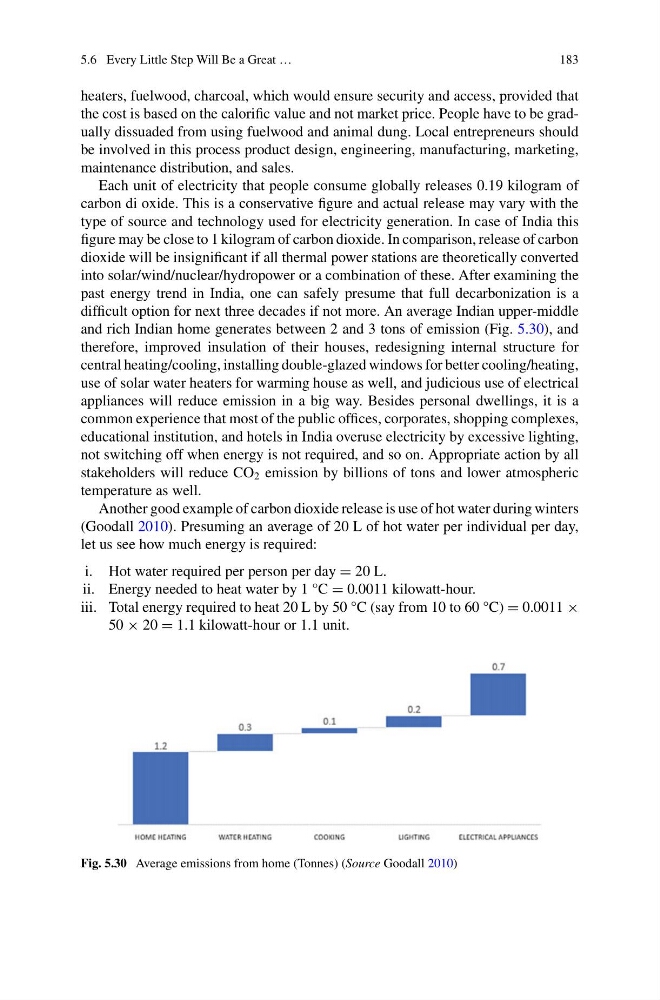
difficult option for next three decades if not more. An average Indian upper-middle
and rich Indian home generates between 2 and 3 tons of emission (Fig. 5.30), and
therefore, improved insulation of their houses, redesigning internal structure for
central heating/cooling, installing double-glazed windows for better cooling/heating,
use of solar water heaters for warming house as well, and judicious use of electrical
appliances will reduce emission in a big way. Besides personal dwellings, it is a
common experience that most of the public offices, corporates, shopping complexes,
educational institution, and hotels in India overuse electricity by excessive lighting,
not switching off when energy is not required, and so on. Appropriate action by all
stakeholders will reduce CO 2 emission by billions of tons and lower atmospheric
temperature as well.
Another good example of carbon dioxide release is use of hot water during winters
(Goodall 2010). Presuming an average of 20 L of hot water per individual per day,
let us see how much energy is required:
i. Hot water required per person per day = 20 L.
ii. Energy needed to heat water by 1 °C = 0.0011 kilowatt-hour.
iii. Total energy required to heat 20 L by 50 °C (say from 10 to 60 °C) = 0.0011 ×
50 × 20 = 1.1 kilowatt-hour or 1.1 unit.
Fig. 5.30 Average emissions from home (Tonnes) (Source Goodall 2010)
183
heaters, fuelwood, charcoal, which would ensure security and access, provided that
the cost is based on the calorific value and not market price. People have to be gradually dissuaded from using fuelwood and animal dung. Local entrepreneurs should
be involved in this process product design, engineering, manufacturing, marketing,
maintenance distribution, and sales.
Each unit of electricity that people consume globally releases 0.19 kilogram of
carbon di oxide. This is a conservative figure and actual release may vary with the
type of source and technology used for electricity generation. In case of India this
figure may be close to 1 kilogram of carbon dioxide. In comparison, release of carbon
dioxide will be insignificant if all thermal power stations are theoretically converted
into solar/wind/nuclear/hydropower or a combination of these. After examining the
past energy trend in India, one can safely presume that full decarbonization is a
difficult option for next three decades if not more. An average Indian upper-middle
and rich Indian home generates between 2 and 3 tons of emission (Fig. 5.30), and
therefore, improved insulation of their houses, redesigning internal structure for
central heating/cooling, installing double-glazed windows for better cooling/heating,
use of solar water heaters for warming house as well, and judicious use of electrical
appliances will reduce emission in a big way. Besides personal dwellings, it is a
common experience that most of the public offices, corporates, shopping complexes,
educational institution, and hotels in India overuse electricity by excessive lighting,
not switching off when energy is not required, and so on. Appropriate action by all
stakeholders will reduce CO 2 emission by billions of tons and lower atmospheric
temperature as well.
Another good example of carbon dioxide release is use of hot water during winters
(Goodall 2010). Presuming an average of 20 L of hot water per individual per day,
let us see how much energy is required:
i. Hot water required per person per day = 20 L.
ii. Energy needed to heat water by 1 °C = 0.0011 kilowatt-hour.
iii. Total energy required to heat 20 L by 50 °C (say from 10 to 60 °C) = 0.0011 ×
50 × 20 = 1.1 kilowatt-hour or 1.1 unit.
Fig. 5.30 Average emissions from home (Tonnes) (Source Goodall 2010)