

160
5 Fourth Industrial Revolution and India
0.0
1.0
2.0
3.0
4.0
5.0
6.0
7.0
8.0
9.0
10.0
1980
1981
1982
1983
1984
1985
1986
1987
1988
1989
1990
1991
1992
1993
1994
1995
1996
1997
1998
1999
2000
2001
2002
2003
2004
2005
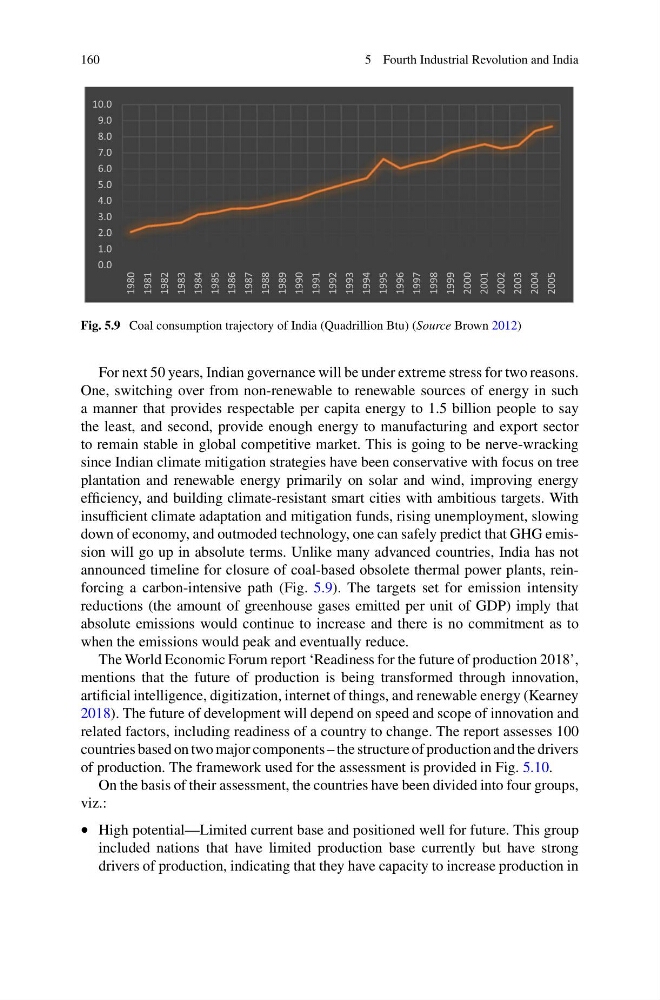
Fig. 5.9 Coal consumption trajectory of India (Quadrillion Btu) (Source Brown 2012)
For next 50 years, Indian governance will be under extreme stress for two reasons.
One, switching over from non-renewable to renewable sources of energy in such
a manner that provides respectable per capita energy to 1.5 billion people to say
the least, and second, provide enough energy to manufacturing and export sector
to remain stable in global competitive market. This is going to be nerve-wracking
since Indian climate mitigation strategies have been conservative with focus on tree
plantation and renewable energy primarily on solar and wind, improving energy
efficiency, and building climate-resistant smart cities with ambitious targets. With
insufficient climate adaptation and mitigation funds, rising unemployment, slowing
down of economy, and outmoded technology, one can safely predict that GHG emission will go up in absolute terms. Unlike many advanced countries, India has not
announced timeline for closure of coal-based obsolete thermal power plants, reinforcing a carbon-intensive path (Fig. 5.9). The targets set for emission intensity
reductions (the amount of greenhouse gases emitted per unit of GDP) imply that
absolute emissions would continue to increase and there is no commitment as to
when the emissions would peak and eventually reduce.
The World Economic Forum report ‘Readiness for the future of production 2018’,
mentions that the future of production is being transformed through innovation,
artificial intelligence, digitization, internet of things, and renewable energy (Kearney
2018). The future of development will depend on speed and scope of innovation and
related factors, including readiness of a country to change. The report assesses 100
countries based on two major components – the structure of production and the drivers
of production. The framework used for the assessment is provided in Fig. 5.10.
On the basis of their assessment, the countries have been divided into four groups,
viz.:
• High potential—Limited current base and positioned well for future. This group
included nations that have limited production base currently but have strong
drivers of production, indicating that they have capacity to increase production in
5 Fourth Industrial Revolution and India
0.0
1.0
2.0
3.0
4.0
5.0
6.0
7.0
8.0
9.0
10.0
1980
1981
1982
1983
1984
1985
1986
1987
1988
1989
1990
1991
1992
1993
1994
1995
1996
1997
1998
1999
2000
2001
2002
2003
2004
2005
Fig. 5.9 Coal consumption trajectory of India (Quadrillion Btu) (Source Brown 2012)
For next 50 years, Indian governance will be under extreme stress for two reasons.
One, switching over from non-renewable to renewable sources of energy in such
a manner that provides respectable per capita energy to 1.5 billion people to say
the least, and second, provide enough energy to manufacturing and export sector
to remain stable in global competitive market. This is going to be nerve-wracking
since Indian climate mitigation strategies have been conservative with focus on tree
plantation and renewable energy primarily on solar and wind, improving energy
efficiency, and building climate-resistant smart cities with ambitious targets. With
insufficient climate adaptation and mitigation funds, rising unemployment, slowing
down of economy, and outmoded technology, one can safely predict that GHG emission will go up in absolute terms. Unlike many advanced countries, India has not
announced timeline for closure of coal-based obsolete thermal power plants, reinforcing a carbon-intensive path (Fig. 5.9). The targets set for emission intensity
reductions (the amount of greenhouse gases emitted per unit of GDP) imply that
absolute emissions would continue to increase and there is no commitment as to
when the emissions would peak and eventually reduce.
The World Economic Forum report ‘Readiness for the future of production 2018’,
mentions that the future of production is being transformed through innovation,
artificial intelligence, digitization, internet of things, and renewable energy (Kearney
2018). The future of development will depend on speed and scope of innovation and
related factors, including readiness of a country to change. The report assesses 100
countries based on two major components – the structure of production and the drivers
of production. The framework used for the assessment is provided in Fig. 5.10.
On the basis of their assessment, the countries have been divided into four groups,
viz.:
• High potential—Limited current base and positioned well for future. This group
included nations that have limited production base currently but have strong
drivers of production, indicating that they have capacity to increase production in