

122
4 Climate Mitigation and India’s Commitment to Global Community
conflicting issues for the sake of posterity. The Swedish Prime Minister Olof Palme
exhorted the delegates by his following remarks:
People are no longer satisfied with declarations. They demand firm actions and concrete
results. They expect that the nations of the world, having identified a problem, will have the
vitality to act.
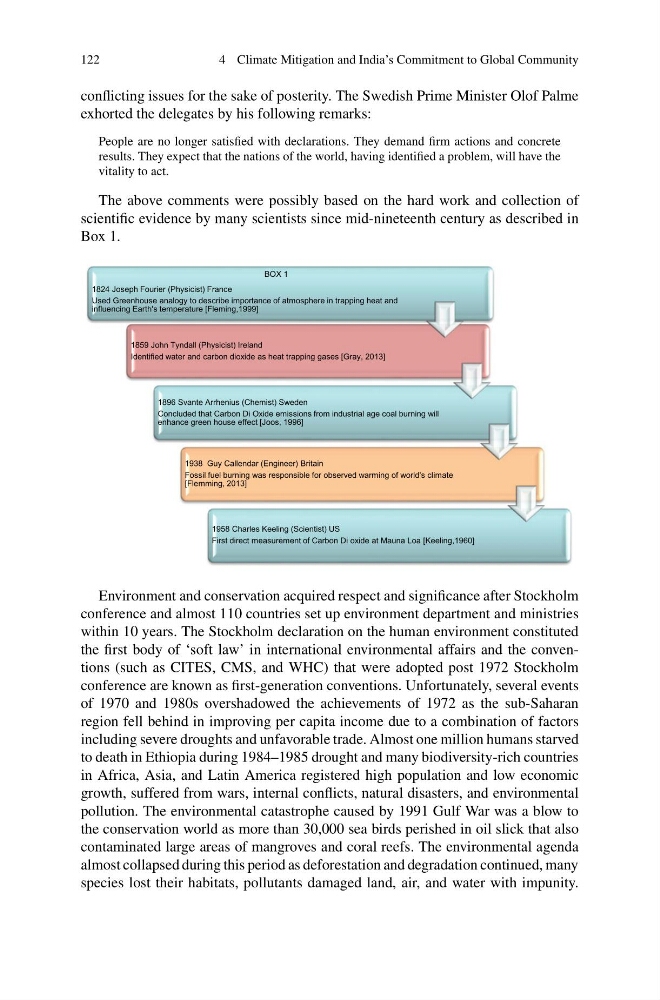
The above comments were possibly based on the hard work and collection of
scientific evidence by many scientists since mid-nineteenth century as described in
Box 1.
1824 Joseph Fourier (Physicist) France
BOX 1
Used Greenhouse analogy to describe importance of atmosphere in trapping heat and
influencing Earth's temperature [Fleming,1999]
1859 John Tyndall (Physicist) Ireland
Identified water and carbon dioxide as heat trapping gases [Gray, 2013]
1896 Svante Arrhenius (Chemist) Sweden
Concluded that Carbon Di Oxide emissions from industrial age coal burning will
enhance green house effect [Joos, 1996]
1938 Guy Callendar (Engineer) Britain
Fossil fuel burning was responsible for observed warming of world's climate
[Flemming, 2013]
1958 Charles Keeling (Scientist) US
First direct measurement of Carbon Di oxide at Mauna Loa [Keeling,1960]
Environment and conservation acquired respect and significance after Stockholm
conference and almost 110 countries set up environment department and ministries
within 10 years. The Stockholm declaration on the human environment constituted
the first body of ‘soft law’ in international environmental affairs and the conventions (such as CITES, CMS, and WHC) that were adopted post 1972 Stockholm
conference are known as first-generation conventions. Unfortunately, several events
of 1970 and 1980s overshadowed the achievements of 1972 as the sub-Saharan
region fell behind in improving per capita income due to a combination of factors
including severe droughts and unfavorable trade. Almost one million humans starved
to death in Ethiopia during 1984–1985 drought and many biodiversity-rich countries
in Africa, Asia, and Latin America registered high population and low economic
growth, suffered from wars, internal conflicts, natural disasters, and environmental
pollution. The environmental catastrophe caused by 1991 Gulf War was a blow to
the conservation world as more than 30,000 sea birds perished in oil slick that also
contaminated large areas of mangroves and coral reefs. The environmental agenda
almost collapsed during this period as deforestation and degradation continued, many
species lost their habitats, pollutants damaged land, air, and water with impunity.
4 Climate Mitigation and India’s Commitment to Global Community
conflicting issues for the sake of posterity. The Swedish Prime Minister Olof Palme
exhorted the delegates by his following remarks:
People are no longer satisfied with declarations. They demand firm actions and concrete
results. They expect that the nations of the world, having identified a problem, will have the
vitality to act.
The above comments were possibly based on the hard work and collection of
scientific evidence by many scientists since mid-nineteenth century as described in
Box 1.
1824 Joseph Fourier (Physicist) France
BOX 1
Used Greenhouse analogy to describe importance of atmosphere in trapping heat and
influencing Earth's temperature [Fleming,1999]
1859 John Tyndall (Physicist) Ireland
Identified water and carbon dioxide as heat trapping gases [Gray, 2013]
1896 Svante Arrhenius (Chemist) Sweden
Concluded that Carbon Di Oxide emissions from industrial age coal burning will
enhance green house effect [Joos, 1996]
1938 Guy Callendar (Engineer) Britain
Fossil fuel burning was responsible for observed warming of world's climate
[Flemming, 2013]
1958 Charles Keeling (Scientist) US
First direct measurement of Carbon Di oxide at Mauna Loa [Keeling,1960]
Environment and conservation acquired respect and significance after Stockholm
conference and almost 110 countries set up environment department and ministries
within 10 years. The Stockholm declaration on the human environment constituted
the first body of ‘soft law’ in international environmental affairs and the conventions (such as CITES, CMS, and WHC) that were adopted post 1972 Stockholm
conference are known as first-generation conventions. Unfortunately, several events
of 1970 and 1980s overshadowed the achievements of 1972 as the sub-Saharan
region fell behind in improving per capita income due to a combination of factors
including severe droughts and unfavorable trade. Almost one million humans starved
to death in Ethiopia during 1984–1985 drought and many biodiversity-rich countries
in Africa, Asia, and Latin America registered high population and low economic
growth, suffered from wars, internal conflicts, natural disasters, and environmental
pollution. The environmental catastrophe caused by 1991 Gulf War was a blow to
the conservation world as more than 30,000 sea birds perished in oil slick that also
contaminated large areas of mangroves and coral reefs. The environmental agenda
almost collapsed during this period as deforestation and degradation continued, many
species lost their habitats, pollutants damaged land, air, and water with impunity.