

4.1 Utilizing Electron Emission Current Measurement
73
Fig. 4.2 Fermi distribution
function as a function of
energy with the scale E/E F
at different temperatures,
where E F is the Fermi level
0.0
0.5
1.0
1.5
2.0
0.0
0.5
1.0
τ= 0
0.02
0.05
0.1
0.2
0.4
=
1
− 1 + 1
=
=
Fermi distribution
function
(a)
The electron current density J S is described by the Richardson–Dushman equation
(Eq. 4.2) [1], where φ is the work function, T is the temperature in Kelvin, k B is the
Boltzmann constant, m and e are the mass and charge of an electron, respectively,
and h is Planck’s constant.
J S = AT
2 exp
−
φ
k B T
A =
4π mek
2
B
h 3
(4.2)
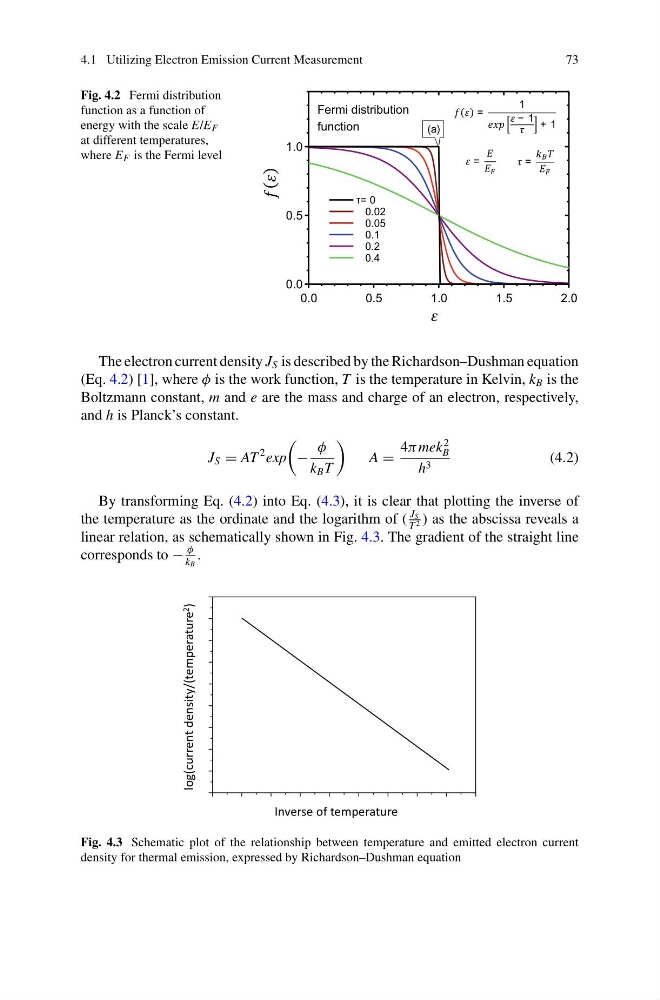
By transforming Eq. (4.2) into Eq. (4.3), it is clear that plotting the inverse of
the temperature as the ordinate and the logarithm of (
J S
T 2 ) as the abscissa reveals a
linear relation, as schematically shown in Fig. 4.3. The gradient of the straight line
corresponds to −
φ
k B
.
Inverse of temperature
log(current density/(temperature 2
)
Fig. 4.3 Schematic plot of the relationship between temperature and emitted electron current
density for thermal emission, expressed by Richardson–Dushman equation
73
Fig. 4.2 Fermi distribution
function as a function of
energy with the scale E/E F
at different temperatures,
where E F is the Fermi level
0.0
0.5
1.0
1.5
2.0
0.0
0.5
1.0
τ= 0
0.02
0.05
0.1
0.2
0.4
=
1
− 1 + 1
=
=
Fermi distribution
function
(a)
The electron current density J S is described by the Richardson–Dushman equation
(Eq. 4.2) [1], where φ is the work function, T is the temperature in Kelvin, k B is the
Boltzmann constant, m and e are the mass and charge of an electron, respectively,
and h is Planck’s constant.
J S = AT
2 exp
−
φ
k B T
A =
4π mek
2
B
h 3
(4.2)
By transforming Eq. (4.2) into Eq. (4.3), it is clear that plotting the inverse of
the temperature as the ordinate and the logarithm of (
J S
T 2 ) as the abscissa reveals a
linear relation, as schematically shown in Fig. 4.3. The gradient of the straight line
corresponds to −
φ
k B
.
Inverse of temperature
log(current density/(temperature 2
)
Fig. 4.3 Schematic plot of the relationship between temperature and emitted electron current
density for thermal emission, expressed by Richardson–Dushman equation