

42
3 Modification of the Work Function
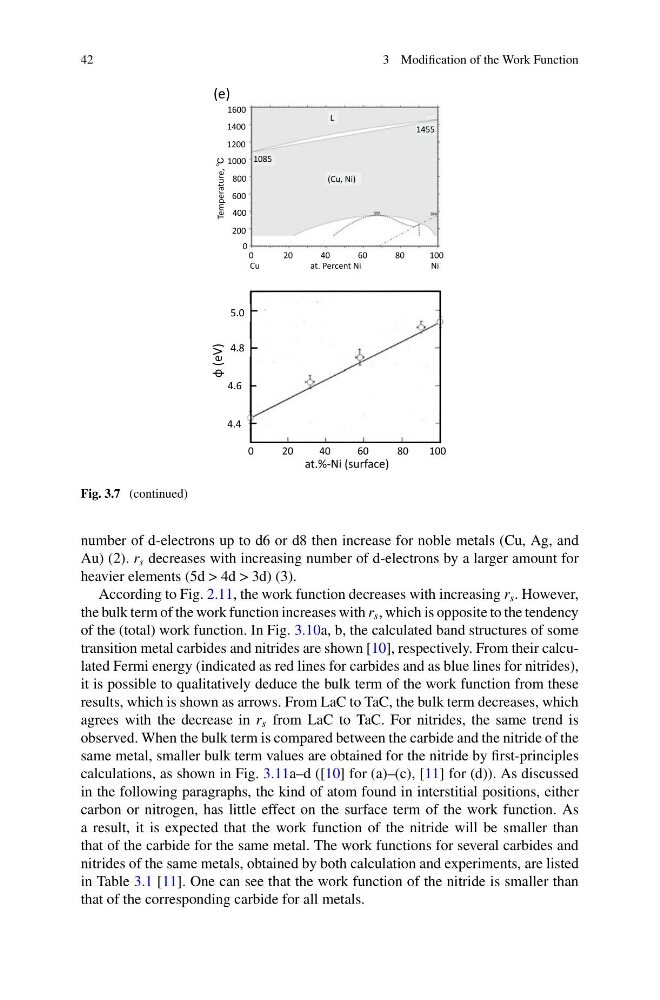
(e)
Fig. 3.7 (continued)
number of d-electrons up to d6 or d8 then increase for noble metals (Cu, Ag, and
Au) (2). r s decreases with increasing number of d-electrons by a larger amount for
heavier elements (5d > 4d > 3d) (3).
According to Fig. 2.11, the work function decreases with increasing r s . However,
the bulk term of the work function increases with r s , which is opposite to the tendency
of the (total) work function. In Fig. 3.10a, b, the calculated band structures of some
transition metal carbides and nitrides are shown [10], respectively. From their calculated Fermi energy (indicated as red lines for carbides and as blue lines for nitrides),
it is possible to qualitatively deduce the bulk term of the work function from these
results, which is shown as arrows. From LaC to TaC, the bulk term decreases, which
agrees with the decrease in r s from LaC to TaC. For nitrides, the same trend is
observed. When the bulk term is compared between the carbide and the nitride of the
same metal, smaller bulk term values are obtained for the nitride by first-principles
calculations, as shown in Fig. 3.11a–d ([10] for (a)–(c), [11] for (d)). As discussed
in the following paragraphs, the kind of atom found in interstitial positions, either
carbon or nitrogen, has little effect on the surface term of the work function. As
a result, it is expected that the work function of the nitride will be smaller than
that of the carbide for the same metal. The work functions for several carbides and
nitrides of the same metals, obtained by both calculation and experiments, are listed
in Table 3.1 [11]. One can see that the work function of the nitride is smaller than
that of the corresponding carbide for all metals.
3 Modification of the Work Function
(e)
Fig. 3.7 (continued)
number of d-electrons up to d6 or d8 then increase for noble metals (Cu, Ag, and
Au) (2). r s decreases with increasing number of d-electrons by a larger amount for
heavier elements (5d > 4d > 3d) (3).
According to Fig. 2.11, the work function decreases with increasing r s . However,
the bulk term of the work function increases with r s , which is opposite to the tendency
of the (total) work function. In Fig. 3.10a, b, the calculated band structures of some
transition metal carbides and nitrides are shown [10], respectively. From their calculated Fermi energy (indicated as red lines for carbides and as blue lines for nitrides),
it is possible to qualitatively deduce the bulk term of the work function from these
results, which is shown as arrows. From LaC to TaC, the bulk term decreases, which
agrees with the decrease in r s from LaC to TaC. For nitrides, the same trend is
observed. When the bulk term is compared between the carbide and the nitride of the
same metal, smaller bulk term values are obtained for the nitride by first-principles
calculations, as shown in Fig. 3.11a–d ([10] for (a)–(c), [11] for (d)). As discussed
in the following paragraphs, the kind of atom found in interstitial positions, either
carbon or nitrogen, has little effect on the surface term of the work function. As
a result, it is expected that the work function of the nitride will be smaller than
that of the carbide for the same metal. The work functions for several carbides and
nitrides of the same metals, obtained by both calculation and experiments, are listed
in Table 3.1 [11]. One can see that the work function of the nitride is smaller than
that of the corresponding carbide for all metals.