

3.1 Mixing Elements
41
(c)
(d)
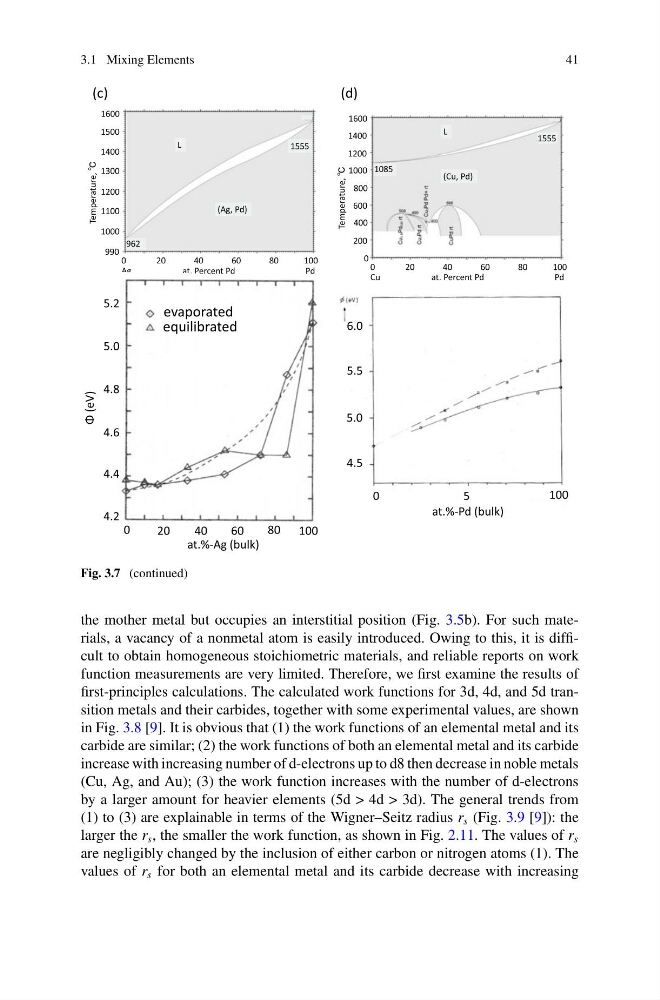
Fig. 3.7 (continued)
the mother metal but occupies an interstitial position (Fig. 3.5b). For such materials, a vacancy of a nonmetal atom is easily introduced. Owing to this, it is difficult to obtain homogeneous stoichiometric materials, and reliable reports on work
function measurements are very limited. Therefore, we first examine the results of
first-principles calculations. The calculated work functions for 3d, 4d, and 5d transition metals and their carbides, together with some experimental values, are shown
in Fig. 3.8 [9]. It is obvious that (1) the work functions of an elemental metal and its
carbide are similar; (2) the work functions of both an elemental metal and its carbide
increase with increasing number of d-electrons up to d8 then decrease in noble metals
(Cu, Ag, and Au); (3) the work function increases with the number of d-electrons
by a larger amount for heavier elements (5d > 4d > 3d). The general trends from
(1) to (3) are explainable in terms of the Wigner–Seitz radius r s (Fig. 3.9 [9]): the
larger the r s , the smaller the work function, as shown in Fig. 2.11. The values of r s
are negligibly changed by the inclusion of either carbon or nitrogen atoms (1). The
values of r s for both an elemental metal and its carbide decrease with increasing
41
(c)
(d)
Fig. 3.7 (continued)
the mother metal but occupies an interstitial position (Fig. 3.5b). For such materials, a vacancy of a nonmetal atom is easily introduced. Owing to this, it is difficult to obtain homogeneous stoichiometric materials, and reliable reports on work
function measurements are very limited. Therefore, we first examine the results of
first-principles calculations. The calculated work functions for 3d, 4d, and 5d transition metals and their carbides, together with some experimental values, are shown
in Fig. 3.8 [9]. It is obvious that (1) the work functions of an elemental metal and its
carbide are similar; (2) the work functions of both an elemental metal and its carbide
increase with increasing number of d-electrons up to d8 then decrease in noble metals
(Cu, Ag, and Au); (3) the work function increases with the number of d-electrons
by a larger amount for heavier elements (5d > 4d > 3d). The general trends from
(1) to (3) are explainable in terms of the Wigner–Seitz radius r s (Fig. 3.9 [9]): the
larger the r s , the smaller the work function, as shown in Fig. 2.11. The values of r s
are negligibly changed by the inclusion of either carbon or nitrogen atoms (1). The
values of r s for both an elemental metal and its carbide decrease with increasing