

2.3 Factors Determining the Work Function
19
(a) Cross sec of loosely
packed (low-atomic-density)
plane
vacuum
Electrons
are
aracted between
nuclei
Atomic nuclei
Electron
cloud
(b) Cross secon of closely
packed (high-atomic-density)
plane
Almost no level out
vacuum
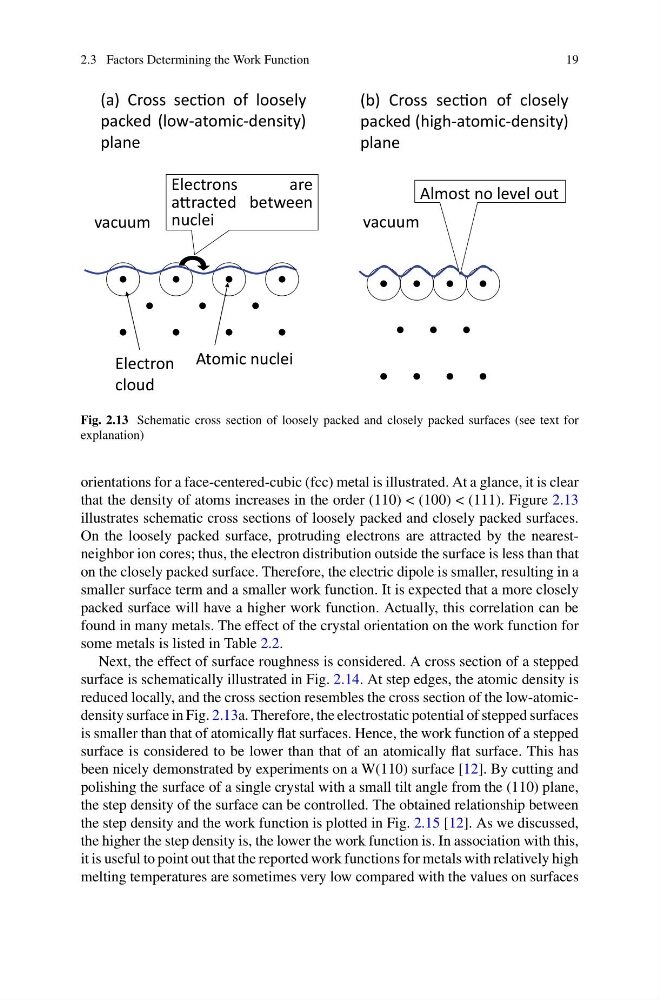
Fig. 2.13 Schematic cross section of loosely packed and closely packed surfaces (see text for
explanation)
orientations for a face-centered-cubic (fcc) metal is illustrated. At a glance, it is clear
that the density of atoms increases in the order (110) < (100) < (111). Figure 2.13
illustrates schematic cross sections of loosely packed and closely packed surfaces.
On the loosely packed surface, protruding electrons are attracted by the nearestneighbor ion cores; thus, the electron distribution outside the surface is less than that
on the closely packed surface. Therefore, the electric dipole is smaller, resulting in a
smaller surface term and a smaller work function. It is expected that a more closely
packed surface will have a higher work function. Actually, this correlation can be
found in many metals. The effect of the crystal orientation on the work function for
some metals is listed in Table 2.2.
Next, the effect of surface roughness is considered. A cross section of a stepped
surface is schematically illustrated in Fig. 2.14. At step edges, the atomic density is
reduced locally, and the cross section resembles the cross section of the low-atomicdensity surface in Fig. 2.13a. Therefore, the electrostatic potential of stepped surfaces
is smaller than that of atomically flat surfaces. Hence, the work function of a stepped
surface is considered to be lower than that of an atomically flat surface. This has
been nicely demonstrated by experiments on a W(110) surface [12]. By cutting and
polishing the surface of a single crystal with a small tilt angle from the (110) plane,
the step density of the surface can be controlled. The obtained relationship between
the step density and the work function is plotted in Fig. 2.15 [12]. As we discussed,
the higher the step density is, the lower the work function is. In association with this,
it is useful to point out that the reported work functions for metals with relatively high
melting temperatures are sometimes very low compared with the values on surfaces
19
(a) Cross sec of loosely
packed (low-atomic-density)
plane
vacuum
Electrons
are
aracted between
nuclei
Atomic nuclei
Electron
cloud
(b) Cross secon of closely
packed (high-atomic-density)
plane
Almost no level out
vacuum
Fig. 2.13 Schematic cross section of loosely packed and closely packed surfaces (see text for
explanation)
orientations for a face-centered-cubic (fcc) metal is illustrated. At a glance, it is clear
that the density of atoms increases in the order (110) < (100) < (111). Figure 2.13
illustrates schematic cross sections of loosely packed and closely packed surfaces.
On the loosely packed surface, protruding electrons are attracted by the nearestneighbor ion cores; thus, the electron distribution outside the surface is less than that
on the closely packed surface. Therefore, the electric dipole is smaller, resulting in a
smaller surface term and a smaller work function. It is expected that a more closely
packed surface will have a higher work function. Actually, this correlation can be
found in many metals. The effect of the crystal orientation on the work function for
some metals is listed in Table 2.2.
Next, the effect of surface roughness is considered. A cross section of a stepped
surface is schematically illustrated in Fig. 2.14. At step edges, the atomic density is
reduced locally, and the cross section resembles the cross section of the low-atomicdensity surface in Fig. 2.13a. Therefore, the electrostatic potential of stepped surfaces
is smaller than that of atomically flat surfaces. Hence, the work function of a stepped
surface is considered to be lower than that of an atomically flat surface. This has
been nicely demonstrated by experiments on a W(110) surface [12]. By cutting and
polishing the surface of a single crystal with a small tilt angle from the (110) plane,
the step density of the surface can be controlled. The obtained relationship between
the step density and the work function is plotted in Fig. 2.15 [12]. As we discussed,
the higher the step density is, the lower the work function is. In association with this,
it is useful to point out that the reported work functions for metals with relatively high
melting temperatures are sometimes very low compared with the values on surfaces