

18
2 What is the Work Function?: Definition and Factors …
2.0
2.5
3.0
3.5
4.0
4.5
5.0
-3
-2
-1
0
1
2
3
4
5
6
7
Au
Pt W Ta Hf
Lanthanoides
K
Na
Li
Mg
Pb
Zn
Al
potenƟal (eV)
Wigner-Seitz radius (Bohr unit)
work funcƟon
bulk-term
surface-term
bulk term
surface term
Lanthanoids
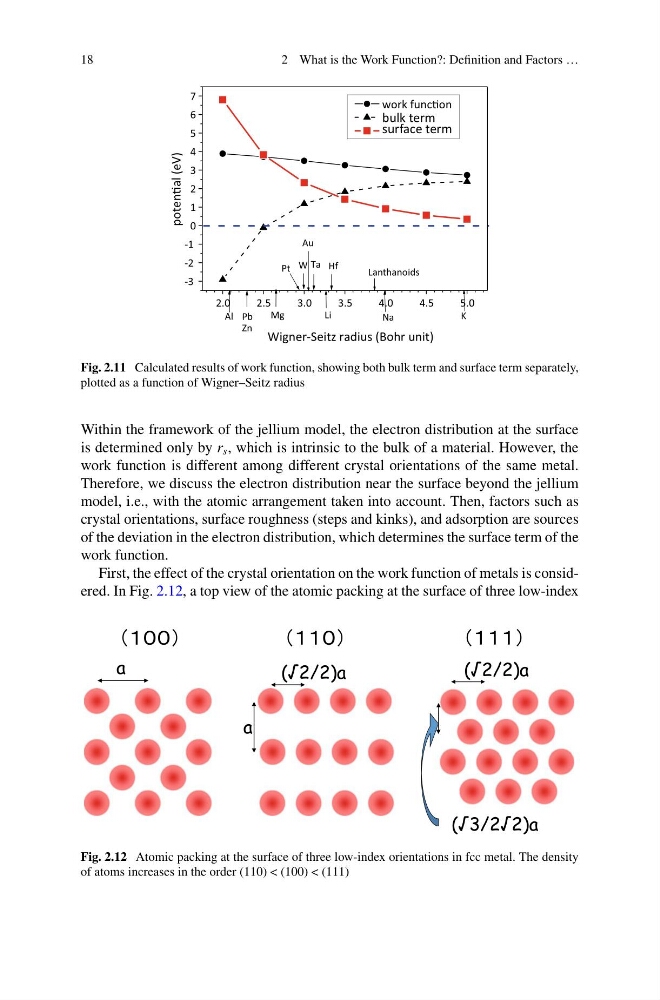
Fig. 2.11 Calculated results of work function, showing both bulk term and surface term separately,
plotted as a function of Wigner–Seitz radius
Within the framework of the jellium model, the electron distribution at the surface
is determined only by r s , which is intrinsic to the bulk of a material. However, the
work function is different among different crystal orientations of the same metal.
Therefore, we discuss the electron distribution near the surface beyond the jellium
model, i.e., with the atomic arrangement taken into account. Then, factors such as
crystal orientations, surface roughness (steps and kinks), and adsorption are sources
of the deviation in the electron distribution, which determines the surface term of the
work function.
First, the effect of the crystal orientation on the work function of metals is considered. In Fig. 2.12, a top view of the atomic packing at the surface of three low-index
Fig. 2.12 Atomic packing at the surface of three low-index orientations in fcc metal. The density
of atoms increases in the order (110) < (100) < (111)
2 What is the Work Function?: Definition and Factors …
2.0
2.5
3.0
3.5
4.0
4.5
5.0
-3
-2
-1
0
1
2
3
4
5
6
7
Au
Pt W Ta Hf
Lanthanoides
K
Na
Li
Mg
Pb
Zn
Al
potenƟal (eV)
Wigner-Seitz radius (Bohr unit)
work funcƟon
bulk-term
surface-term
bulk term
surface term
Lanthanoids
Fig. 2.11 Calculated results of work function, showing both bulk term and surface term separately,
plotted as a function of Wigner–Seitz radius
Within the framework of the jellium model, the electron distribution at the surface
is determined only by r s , which is intrinsic to the bulk of a material. However, the
work function is different among different crystal orientations of the same metal.
Therefore, we discuss the electron distribution near the surface beyond the jellium
model, i.e., with the atomic arrangement taken into account. Then, factors such as
crystal orientations, surface roughness (steps and kinks), and adsorption are sources
of the deviation in the electron distribution, which determines the surface term of the
work function.
First, the effect of the crystal orientation on the work function of metals is considered. In Fig. 2.12, a top view of the atomic packing at the surface of three low-index
Fig. 2.12 Atomic packing at the surface of three low-index orientations in fcc metal. The density
of atoms increases in the order (110) < (100) < (111)