

8
2 What is the Work Function?: Definition and Factors …
e -
> 10 3 nm
e -
atomic distance: a
a << d(> 10 3 nm) << L
large area
L >> d
a)
b)
c)
(local work func
e -
a
d ≈ a
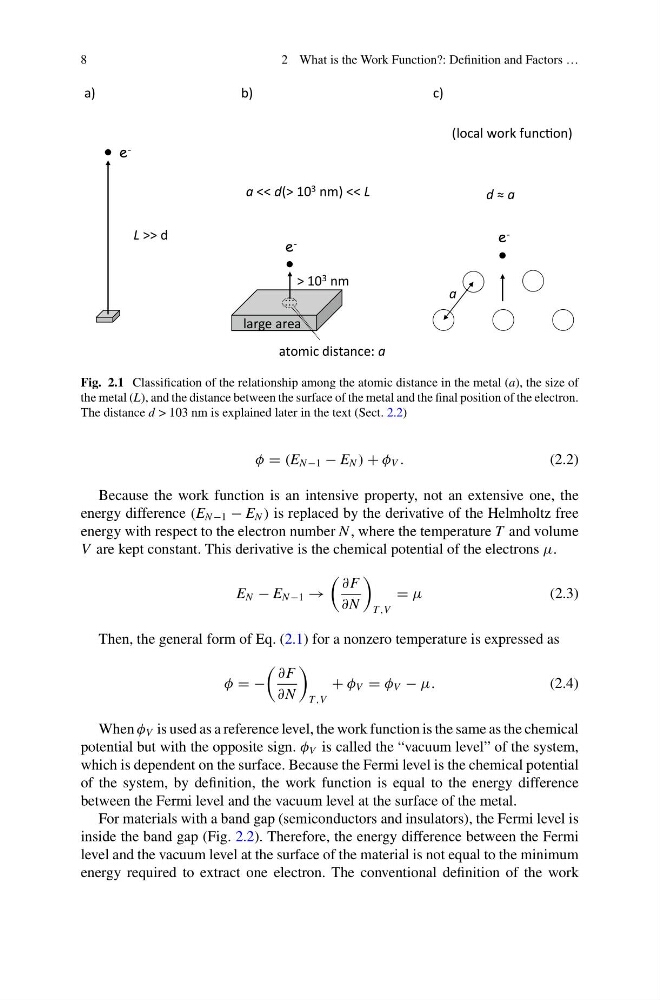
Fig. 2.1 Classification of the relationship among the atomic distance in the metal (a), the size of
the metal (L), and the distance between the surface of the metal and the final position of the electron.
The distance d > 103 nm is explained later in the text (Sect. 2.2)
φ = (E N −1 − E N ) + φ V .
(2.2)
Because the work function is an intensive property, not an extensive one, the
energy difference (E N −1 − E N ) is replaced by the derivative of the Helmholtz free
energy with respect to the electron number N , where the temperature T and volume
V are kept constant. This derivative is the chemical potential of the electrons μ.
E N − E N −1 →
∂F
∂N
T ,V
= μ
(2.3)
Then, the general form of Eq. (2.1) for a nonzero temperature is expressed as
φ = −
∂F
∂N
T ,V
+ φ V = φ V − μ.
(2.4)
When φ V is used as a reference level, the work function is the same as the chemical
potential but with the opposite sign. φ V is called the “vacuum level” of the system,
which is dependent on the surface. Because the Fermi level is the chemical potential
of the system, by definition, the work function is equal to the energy difference
between the Fermi level and the vacuum level at the surface of the metal.
For materials with a band gap (semiconductors and insulators), the Fermi level is
inside the band gap (Fig. 2.2). Therefore, the energy difference between the Fermi
level and the vacuum level at the surface of the material is not equal to the minimum
energy required to extract one electron. The conventional definition of the work
2 What is the Work Function?: Definition and Factors …
e -
> 10 3 nm
e -
atomic distance: a
a << d(> 10 3 nm) << L
large area
L >> d
a)
b)
c)
(local work func
e -
a
d ≈ a
Fig. 2.1 Classification of the relationship among the atomic distance in the metal (a), the size of
the metal (L), and the distance between the surface of the metal and the final position of the electron.
The distance d > 103 nm is explained later in the text (Sect. 2.2)
φ = (E N −1 − E N ) + φ V .
(2.2)
Because the work function is an intensive property, not an extensive one, the
energy difference (E N −1 − E N ) is replaced by the derivative of the Helmholtz free
energy with respect to the electron number N , where the temperature T and volume
V are kept constant. This derivative is the chemical potential of the electrons μ.
E N − E N −1 →
∂F
∂N
T ,V
= μ
(2.3)
Then, the general form of Eq. (2.1) for a nonzero temperature is expressed as
φ = −
∂F
∂N
T ,V
+ φ V = φ V − μ.
(2.4)
When φ V is used as a reference level, the work function is the same as the chemical
potential but with the opposite sign. φ V is called the “vacuum level” of the system,
which is dependent on the surface. Because the Fermi level is the chemical potential
of the system, by definition, the work function is equal to the energy difference
between the Fermi level and the vacuum level at the surface of the metal.
For materials with a band gap (semiconductors and insulators), the Fermi level is
inside the band gap (Fig. 2.2). Therefore, the energy difference between the Fermi
level and the vacuum level at the surface of the material is not equal to the minimum
energy required to extract one electron. The conventional definition of the work