

7.2 Insertion of a 1-ML-Thick Material
135
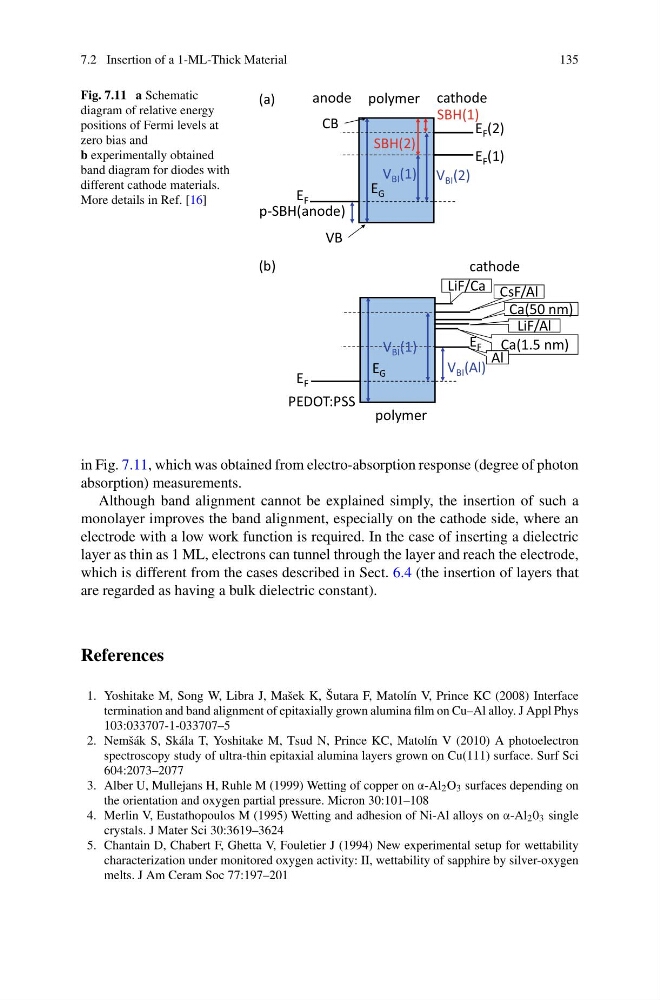
Fig. 7.11 a Schematic
diagram of relative energy
positions of Fermi levels at
zero bias and
b experimentally obtained
band diagram for diodes with
different cathode materials.
More details in Ref. [16]
anode
p-SBH(anode)
polymer cathode
E F (2)
E F (1)
(a)
(b)
E G
SBH(1)
SBH(2)
V BI (2)
V BI (1)
E F
E G
V BI (Al)
V BI (1)
E F
PEDOT:PSS
polymer
LiF/Ca CsF/Al
Ca(50 nm)
LiF/Al
Ca(1.5 nm)
Al
cathode
E F
VB
CB
in Fig. 7.11, which was obtained from electro-absorption response (degree of photon
absorption) measurements.
Although band alignment cannot be explained simply, the insertion of such a
monolayer improves the band alignment, especially on the cathode side, where an
electrode with a low work function is required. In the case of inserting a dielectric
layer as thin as 1 ML, electrons can tunnel through the layer and reach the electrode,
which is different from the cases described in Sect. 6.4 (the insertion of layers that
are regarded as having a bulk dielectric constant).
References
1. Yoshitake M, Song W, Libra J, Mašek K, Šutara F, Matolín V, Prince KC (2008) Interface
termination and band alignment of epitaxially grown alumina film on Cu–Al alloy. J Appl Phys
103:033707-1-033707–5
2. Nemšák S, Skála T, Yoshitake M, Tsud N, Prince KC, Matolín V (2010) A photoelectron
spectroscopy study of ultra-thin epitaxial alumina layers grown on Cu(111) surface. Surf Sci
604:2073–2077
3. Alber U, Mullejans H, Ruhle M (1999) Wetting of copper on α-Al 2 O 3 surfaces depending on
the orientation and oxygen partial pressure. Micron 30:101–108
4. Merlin V, Eustathopoulos M (1995) Wetting and adhesion of Ni-Al alloys on α-Al 2 0 3 single
crystals. J Mater Sci 30:3619–3624
5. Chantain D, Chabert F, Ghetta V, Fouletier J (1994) New experimental setup for wettability
characterization under monitored oxygen activity: II, wettability of sapphire by silver-oxygen
melts. J Am Ceram Soc 77:197–201
135
Fig. 7.11 a Schematic
diagram of relative energy
positions of Fermi levels at
zero bias and
b experimentally obtained
band diagram for diodes with
different cathode materials.
More details in Ref. [16]
anode
p-SBH(anode)
polymer cathode
E F (2)
E F (1)
(a)
(b)
E G
SBH(1)
SBH(2)
V BI (2)
V BI (1)
E F
E G
V BI (Al)
V BI (1)
E F
PEDOT:PSS
polymer
LiF/Ca CsF/Al
Ca(50 nm)
LiF/Al
Ca(1.5 nm)
Al
cathode
E F
VB
CB
in Fig. 7.11, which was obtained from electro-absorption response (degree of photon
absorption) measurements.
Although band alignment cannot be explained simply, the insertion of such a
monolayer improves the band alignment, especially on the cathode side, where an
electrode with a low work function is required. In the case of inserting a dielectric
layer as thin as 1 ML, electrons can tunnel through the layer and reach the electrode,
which is different from the cases described in Sect. 6.4 (the insertion of layers that
are regarded as having a bulk dielectric constant).
References
1. Yoshitake M, Song W, Libra J, Mašek K, Šutara F, Matolín V, Prince KC (2008) Interface
termination and band alignment of epitaxially grown alumina film on Cu–Al alloy. J Appl Phys
103:033707-1-033707–5
2. Nemšák S, Skála T, Yoshitake M, Tsud N, Prince KC, Matolín V (2010) A photoelectron
spectroscopy study of ultra-thin epitaxial alumina layers grown on Cu(111) surface. Surf Sci
604:2073–2077
3. Alber U, Mullejans H, Ruhle M (1999) Wetting of copper on α-Al 2 O 3 surfaces depending on
the orientation and oxygen partial pressure. Micron 30:101–108
4. Merlin V, Eustathopoulos M (1995) Wetting and adhesion of Ni-Al alloys on α-Al 2 0 3 single
crystals. J Mater Sci 30:3619–3624
5. Chantain D, Chabert F, Ghetta V, Fouletier J (1994) New experimental setup for wettability
characterization under monitored oxygen activity: II, wettability of sapphire by silver-oxygen
melts. J Am Ceram Soc 77:197–201