

6.3 Charge Neutrality Level (CNL) and S Parameter
121
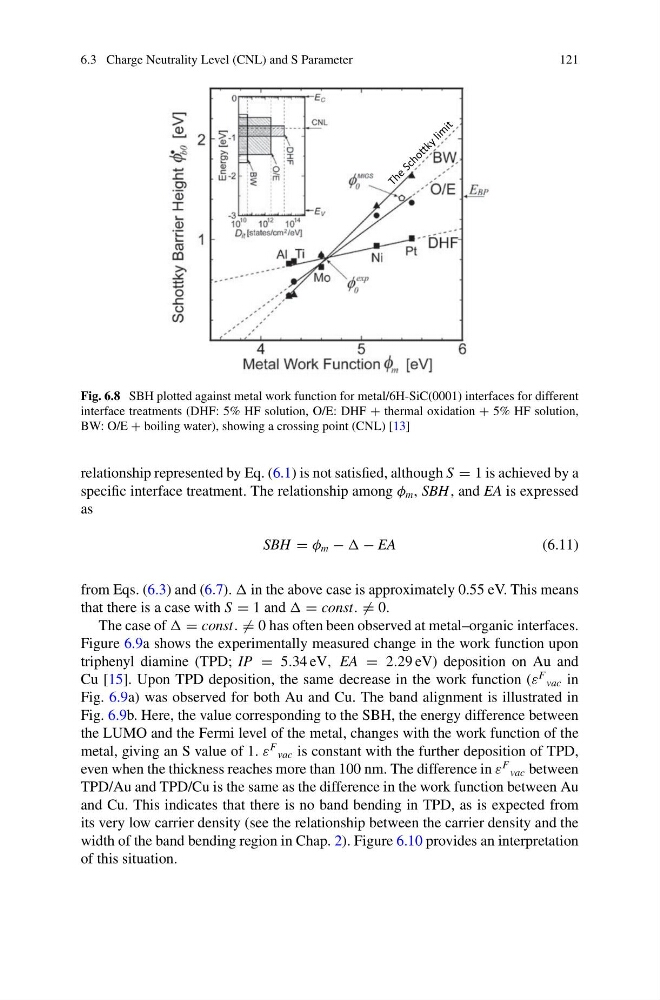
Fig. 6.8 SBH plotted against metal work function for metal/6H-SiC(0001) interfaces for different
interface treatments (DHF: 5% HF solution, O/E: DHF + thermal oxidation + 5% HF solution,
BW: O/E + boiling water), showing a crossing point (CNL) [13]
relationship represented by Eq. (6.1) is not satisfied, although S = 1 is achieved by a
specific interface treatment. The relationship among φ m , SBH , and EA is expressed
as
SBH = φ m − − EA
(6.11)
from Eqs. (6.3) and (6.7). in the above case is approximately 0.55 eV. This means
that there is a case with S = 1 and = const. = 0.
The case of = const. = 0 has often been observed at metal–organic interfaces.
Figure 6.9a shows the experimentally measured change in the work function upon
triphenyl diamine (TPD; IP = 5.34 eV, EA = 2.29 eV) deposition on Au and
Cu [15]. Upon TPD deposition, the same decrease in the work function (ε
F
vac in
Fig. 6.9a) was observed for both Au and Cu. The band alignment is illustrated in
Fig. 6.9b. Here, the value corresponding to the SBH, the energy difference between
the LUMO and the Fermi level of the metal, changes with the work function of the
metal, giving an S value of 1. ε
F
vac is constant with the further deposition of TPD,
even when the thickness reaches more than 100 nm. The difference in ε
F
vac between
TPD/Au and TPD/Cu is the same as the difference in the work function between Au
and Cu. This indicates that there is no band bending in TPD, as is expected from
its very low carrier density (see the relationship between the carrier density and the
width of the band bending region in Chap. 2). Figure 6.10 provides an interpretation
of this situation.
121
Fig. 6.8 SBH plotted against metal work function for metal/6H-SiC(0001) interfaces for different
interface treatments (DHF: 5% HF solution, O/E: DHF + thermal oxidation + 5% HF solution,
BW: O/E + boiling water), showing a crossing point (CNL) [13]
relationship represented by Eq. (6.1) is not satisfied, although S = 1 is achieved by a
specific interface treatment. The relationship among φ m , SBH , and EA is expressed
as
SBH = φ m − − EA
(6.11)
from Eqs. (6.3) and (6.7). in the above case is approximately 0.55 eV. This means
that there is a case with S = 1 and = const. = 0.
The case of = const. = 0 has often been observed at metal–organic interfaces.
Figure 6.9a shows the experimentally measured change in the work function upon
triphenyl diamine (TPD; IP = 5.34 eV, EA = 2.29 eV) deposition on Au and
Cu [15]. Upon TPD deposition, the same decrease in the work function (ε
F
vac in
Fig. 6.9a) was observed for both Au and Cu. The band alignment is illustrated in
Fig. 6.9b. Here, the value corresponding to the SBH, the energy difference between
the LUMO and the Fermi level of the metal, changes with the work function of the
metal, giving an S value of 1. ε
F
vac is constant with the further deposition of TPD,
even when the thickness reaches more than 100 nm. The difference in ε
F
vac between
TPD/Au and TPD/Cu is the same as the difference in the work function between Au
and Cu. This indicates that there is no band bending in TPD, as is expected from
its very low carrier density (see the relationship between the carrier density and the
width of the band bending region in Chap. 2). Figure 6.10 provides an interpretation
of this situation.