

204
A. Fainsod et al.
exhibit a partial set of the FAS characteristic features, sometimes in a milder form.
ARND is a form of the disorder that includes central nervous system neurodevelopmental malformations and/or a complex pattern of behavioral or cognitive abnormalities. Individuals with ARBD exhibit one or more congenital anomalies that can
include: craniofacial, cardiac, skeletal, and ocular congenital malformations.
Current State of the Field
A Connection Between Ethanol and Retinol Metabolism
Recent evidence links the induction of FASD to reduced RA signaling during embryogenesis (Duester 1991; Pullarkat 1991; Shabtai et al. 2018; Shabtai and Fainsod
2018). Indeed, experimental evidence supports the idea that alcohol exposure alters
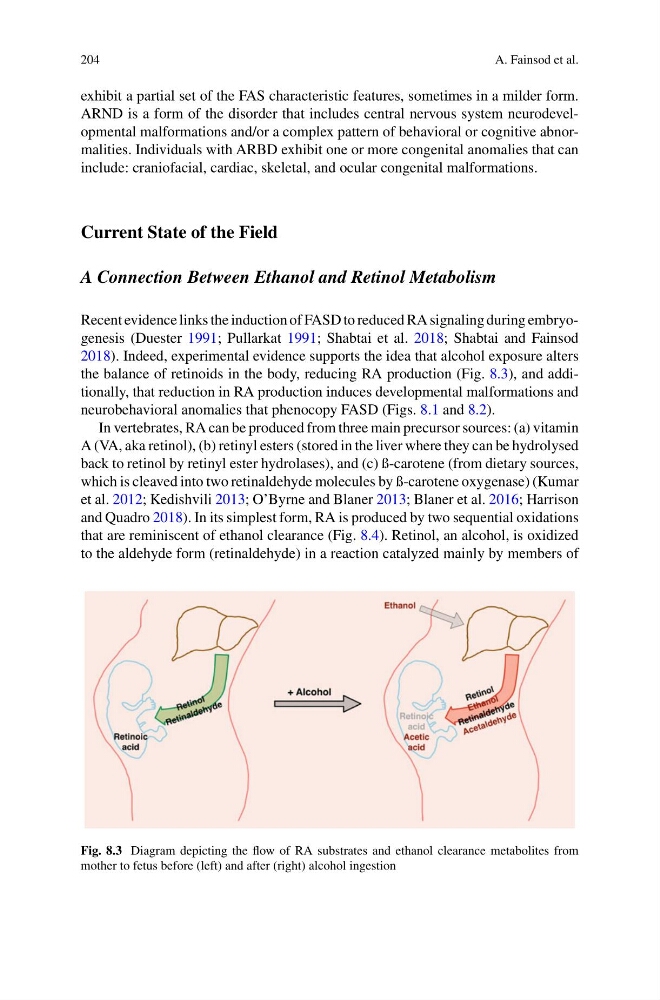
the balance of retinoids in the body, reducing RA production (Fig. 8.3), and additionally, that reduction in RA production induces developmental malformations and
neurobehavioral anomalies that phenocopy FASD (Figs. 8.1 and 8.2).
In vertebrates, RA can be produced from three main precursor sources: (a) vitamin
A (VA, aka retinol), (b) retinyl esters (stored in the liver where they can be hydrolysed
back to retinol by retinyl ester hydrolases), and (c) ß-carotene (from dietary sources,
which is cleaved into two retinaldehyde molecules by ß-carotene oxygenase) (Kumar
et al. 2012; Kedishvili 2013; O’Byrne and Blaner 2013; Blaner et al. 2016; Harrison
and Quadro 2018). In its simplest form, RA is produced by two sequential oxidations
that are reminiscent of ethanol clearance (Fig. 8.4). Retinol, an alcohol, is oxidized
to the aldehyde form (retinaldehyde) in a reaction catalyzed mainly by members of
Fig. 8.3 Diagram depicting the flow of RA substrates and ethanol clearance metabolites from
mother to fetus before (left) and after (right) alcohol ingestion
A. Fainsod et al.
exhibit a partial set of the FAS characteristic features, sometimes in a milder form.
ARND is a form of the disorder that includes central nervous system neurodevelopmental malformations and/or a complex pattern of behavioral or cognitive abnormalities. Individuals with ARBD exhibit one or more congenital anomalies that can
include: craniofacial, cardiac, skeletal, and ocular congenital malformations.
Current State of the Field
A Connection Between Ethanol and Retinol Metabolism
Recent evidence links the induction of FASD to reduced RA signaling during embryogenesis (Duester 1991; Pullarkat 1991; Shabtai et al. 2018; Shabtai and Fainsod
2018). Indeed, experimental evidence supports the idea that alcohol exposure alters
the balance of retinoids in the body, reducing RA production (Fig. 8.3), and additionally, that reduction in RA production induces developmental malformations and
neurobehavioral anomalies that phenocopy FASD (Figs. 8.1 and 8.2).
In vertebrates, RA can be produced from three main precursor sources: (a) vitamin
A (VA, aka retinol), (b) retinyl esters (stored in the liver where they can be hydrolysed
back to retinol by retinyl ester hydrolases), and (c) ß-carotene (from dietary sources,
which is cleaved into two retinaldehyde molecules by ß-carotene oxygenase) (Kumar
et al. 2012; Kedishvili 2013; O’Byrne and Blaner 2013; Blaner et al. 2016; Harrison
and Quadro 2018). In its simplest form, RA is produced by two sequential oxidations
that are reminiscent of ethanol clearance (Fig. 8.4). Retinol, an alcohol, is oxidized
to the aldehyde form (retinaldehyde) in a reaction catalyzed mainly by members of
Fig. 8.3 Diagram depicting the flow of RA substrates and ethanol clearance metabolites from
mother to fetus before (left) and after (right) alcohol ingestion