

56
M. Hiramoto
length of H 2 Pc (4.6 and 5.0 nm) were observed irrespective of the C 60 /H 2 Pc and
Me-PTC/H 2 Pc systems.
In Fig. 3.10a, when the layer width became as narrow as x = 2.5 nm, the quantum
efficiency decreased. When the film was less than 2.5 nm thick, each layer had not
completely formed as a single sheet, and the probability of growth remaining as island
regions became higher. Such spatial incompleteness of the extraction route decreased
the efficiency of transporting the electrons and holes without recombination over a
distance of 2 μm to each electrode.
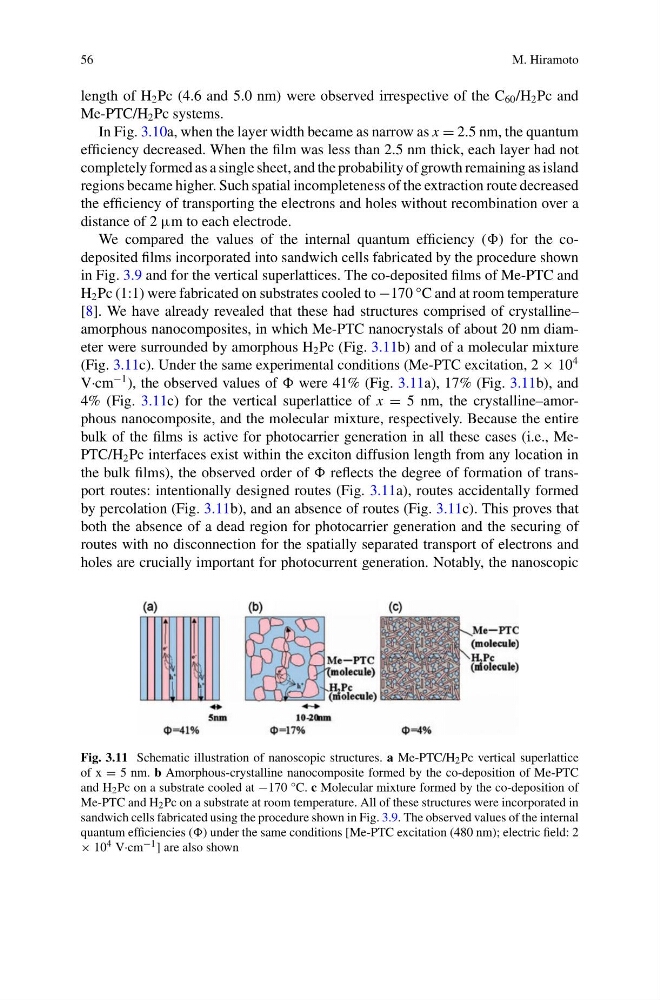
We compared the values of the internal quantum efficiency () for the codeposited films incorporated into sandwich cells fabricated by the procedure shown
in Fig. 3.9 and for the vertical superlattices. The co-deposited films of Me-PTC and
H 2 Pc (1:1) were fabricated on substrates cooled to −170 °C and at room temperature
[8]. We have already revealed that these had structures comprised of crystalline–
amorphous nanocomposites, in which Me-PTC nanocrystals of about 20 nm diameter were surrounded by amorphous H 2 Pc (Fig. 3.11b) and of a molecular mixture
(Fig. 3.11c). Under the same experimental conditions (Me-PTC excitation, 2 × 10
4
V·cm
−1 ), the observed values of were 41% (Fig. 3.11a), 17% (Fig. 3.11b), and
4% (Fig. 3.11c) for the vertical superlattice of x = 5 nm, the crystalline–amorphous nanocomposite, and the molecular mixture, respectively. Because the entire
bulk of the films is active for photocarrier generation in all these cases (i.e., MePTC/H 2 Pc interfaces exist within the exciton diffusion length from any location in
the bulk films), the observed order of reflects the degree of formation of transport routes: intentionally designed routes (Fig. 3.11a), routes accidentally formed
by percolation (Fig. 3.11b), and an absence of routes (Fig. 3.11c). This proves that
both the absence of a dead region for photocarrier generation and the securing of
routes with no disconnection for the spatially separated transport of electrons and
holes are crucially important for photocurrent generation. Notably, the nanoscopic
Fig. 3.11 Schematic illustration of nanoscopic structures. a Me-PTC/H 2 Pc vertical superlattice
of x = 5 nm. b Amorphous-crystalline nanocomposite formed by the co-deposition of Me-PTC
and H 2 Pc on a substrate cooled at −170 °C. c Molecular mixture formed by the co-deposition of
Me-PTC and H 2 Pc on a substrate at room temperature. All of these structures were incorporated in
sandwich cells fabricated using the procedure shown in Fig. 3.9. The observed values of the internal
quantum efficiencies () under the same conditions [Me-PTC excitation (480 nm); electric field: 2
× 10 4 V·cm −1 ] are also shown
M. Hiramoto
length of H 2 Pc (4.6 and 5.0 nm) were observed irrespective of the C 60 /H 2 Pc and
Me-PTC/H 2 Pc systems.
In Fig. 3.10a, when the layer width became as narrow as x = 2.5 nm, the quantum
efficiency decreased. When the film was less than 2.5 nm thick, each layer had not
completely formed as a single sheet, and the probability of growth remaining as island
regions became higher. Such spatial incompleteness of the extraction route decreased
the efficiency of transporting the electrons and holes without recombination over a
distance of 2 μm to each electrode.
We compared the values of the internal quantum efficiency () for the codeposited films incorporated into sandwich cells fabricated by the procedure shown
in Fig. 3.9 and for the vertical superlattices. The co-deposited films of Me-PTC and
H 2 Pc (1:1) were fabricated on substrates cooled to −170 °C and at room temperature
[8]. We have already revealed that these had structures comprised of crystalline–
amorphous nanocomposites, in which Me-PTC nanocrystals of about 20 nm diameter were surrounded by amorphous H 2 Pc (Fig. 3.11b) and of a molecular mixture
(Fig. 3.11c). Under the same experimental conditions (Me-PTC excitation, 2 × 10
4
V·cm
−1 ), the observed values of were 41% (Fig. 3.11a), 17% (Fig. 3.11b), and
4% (Fig. 3.11c) for the vertical superlattice of x = 5 nm, the crystalline–amorphous nanocomposite, and the molecular mixture, respectively. Because the entire
bulk of the films is active for photocarrier generation in all these cases (i.e., MePTC/H 2 Pc interfaces exist within the exciton diffusion length from any location in
the bulk films), the observed order of reflects the degree of formation of transport routes: intentionally designed routes (Fig. 3.11a), routes accidentally formed
by percolation (Fig. 3.11b), and an absence of routes (Fig. 3.11c). This proves that
both the absence of a dead region for photocarrier generation and the securing of
routes with no disconnection for the spatially separated transport of electrons and
holes are crucially important for photocurrent generation. Notably, the nanoscopic
Fig. 3.11 Schematic illustration of nanoscopic structures. a Me-PTC/H 2 Pc vertical superlattice
of x = 5 nm. b Amorphous-crystalline nanocomposite formed by the co-deposition of Me-PTC
and H 2 Pc on a substrate cooled at −170 °C. c Molecular mixture formed by the co-deposition of
Me-PTC and H 2 Pc on a substrate at room temperature. All of these structures were incorporated in
sandwich cells fabricated using the procedure shown in Fig. 3.9. The observed values of the internal
quantum efficiencies () under the same conditions [Me-PTC excitation (480 nm); electric field: 2
× 10 4 V·cm −1 ] are also shown