

2 A Path to the Blended Junction
25
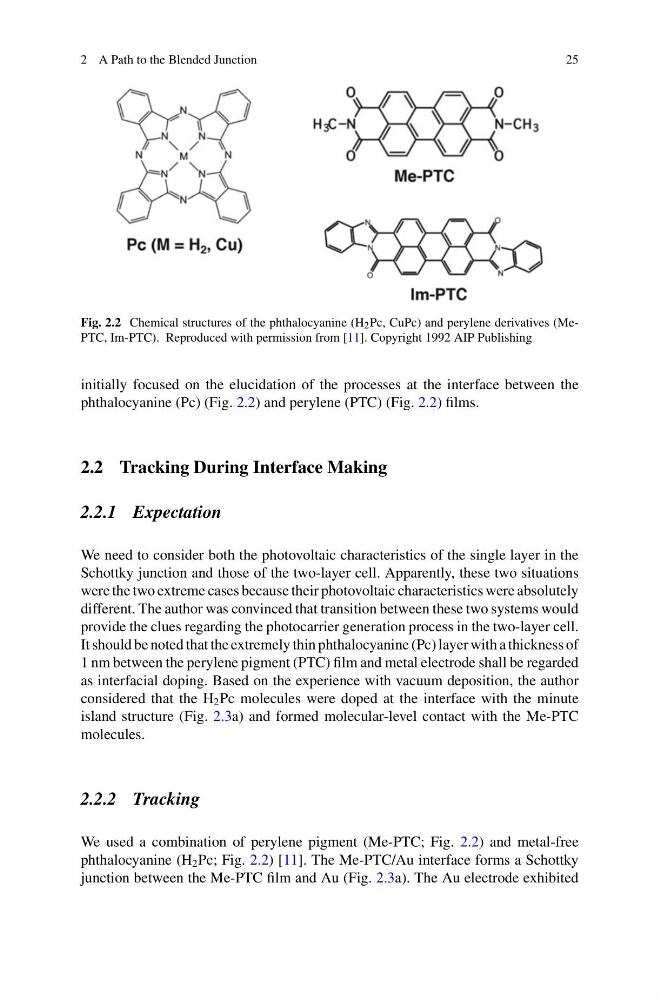
Fig. 2.2 Chemical structures of the phthalocyanine (H 2 Pc, CuPc) and perylene derivatives (MePTC, Im-PTC). Reproduced with permission from [11]. Copyright 1992 AIP Publishing
initially focused on the elucidation of the processes at the interface between the
phthalocyanine (Pc) (Fig. 2.2) and perylene (PTC) (Fig. 2.2) films.
2.2 Tracking During Interface Making
2.2.1 Expectation
We need to consider both the photovoltaic characteristics of the single layer in the
Schottky junction and those of the two-layer cell. Apparently, these two situations
were the two extreme cases because their photovoltaic characteristics were absolutely
different. The author was convinced that transition between these two systems would
provide the clues regarding the photocarrier generation process in the two-layer cell.
It should be noted that the extremely thin phthalocyanine (Pc) layer with a thickness of
1 nm between the perylene pigment (PTC) film and metal electrode shall be regarded
as interfacial doping. Based on the experience with vacuum deposition, the author
considered that the H 2 Pc molecules were doped at the interface with the minute
island structure (Fig. 2.3a) and formed molecular-level contact with the Me-PTC
molecules.
2.2.2 Tracking
We used a combination of perylene pigment (Me-PTC; Fig. 2.2) and metal-free
phthalocyanine (H 2 Pc; Fig. 2.2) [11]. The Me-PTC/Au interface forms a Schottky
junction between the Me-PTC film and Au (Fig. 2.3a). The Au electrode exhibited
25
Fig. 2.2 Chemical structures of the phthalocyanine (H 2 Pc, CuPc) and perylene derivatives (MePTC, Im-PTC). Reproduced with permission from [11]. Copyright 1992 AIP Publishing
initially focused on the elucidation of the processes at the interface between the
phthalocyanine (Pc) (Fig. 2.2) and perylene (PTC) (Fig. 2.2) films.
2.2 Tracking During Interface Making
2.2.1 Expectation
We need to consider both the photovoltaic characteristics of the single layer in the
Schottky junction and those of the two-layer cell. Apparently, these two situations
were the two extreme cases because their photovoltaic characteristics were absolutely
different. The author was convinced that transition between these two systems would
provide the clues regarding the photocarrier generation process in the two-layer cell.
It should be noted that the extremely thin phthalocyanine (Pc) layer with a thickness of
1 nm between the perylene pigment (PTC) film and metal electrode shall be regarded
as interfacial doping. Based on the experience with vacuum deposition, the author
considered that the H 2 Pc molecules were doped at the interface with the minute
island structure (Fig. 2.3a) and formed molecular-level contact with the Me-PTC
molecules.
2.2.2 Tracking
We used a combination of perylene pigment (Me-PTC; Fig. 2.2) and metal-free
phthalocyanine (H 2 Pc; Fig. 2.2) [11]. The Me-PTC/Au interface forms a Schottky
junction between the Me-PTC film and Au (Fig. 2.3a). The Au electrode exhibited