

24
M. Hiramoto
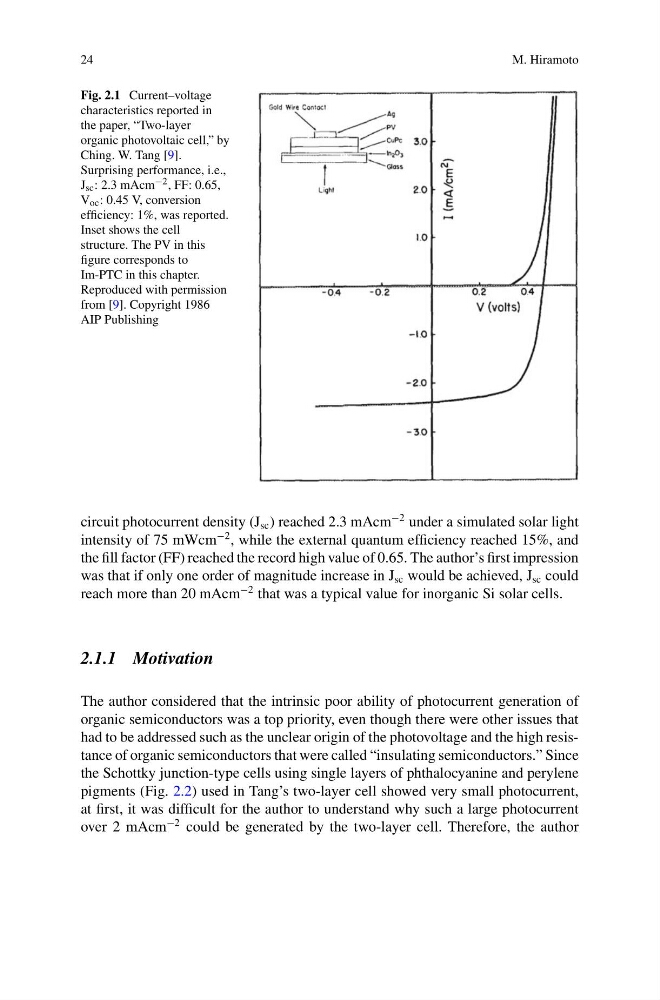
Fig. 2.1 Current–voltage
characteristics reported in
the paper, “Two-layer
organic photovoltaic cell,” by
Ching. W. Tang [9].
Surprising performance, i.e.,
J sc : 2.3 mAcm −2 , FF: 0.65,
V oc : 0.45 V, conversion
efficiency: 1%, was reported.
Inset shows the cell
structure. The PV in this
figure corresponds to
Im-PTC in this chapter.
Reproduced with permission
from [9]. Copyright 1986
AIP Publishing
circuit photocurrent density (J sc ) reached 2.3 mAcm
−2 under a simulated solar light
intensity of 75 mWcm
−2 , while the external quantum efficiency reached 15%, and
the fill factor (FF) reached the record high value of 0.65. The author’s first impression
was that if only one order of magnitude increase in J sc would be achieved, J sc could
reach more than 20 mAcm
−2 that was a typical value for inorganic Si solar cells.
2.1.1 Motivation
The author considered that the intrinsic poor ability of photocurrent generation of
organic semiconductors was a top priority, even though there were other issues that
had to be addressed such as the unclear origin of the photovoltage and the high resistance of organic semiconductors that were called “insulating semiconductors.” Since
the Schottky junction-type cells using single layers of phthalocyanine and perylene
pigments (Fig. 2.2) used in Tang’s two-layer cell showed very small photocurrent,
at first, it was difficult for the author to understand why such a large photocurrent
over 2 mAcm
−2 could be generated by the two-layer cell. Therefore, the author
M. Hiramoto
Fig. 2.1 Current–voltage
characteristics reported in
the paper, “Two-layer
organic photovoltaic cell,” by
Ching. W. Tang [9].
Surprising performance, i.e.,
J sc : 2.3 mAcm −2 , FF: 0.65,
V oc : 0.45 V, conversion
efficiency: 1%, was reported.
Inset shows the cell
structure. The PV in this
figure corresponds to
Im-PTC in this chapter.
Reproduced with permission
from [9]. Copyright 1986
AIP Publishing
circuit photocurrent density (J sc ) reached 2.3 mAcm
−2 under a simulated solar light
intensity of 75 mWcm
−2 , while the external quantum efficiency reached 15%, and
the fill factor (FF) reached the record high value of 0.65. The author’s first impression
was that if only one order of magnitude increase in J sc would be achieved, J sc could
reach more than 20 mAcm
−2 that was a typical value for inorganic Si solar cells.
2.1.1 Motivation
The author considered that the intrinsic poor ability of photocurrent generation of
organic semiconductors was a top priority, even though there were other issues that
had to be addressed such as the unclear origin of the photovoltage and the high resistance of organic semiconductors that were called “insulating semiconductors.” Since
the Schottky junction-type cells using single layers of phthalocyanine and perylene
pigments (Fig. 2.2) used in Tang’s two-layer cell showed very small photocurrent,
at first, it was difficult for the author to understand why such a large photocurrent
over 2 mAcm
−2 could be generated by the two-layer cell. Therefore, the author