

9 Parts-Per-Million-Level Doping Effects …
239
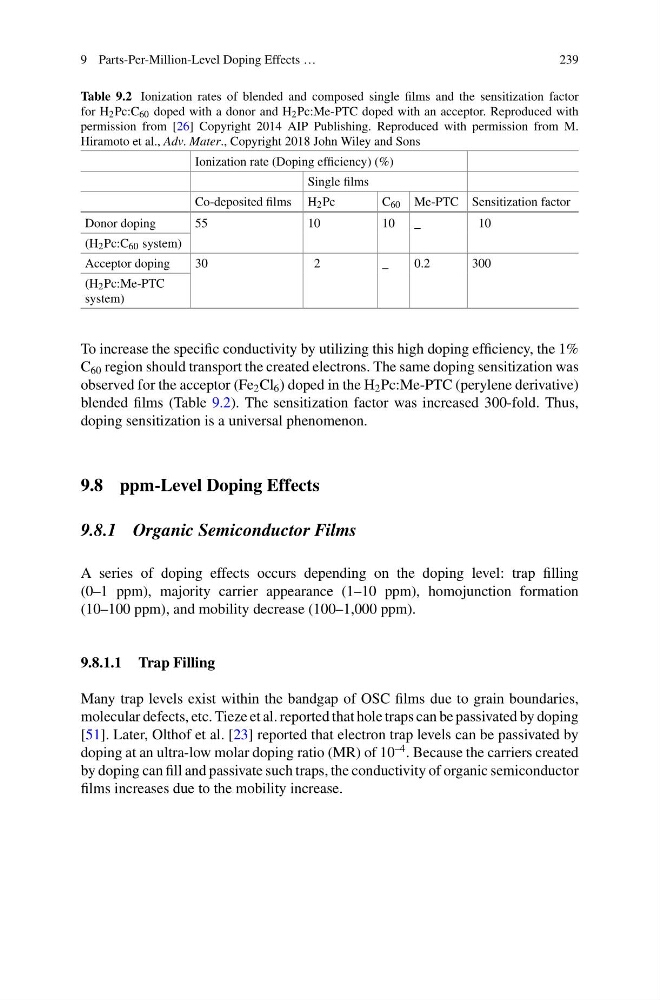
Table 9.2 Ionization rates of blended and composed single films and the sensitization factor
for H 2 Pc:C 60 doped with a donor and H 2 Pc:Me-PTC doped with an acceptor. Reproduced with
permission from [26] Copyright 2014 AIP Publishing. Reproduced with permission from M.
Hiramoto et al., Adv. Mater., Copyright 2018 John Wiley and Sons
Ionization rate (Doping efficiency) (%)
Single films
Co-deposited films H 2 Pc
C 60 Me-PTC Sensitization factor
Donor doping
55
10
10
_
10
(H 2 Pc:C 60 system)
Acceptor doping
30
2
_
0.2
300
(H 2 Pc:Me-PTC
system)
To increase the specific conductivity by utilizing this high doping efficiency, the 1%
C 60 region should transport the created electrons. The same doping sensitization was
observed for the acceptor (Fe 2 Cl 6 ) doped in the H 2 Pc:Me-PTC (perylene derivative)
blended films (Table 9.2). The sensitization factor was increased 300-fold. Thus,
doping sensitization is a universal phenomenon.
9.8 ppm-Level Doping Effects
9.8.1 Organic Semiconductor Films
A series of doping effects occurs depending on the doping level: trap filling
(0–1 ppm), majority carrier appearance (1–10 ppm), homojunction formation
(10–100 ppm), and mobility decrease (100–1,000 ppm).
9.8.1.1 Trap Filling
Many trap levels exist within the bandgap of OSC films due to grain boundaries,
molecular defects, etc. Tieze et al. reported that hole traps can be passivated by doping
[51]. Later, Olthof et al. [23] reported that electron trap levels can be passivated by
doping at an ultra-low molar doping ratio (MR) of 10
–4 . Because the carriers created
by doping can fill and passivate such traps, the conductivity of organic semiconductor
films increases due to the mobility increase.
239
Table 9.2 Ionization rates of blended and composed single films and the sensitization factor
for H 2 Pc:C 60 doped with a donor and H 2 Pc:Me-PTC doped with an acceptor. Reproduced with
permission from [26] Copyright 2014 AIP Publishing. Reproduced with permission from M.
Hiramoto et al., Adv. Mater., Copyright 2018 John Wiley and Sons
Ionization rate (Doping efficiency) (%)
Single films
Co-deposited films H 2 Pc
C 60 Me-PTC Sensitization factor
Donor doping
55
10
10
_
10
(H 2 Pc:C 60 system)
Acceptor doping
30
2
_
0.2
300
(H 2 Pc:Me-PTC
system)
To increase the specific conductivity by utilizing this high doping efficiency, the 1%
C 60 region should transport the created electrons. The same doping sensitization was
observed for the acceptor (Fe 2 Cl 6 ) doped in the H 2 Pc:Me-PTC (perylene derivative)
blended films (Table 9.2). The sensitization factor was increased 300-fold. Thus,
doping sensitization is a universal phenomenon.
9.8 ppm-Level Doping Effects
9.8.1 Organic Semiconductor Films
A series of doping effects occurs depending on the doping level: trap filling
(0–1 ppm), majority carrier appearance (1–10 ppm), homojunction formation
(10–100 ppm), and mobility decrease (100–1,000 ppm).
9.8.1.1 Trap Filling
Many trap levels exist within the bandgap of OSC films due to grain boundaries,
molecular defects, etc. Tieze et al. reported that hole traps can be passivated by doping
[51]. Later, Olthof et al. [23] reported that electron trap levels can be passivated by
doping at an ultra-low molar doping ratio (MR) of 10
–4 . Because the carriers created
by doping can fill and passivate such traps, the conductivity of organic semiconductor
films increases due to the mobility increase.