

238
M. Hiramoto
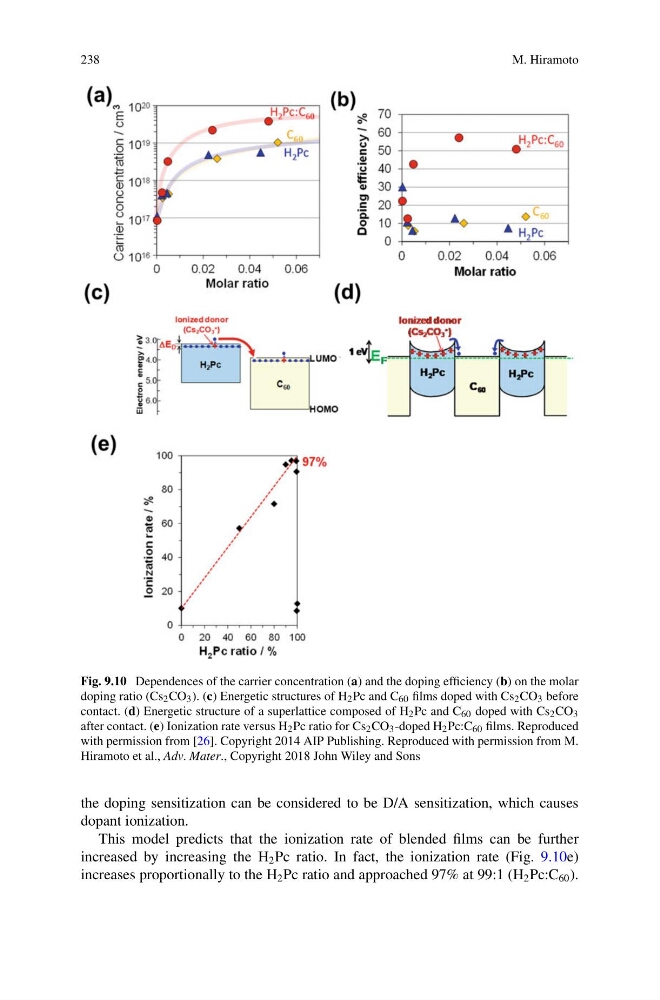
Fig. 9.10 Dependences of the carrier concentration (a) and the doping efficiency (b) on the molar
doping ratio (Cs 2 CO 3 ). (c) Energetic structures of H 2 Pc and C 60 films doped with Cs 2 CO 3 before
contact. (d) Energetic structure of a superlattice composed of H 2 Pc and C 60 doped with Cs 2 CO 3
after contact. (e) Ionization rate versus H 2 Pc ratio for Cs 2 CO 3 -doped H 2 Pc:C 60 films. Reproduced
with permission from [26]. Copyright 2014 AIP Publishing. Reproduced with permission from M.
Hiramoto et al., Adv. Mater., Copyright 2018 John Wiley and Sons
the doping sensitization can be considered to be D/A sensitization, which causes
dopant ionization.
This model predicts that the ionization rate of blended films can be further
increased by increasing the H 2 Pc ratio. In fact, the ionization rate (Fig. 9.10e)
increases proportionally to the H 2 Pc ratio and approached 97% at 99:1 (H 2 Pc:C 60 ).
M. Hiramoto
Fig. 9.10 Dependences of the carrier concentration (a) and the doping efficiency (b) on the molar
doping ratio (Cs 2 CO 3 ). (c) Energetic structures of H 2 Pc and C 60 films doped with Cs 2 CO 3 before
contact. (d) Energetic structure of a superlattice composed of H 2 Pc and C 60 doped with Cs 2 CO 3
after contact. (e) Ionization rate versus H 2 Pc ratio for Cs 2 CO 3 -doped H 2 Pc:C 60 films. Reproduced
with permission from [26]. Copyright 2014 AIP Publishing. Reproduced with permission from M.
Hiramoto et al., Adv. Mater., Copyright 2018 John Wiley and Sons
the doping sensitization can be considered to be D/A sensitization, which causes
dopant ionization.
This model predicts that the ionization rate of blended films can be further
increased by increasing the H 2 Pc ratio. In fact, the ionization rate (Fig. 9.10e)
increases proportionally to the H 2 Pc ratio and approached 97% at 99:1 (H 2 Pc:C 60 ).