

1 Basic Principles of Modern Organic Solar Cells
17
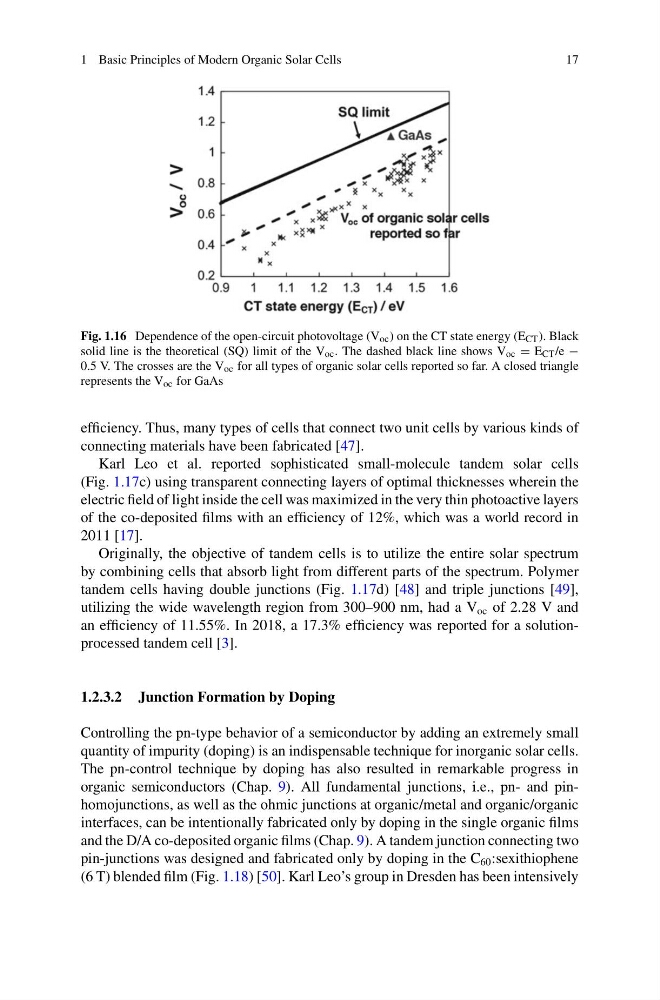
Fig. 1.16 Dependence of the open-circuit photovoltage (V oc ) on the CT state energy (E CT ). Black
solid line is the theoretical (SQ) limit of the V oc . The dashed black line shows V oc = E CT /e −
0.5 V. The crosses are the V oc for all types of organic solar cells reported so far. A closed triangle
represents the V oc for GaAs
efficiency. Thus, many types of cells that connect two unit cells by various kinds of
connecting materials have been fabricated [47].
Karl Leo et al. reported sophisticated small-molecule tandem solar cells
(Fig. 1.17c) using transparent connecting layers of optimal thicknesses wherein the
electric field of light inside the cell was maximized in the very thin photoactive layers
of the co-deposited films with an efficiency of 12%, which was a world record in
2011 [17].
Originally, the objective of tandem cells is to utilize the entire solar spectrum
by combining cells that absorb light from different parts of the spectrum. Polymer
tandem cells having double junctions (Fig. 1.17d) [48] and triple junctions [49],
utilizing the wide wavelength region from 300–900 nm, had a V oc of 2.28 V and
an efficiency of 11.55%. In 2018, a 17.3% efficiency was reported for a solutionprocessed tandem cell [3].
1.2.3.2 Junction Formation by Doping
Controlling the pn-type behavior of a semiconductor by adding an extremely small
quantity of impurity (doping) is an indispensable technique for inorganic solar cells.
The pn-control technique by doping has also resulted in remarkable progress in
organic semiconductors (Chap. 9). All fundamental junctions, i.e., pn- and pinhomojunctions, as well as the ohmic junctions at organic/metal and organic/organic
interfaces, can be intentionally fabricated only by doping in the single organic films
and the D/A co-deposited organic films (Chap. 9). A tandem junction connecting two
pin-junctions was designed and fabricated only by doping in the C 60 :sexithiophene
(6 T) blended film (Fig. 1.18) [50]. Karl Leo’s group in Dresden has been intensively
17
Fig. 1.16 Dependence of the open-circuit photovoltage (V oc ) on the CT state energy (E CT ). Black
solid line is the theoretical (SQ) limit of the V oc . The dashed black line shows V oc = E CT /e −
0.5 V. The crosses are the V oc for all types of organic solar cells reported so far. A closed triangle
represents the V oc for GaAs
efficiency. Thus, many types of cells that connect two unit cells by various kinds of
connecting materials have been fabricated [47].
Karl Leo et al. reported sophisticated small-molecule tandem solar cells
(Fig. 1.17c) using transparent connecting layers of optimal thicknesses wherein the
electric field of light inside the cell was maximized in the very thin photoactive layers
of the co-deposited films with an efficiency of 12%, which was a world record in
2011 [17].
Originally, the objective of tandem cells is to utilize the entire solar spectrum
by combining cells that absorb light from different parts of the spectrum. Polymer
tandem cells having double junctions (Fig. 1.17d) [48] and triple junctions [49],
utilizing the wide wavelength region from 300–900 nm, had a V oc of 2.28 V and
an efficiency of 11.55%. In 2018, a 17.3% efficiency was reported for a solutionprocessed tandem cell [3].
1.2.3.2 Junction Formation by Doping
Controlling the pn-type behavior of a semiconductor by adding an extremely small
quantity of impurity (doping) is an indispensable technique for inorganic solar cells.
The pn-control technique by doping has also resulted in remarkable progress in
organic semiconductors (Chap. 9). All fundamental junctions, i.e., pn- and pinhomojunctions, as well as the ohmic junctions at organic/metal and organic/organic
interfaces, can be intentionally fabricated only by doping in the single organic films
and the D/A co-deposited organic films (Chap. 9). A tandem junction connecting two
pin-junctions was designed and fabricated only by doping in the C 60 :sexithiophene
(6 T) blended film (Fig. 1.18) [50]. Karl Leo’s group in Dresden has been intensively