

226
M. Hiramoto
W dep = (2εε 0 V bi /eN)
1/2
(9.2)
Band-mapping of the doped C 60 films is shown in Fig. 9.4b. Upon doping with the
donor (Cs 2 CO 3 ) and acceptor (MoO 3 ), the work function moved negatively (triangular dots) and positively (circular dots), respectively. For both dopants, increasing
the doping concentration decreased the depletion layer width (W dep ) decreased and
increased the built-in potential (V bi ). The band-bending profile obeyed the quadratic
curve of Poisson’s equation (Fig. 9.4b, solid curves), thus providing precise values
of W dep and V bi .
9.5.2 Low Doping Efficiency in Single Films
The electron and hole concentrations in single C 60 films can be controlled between
10
15 and 10
19 cm
−3 (Fig. 9.4c). The doping efficiency, i.e., the ratio of the concentrations of created carriers and dopant molecules, was 10% for Cs 2 CO 3 and 3% for
MoO 3 , assuming that MoO 3 forms a trimer (Mo 3 O 9 ) [50] (Fig. 9.4d). The doping
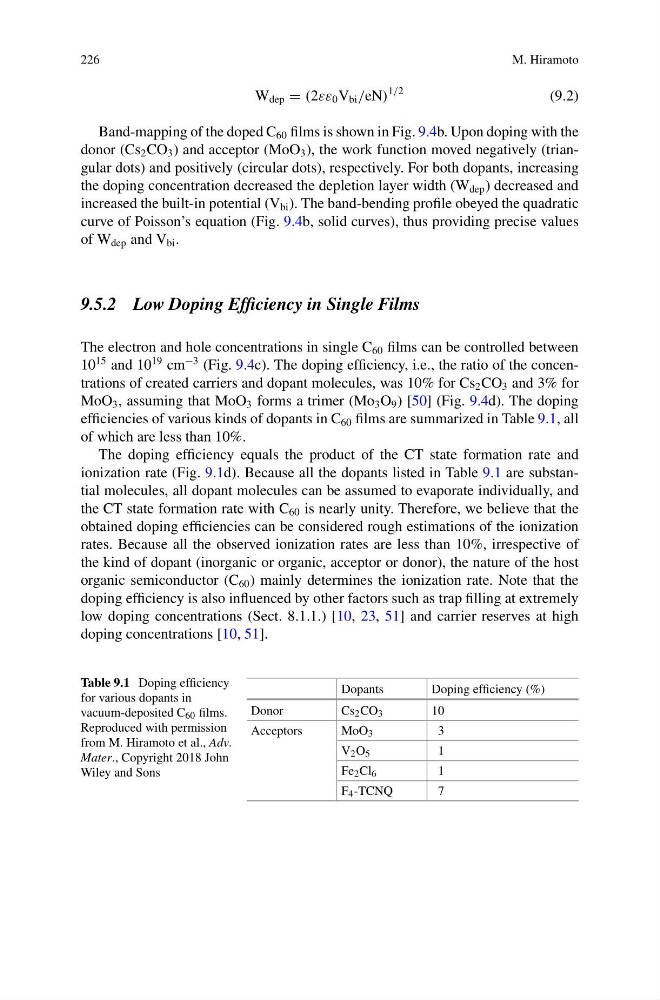
efficiencies of various kinds of dopants in C 60 films are summarized in Table 9.1, all
of which are less than 10%.
The doping efficiency equals the product of the CT state formation rate and
ionization rate (Fig. 9.1d). Because all the dopants listed in Table 9.1 are substantial molecules, all dopant molecules can be assumed to evaporate individually, and
the CT state formation rate with C 60 is nearly unity. Therefore, we believe that the
obtained doping efficiencies can be considered rough estimations of the ionization
rates. Because all the observed ionization rates are less than 10%, irrespective of
the kind of dopant (inorganic or organic, acceptor or donor), the nature of the host
organic semiconductor (C 60 ) mainly determines the ionization rate. Note that the
doping efficiency is also influenced by other factors such as trap filling at extremely
low doping concentrations (Sect. 8.1.1.) [10, 23, 51] and carrier reserves at high
doping concentrations [10, 51].
Table 9.1 Doping efficiency
for various dopants in
vacuum-deposited C 60 films.
Reproduced with permission
from M. Hiramoto et al., Adv.
Mater., Copyright 2018 John
Wiley and Sons
Dopants
Doping efficiency (%)
Donor
Cs 2 CO 3
10
Acceptors
MoO 3
3
V 2 O 5
1
Fe 2 Cl 6
1
F 4 -TCNQ
7
M. Hiramoto
W dep = (2εε 0 V bi /eN)
1/2
(9.2)
Band-mapping of the doped C 60 films is shown in Fig. 9.4b. Upon doping with the
donor (Cs 2 CO 3 ) and acceptor (MoO 3 ), the work function moved negatively (triangular dots) and positively (circular dots), respectively. For both dopants, increasing
the doping concentration decreased the depletion layer width (W dep ) decreased and
increased the built-in potential (V bi ). The band-bending profile obeyed the quadratic
curve of Poisson’s equation (Fig. 9.4b, solid curves), thus providing precise values
of W dep and V bi .
9.5.2 Low Doping Efficiency in Single Films
The electron and hole concentrations in single C 60 films can be controlled between
10
15 and 10
19 cm
−3 (Fig. 9.4c). The doping efficiency, i.e., the ratio of the concentrations of created carriers and dopant molecules, was 10% for Cs 2 CO 3 and 3% for
MoO 3 , assuming that MoO 3 forms a trimer (Mo 3 O 9 ) [50] (Fig. 9.4d). The doping
efficiencies of various kinds of dopants in C 60 films are summarized in Table 9.1, all
of which are less than 10%.
The doping efficiency equals the product of the CT state formation rate and
ionization rate (Fig. 9.1d). Because all the dopants listed in Table 9.1 are substantial molecules, all dopant molecules can be assumed to evaporate individually, and
the CT state formation rate with C 60 is nearly unity. Therefore, we believe that the
obtained doping efficiencies can be considered rough estimations of the ionization
rates. Because all the observed ionization rates are less than 10%, irrespective of
the kind of dopant (inorganic or organic, acceptor or donor), the nature of the host
organic semiconductor (C 60 ) mainly determines the ionization rate. Note that the
doping efficiency is also influenced by other factors such as trap filling at extremely
low doping concentrations (Sect. 8.1.1.) [10, 23, 51] and carrier reserves at high
doping concentrations [10, 51].
Table 9.1 Doping efficiency
for various dopants in
vacuum-deposited C 60 films.
Reproduced with permission
from M. Hiramoto et al., Adv.
Mater., Copyright 2018 John
Wiley and Sons
Dopants
Doping efficiency (%)
Donor
Cs 2 CO 3
10
Acceptors
MoO 3
3
V 2 O 5
1
Fe 2 Cl 6
1
F 4 -TCNQ
7