

8 Open-Circuit Voltage in Organic Solar Cells
207
nature of charges in organic semiconductors has a dominant role in the recombination
processes and in how V OC is determined.
8.3.4 Enhancement of Open-Circuit Voltage in Organic
Solar Cells by Monolayer Cascade Energy Structure
at Donor/Acceptor Interface
The effect of energy-level alignment at the D/A interface and the strategy to control
it by doping were presented in the Sect. 8.3.3. The dominant effect of the energy
structure at the D/A interface on E CT and V OC in OSCs is discussed in this section
[20].
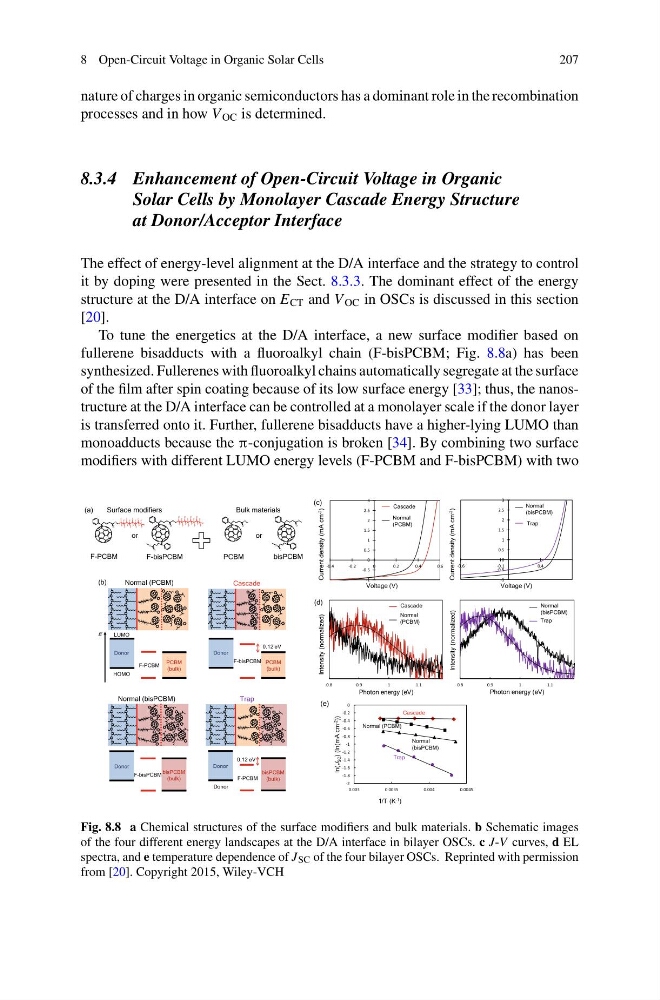
To tune the energetics at the D/A interface, a new surface modifier based on
fullerene bisadducts with a fluoroalkyl chain (F-bisPCBM; Fig. 8.8a) has been
synthesized. Fullerenes with fluoroalkyl chains automatically segregate at the surface
of the film after spin coating because of its low surface energy [33]; thus, the nanostructure at the D/A interface can be controlled at a monolayer scale if the donor layer
is transferred onto it. Further, fullerene bisadducts have a higher-lying LUMO than
monoadducts because the π-conjugation is broken [34]. By combining two surface
modifiers with different LUMO energy levels (F-PCBM and F-bisPCBM) with two
Fig. 8.8 a Chemical structures of the surface modifiers and bulk materials. b Schematic images
of the four different energy landscapes at the D/A interface in bilayer OSCs. c J-V curves, d EL
spectra, and e temperature dependence of J SC of the four bilayer OSCs. Reprinted with permission
from [20]. Copyright 2015, Wiley-VCH
207
nature of charges in organic semiconductors has a dominant role in the recombination
processes and in how V OC is determined.
8.3.4 Enhancement of Open-Circuit Voltage in Organic
Solar Cells by Monolayer Cascade Energy Structure
at Donor/Acceptor Interface
The effect of energy-level alignment at the D/A interface and the strategy to control
it by doping were presented in the Sect. 8.3.3. The dominant effect of the energy
structure at the D/A interface on E CT and V OC in OSCs is discussed in this section
[20].
To tune the energetics at the D/A interface, a new surface modifier based on
fullerene bisadducts with a fluoroalkyl chain (F-bisPCBM; Fig. 8.8a) has been
synthesized. Fullerenes with fluoroalkyl chains automatically segregate at the surface
of the film after spin coating because of its low surface energy [33]; thus, the nanostructure at the D/A interface can be controlled at a monolayer scale if the donor layer
is transferred onto it. Further, fullerene bisadducts have a higher-lying LUMO than
monoadducts because the π-conjugation is broken [34]. By combining two surface
modifiers with different LUMO energy levels (F-PCBM and F-bisPCBM) with two
Fig. 8.8 a Chemical structures of the surface modifiers and bulk materials. b Schematic images
of the four different energy landscapes at the D/A interface in bilayer OSCs. c J-V curves, d EL
spectra, and e temperature dependence of J SC of the four bilayer OSCs. Reprinted with permission
from [20]. Copyright 2015, Wiley-VCH