

206
S. Izawa
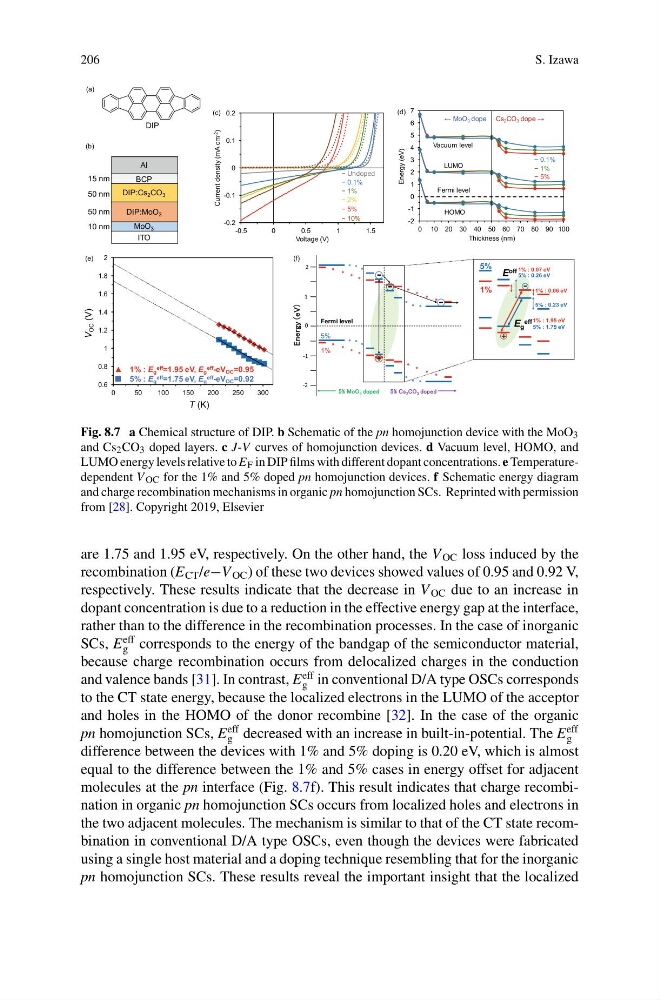
Fig. 8.7 a Chemical structure of DIP. b Schematic of the pn homojunction device with the MoO 3
and Cs 2 CO 3 doped layers. c J-V curves of homojunction devices. d Vacuum level, HOMO, and
LUMO energy levels relative to E F in DIP films with different dopant concentrations. e Temperaturedependent V OC for the 1% and 5% doped pn homojunction devices. f Schematic energy diagram
and charge recombination mechanisms in organic pn homojunction SCs. Reprinted with permission
from [28]. Copyright 2019, Elsevier
are 1.75 and 1.95 eV, respectively. On the other hand, the V OC loss induced by the
recombination (E CT /e−V OC ) of these two devices showed values of 0.95 and 0.92 V,
respectively. These results indicate that the decrease in V OC due to an increase in
dopant concentration is due to a reduction in the effective energy gap at the interface,
rather than to the difference in the recombination processes. In the case of inorganic
SCs, E
eff
g corresponds to the energy of the bandgap of the semiconductor material,
because charge recombination occurs from delocalized charges in the conduction
and valence bands [31]. In contrast, E
eff
g in conventional D/A type OSCs corresponds
to the CT state energy, because the localized electrons in the LUMO of the acceptor
and holes in the HOMO of the donor recombine [32]. In the case of the organic
pn homojunction SCs, E
eff
g decreased with an increase in built-in-potential. The E
eff
g
difference between the devices with 1% and 5% doping is 0.20 eV, which is almost
equal to the difference between the 1% and 5% cases in energy offset for adjacent
molecules at the pn interface (Fig. 8.7f). This result indicates that charge recombination in organic pn homojunction SCs occurs from localized holes and electrons in
the two adjacent molecules. The mechanism is similar to that of the CT state recombination in conventional D/A type OSCs, even though the devices were fabricated
using a single host material and a doping technique resembling that for the inorganic
pn homojunction SCs. These results reveal the important insight that the localized
S. Izawa
Fig. 8.7 a Chemical structure of DIP. b Schematic of the pn homojunction device with the MoO 3
and Cs 2 CO 3 doped layers. c J-V curves of homojunction devices. d Vacuum level, HOMO, and
LUMO energy levels relative to E F in DIP films with different dopant concentrations. e Temperaturedependent V OC for the 1% and 5% doped pn homojunction devices. f Schematic energy diagram
and charge recombination mechanisms in organic pn homojunction SCs. Reprinted with permission
from [28]. Copyright 2019, Elsevier
are 1.75 and 1.95 eV, respectively. On the other hand, the V OC loss induced by the
recombination (E CT /e−V OC ) of these two devices showed values of 0.95 and 0.92 V,
respectively. These results indicate that the decrease in V OC due to an increase in
dopant concentration is due to a reduction in the effective energy gap at the interface,
rather than to the difference in the recombination processes. In the case of inorganic
SCs, E
eff
g corresponds to the energy of the bandgap of the semiconductor material,
because charge recombination occurs from delocalized charges in the conduction
and valence bands [31]. In contrast, E
eff
g in conventional D/A type OSCs corresponds
to the CT state energy, because the localized electrons in the LUMO of the acceptor
and holes in the HOMO of the donor recombine [32]. In the case of the organic
pn homojunction SCs, E
eff
g decreased with an increase in built-in-potential. The E
eff
g
difference between the devices with 1% and 5% doping is 0.20 eV, which is almost
equal to the difference between the 1% and 5% cases in energy offset for adjacent
molecules at the pn interface (Fig. 8.7f). This result indicates that charge recombination in organic pn homojunction SCs occurs from localized holes and electrons in
the two adjacent molecules. The mechanism is similar to that of the CT state recombination in conventional D/A type OSCs, even though the devices were fabricated
using a single host material and a doping technique resembling that for the inorganic
pn homojunction SCs. These results reveal the important insight that the localized