

7 First-Principles Investigations of Electronically …
185
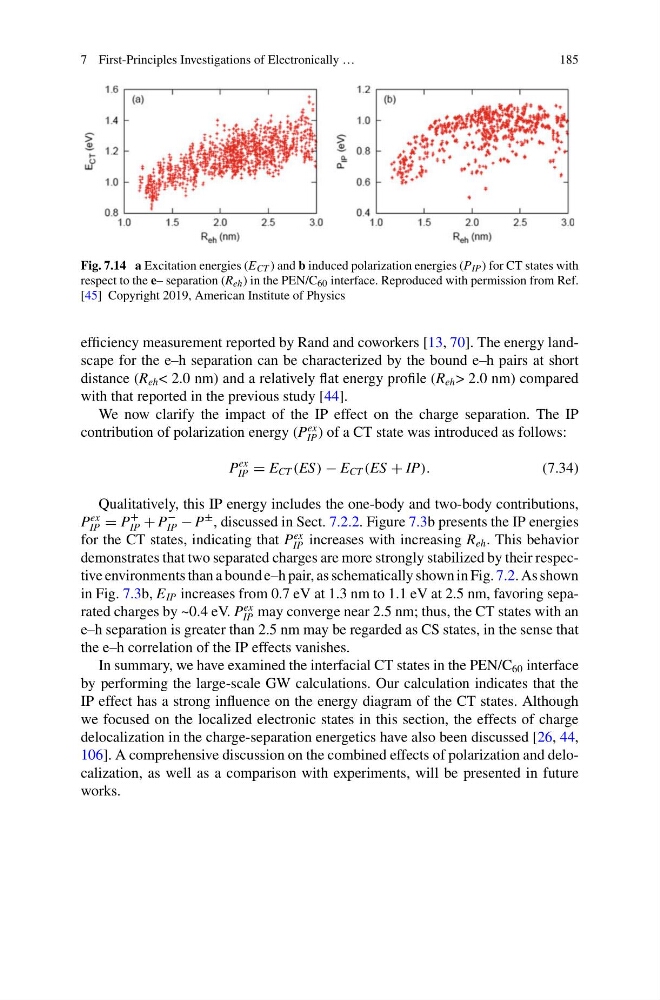
Fig. 7.14 a Excitation energies (E CT ) and b induced polarization energies (P IP ) for CT states with
respect to the e– separation (R eh ) in the PEN/C 60 interface. Reproduced with permission from Ref.
[45] Copyright 2019, American Institute of Physics
efficiency measurement reported by Rand and coworkers [13, 70]. The energy landscape for the e–h separation can be characterized by the bound e–h pairs at short
distance (R eh < 2.0 nm) and a relatively flat energy profile (R eh > 2.0 nm) compared
with that reported in the previous study [44].
We now clarify the impact of the IP effect on the charge separation. The IP
contribution of polarization energy (P
ex
IP ) of a CT state was introduced as follows:
P
ex
IP = E CT (ES) − E CT (ES + IP).
(7.34)
Qualitatively, this IP energy includes the one-body and two-body contributions,
P
ex
IP = P
+
IP + P
−
IP − P
± , discussed in Sect. 7.2.2. Figure 7.3b presents the IP energies
for the CT states, indicating that P
ex
IP increases with increasing R eh . This behavior
demonstrates that two separated charges are more strongly stabilized by their respective environments than a bound e–h pair, as schematically shown in Fig. 7.2. As shown
in Fig. 7.3b, E IP increases from 0.7 eV at 1.3 nm to 1.1 eV at 2.5 nm, favoring separated charges by ~0.4 eV. P
ex
IP may converge near 2.5 nm; thus, the CT states with an
e–h separation is greater than 2.5 nm may be regarded as CS states, in the sense that
the e–h correlation of the IP effects vanishes.
In summary, we have examined the interfacial CT states in the PEN/C 60 interface
by performing the large-scale GW calculations. Our calculation indicates that the
IP effect has a strong influence on the energy diagram of the CT states. Although
we focused on the localized electronic states in this section, the effects of charge
delocalization in the charge-separation energetics have also been discussed [26, 44,
106]. A comprehensive discussion on the combined effects of polarization and delocalization, as well as a comparison with experiments, will be presented in future
works.
185
Fig. 7.14 a Excitation energies (E CT ) and b induced polarization energies (P IP ) for CT states with
respect to the e– separation (R eh ) in the PEN/C 60 interface. Reproduced with permission from Ref.
[45] Copyright 2019, American Institute of Physics
efficiency measurement reported by Rand and coworkers [13, 70]. The energy landscape for the e–h separation can be characterized by the bound e–h pairs at short
distance (R eh < 2.0 nm) and a relatively flat energy profile (R eh > 2.0 nm) compared
with that reported in the previous study [44].
We now clarify the impact of the IP effect on the charge separation. The IP
contribution of polarization energy (P
ex
IP ) of a CT state was introduced as follows:
P
ex
IP = E CT (ES) − E CT (ES + IP).
(7.34)
Qualitatively, this IP energy includes the one-body and two-body contributions,
P
ex
IP = P
+
IP + P
−
IP − P
± , discussed in Sect. 7.2.2. Figure 7.3b presents the IP energies
for the CT states, indicating that P
ex
IP increases with increasing R eh . This behavior
demonstrates that two separated charges are more strongly stabilized by their respective environments than a bound e–h pair, as schematically shown in Fig. 7.2. As shown
in Fig. 7.3b, E IP increases from 0.7 eV at 1.3 nm to 1.1 eV at 2.5 nm, favoring separated charges by ~0.4 eV. P
ex
IP may converge near 2.5 nm; thus, the CT states with an
e–h separation is greater than 2.5 nm may be regarded as CS states, in the sense that
the e–h correlation of the IP effects vanishes.
In summary, we have examined the interfacial CT states in the PEN/C 60 interface
by performing the large-scale GW calculations. Our calculation indicates that the
IP effect has a strong influence on the energy diagram of the CT states. Although
we focused on the localized electronic states in this section, the effects of charge
delocalization in the charge-separation energetics have also been discussed [26, 44,
106]. A comprehensive discussion on the combined effects of polarization and delocalization, as well as a comparison with experiments, will be presented in future
works.