

7 First-Principles Investigations of Electronically …
183
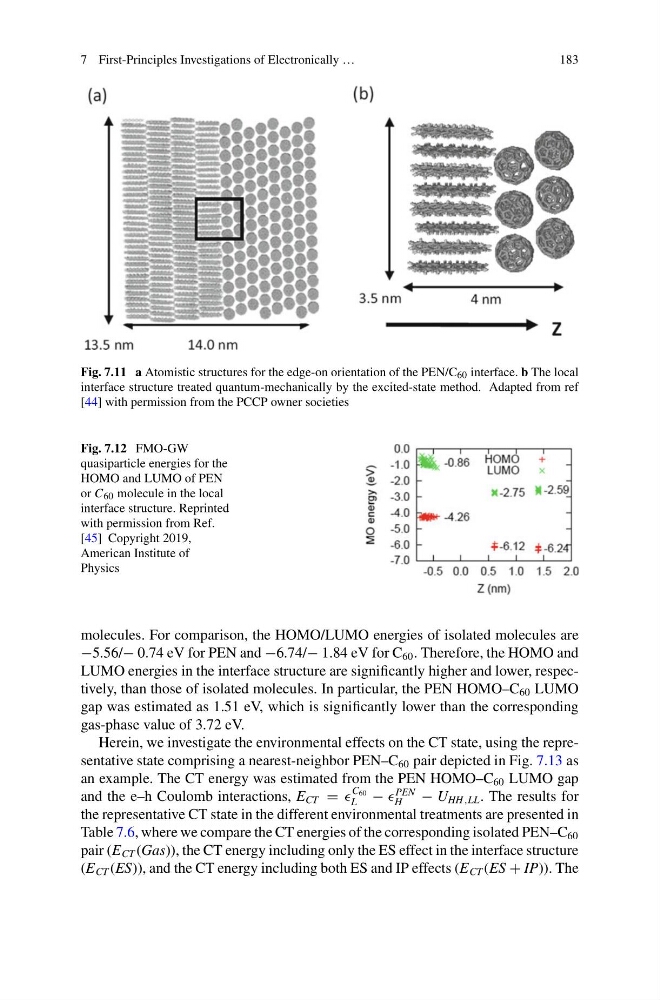
Fig. 7.11 a Atomistic structures for the edge-on orientation of the PEN/C 60 interface. b The local
interface structure treated quantum-mechanically by the excited-state method. Adapted from ref
[44] with permission from the PCCP owner societies
Fig. 7.12 FMO-GW
quasiparticle energies for the
HOMO and LUMO of PEN
or C 60 molecule in the local
interface structure. Reprinted
with permission from Ref.
[45] Copyright 2019,
American Institute of
Physics
molecules. For comparison, the HOMO/LUMO energies of isolated molecules are
−5.56/− 0.74 eV for PEN and −6.74/− 1.84 eV for C 60 . Therefore, the HOMO and
LUMO energies in the interface structure are significantly higher and lower, respectively, than those of isolated molecules. In particular, the PEN HOMO–C 60 LUMO
gap was estimated as 1.51 eV, which is significantly lower than the corresponding
gas-phase value of 3.72 eV.
Herein, we investigate the environmental effects on the CT state, using the representative state comprising a nearest-neighbor PEN–C 60 pair depicted in Fig. 7.13 as
an example. The CT energy was estimated from the PEN HOMO–C 60 LUMO gap
and the e–h Coulomb interactions, E CT =
C 60
L −
PEN
H
− U HH ,LL . The results for
the representative CT state in the different environmental treatments are presented in
Table 7.6, where we compare the CT energies of the corresponding isolated PEN–C 60
pair (E CT (Gas)), the CT energy including only the ES effect in the interface structure
(E CT (ES)), and the CT energy including both ES and IP effects (E CT (ES + IP)). The
183
Fig. 7.11 a Atomistic structures for the edge-on orientation of the PEN/C 60 interface. b The local
interface structure treated quantum-mechanically by the excited-state method. Adapted from ref
[44] with permission from the PCCP owner societies
Fig. 7.12 FMO-GW
quasiparticle energies for the
HOMO and LUMO of PEN
or C 60 molecule in the local
interface structure. Reprinted
with permission from Ref.
[45] Copyright 2019,
American Institute of
Physics
molecules. For comparison, the HOMO/LUMO energies of isolated molecules are
−5.56/− 0.74 eV for PEN and −6.74/− 1.84 eV for C 60 . Therefore, the HOMO and
LUMO energies in the interface structure are significantly higher and lower, respectively, than those of isolated molecules. In particular, the PEN HOMO–C 60 LUMO
gap was estimated as 1.51 eV, which is significantly lower than the corresponding
gas-phase value of 3.72 eV.
Herein, we investigate the environmental effects on the CT state, using the representative state comprising a nearest-neighbor PEN–C 60 pair depicted in Fig. 7.13 as
an example. The CT energy was estimated from the PEN HOMO–C 60 LUMO gap
and the e–h Coulomb interactions, E CT =
C 60
L −
PEN
H
− U HH ,LL . The results for
the representative CT state in the different environmental treatments are presented in
Table 7.6, where we compare the CT energies of the corresponding isolated PEN–C 60
pair (E CT (Gas)), the CT energy including only the ES effect in the interface structure
(E CT (ES)), and the CT energy including both ES and IP effects (E CT (ES + IP)). The