

172
T. Fujita
F
I
+ V
I
EESP
ψ
I
p =
I
p
ψ
I
p ,
(7.26)
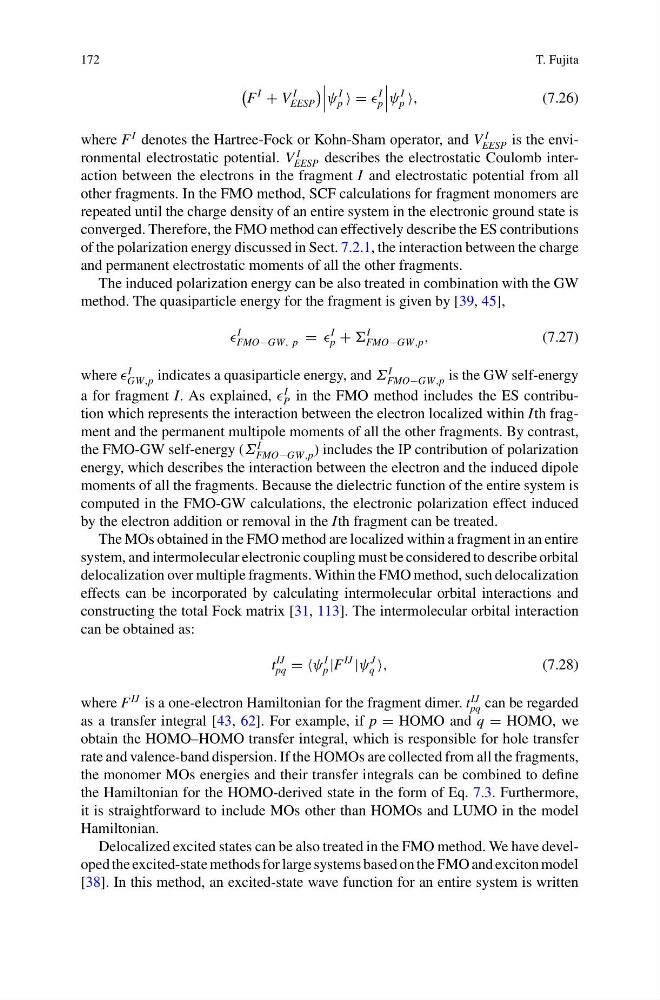
where F
I denotes the Hartree-Fock or Kohn-Sham operator, and V
I
EESP is the environmental electrostatic potential. V
I
EESP describes the electrostatic Coulomb interaction between the electrons in the fragment I and electrostatic potential from all
other fragments. In the FMO method, SCF calculations for fragment monomers are
repeated until the charge density of an entire system in the electronic ground state is
converged. Therefore, the FMO method can effectively describe the ES contributions
of the polarization energy discussed in Sect. 7.2.1, the interaction between the charge
and permanent electrostatic moments of all the other fragments.
The induced polarization energy can be also treated in combination with the GW
method. The quasiparticle energy for the fragment is given by [39, 45],
I
FMO−GW, p =
I
p +
I
FMO−GW,p ,
(7.27)
where
I
GW,p indicates a quasiparticle energy, and Σ
I
FMO−GW,p is the GW self-energy
a for fragment I. As explained,
I
P in the FMO method includes the ES contribution which represents the interaction between the electron localized within Ith fragment and the permanent multipole moments of all the other fragments. By contrast,
the FMO-GW self-energy (Σ
I
FMO−GW,p ) includes the IP contribution of polarization
energy, which describes the interaction between the electron and the induced dipole
moments of all the fragments. Because the dielectric function of the entire system is
computed in the FMO-GW calculations, the electronic polarization effect induced
by the electron addition or removal in the Ith fragment can be treated.
The MOs obtained in the FMO method are localized within a fragment in an entire
system, and intermolecular electronic coupling must be considered to describe orbital
delocalization over multiple fragments. Within the FMO method, such delocalization
effects can be incorporated by calculating intermolecular orbital interactions and
constructing the total Fock matrix [31, 113]. The intermolecular orbital interaction
can be obtained as:
t
IJ
pq = =ψ
I
p |F
IJ
|ψ
J
q ,
(7.28)
where F
IJ is a one-electron Hamiltonian for the fragment dimer. t
IJ
pq can be regarded
as a transfer integral [43, 62]. For example, if p = HOMO and q = HOMO, we
obtain the HOMO–HOMO transfer integral, which is responsible for hole transfer
rate and valence-band dispersion. If the HOMOs are collected from all the fragments,
the monomer MOs energies and their transfer integrals can be combined to define
the Hamiltonian for the HOMO-derived state in the form of Eq. 7.3. Furthermore,
it is straightforward to include MOs other than HOMOs and LUMO in the model
Hamiltonian.
Delocalized excited states can be also treated in the FMO method. We have developed the excited-state methods for large systems based on the FMO and exciton model
[38]. In this method, an excited-state wave function for an entire system is written
T. Fujita
F
I
+ V
I
EESP
ψ
I
p =
I
p
ψ
I
p ,
(7.26)
where F
I denotes the Hartree-Fock or Kohn-Sham operator, and V
I
EESP is the environmental electrostatic potential. V
I
EESP describes the electrostatic Coulomb interaction between the electrons in the fragment I and electrostatic potential from all
other fragments. In the FMO method, SCF calculations for fragment monomers are
repeated until the charge density of an entire system in the electronic ground state is
converged. Therefore, the FMO method can effectively describe the ES contributions
of the polarization energy discussed in Sect. 7.2.1, the interaction between the charge
and permanent electrostatic moments of all the other fragments.
The induced polarization energy can be also treated in combination with the GW
method. The quasiparticle energy for the fragment is given by [39, 45],
I
FMO−GW, p =
I
p +
I
FMO−GW,p ,
(7.27)
where
I
GW,p indicates a quasiparticle energy, and Σ
I
FMO−GW,p is the GW self-energy
a for fragment I. As explained,
I
P in the FMO method includes the ES contribution which represents the interaction between the electron localized within Ith fragment and the permanent multipole moments of all the other fragments. By contrast,
the FMO-GW self-energy (Σ
I
FMO−GW,p ) includes the IP contribution of polarization
energy, which describes the interaction between the electron and the induced dipole
moments of all the fragments. Because the dielectric function of the entire system is
computed in the FMO-GW calculations, the electronic polarization effect induced
by the electron addition or removal in the Ith fragment can be treated.
The MOs obtained in the FMO method are localized within a fragment in an entire
system, and intermolecular electronic coupling must be considered to describe orbital
delocalization over multiple fragments. Within the FMO method, such delocalization
effects can be incorporated by calculating intermolecular orbital interactions and
constructing the total Fock matrix [31, 113]. The intermolecular orbital interaction
can be obtained as:
t
IJ
pq = =ψ
I
p |F
IJ
|ψ
J
q ,
(7.28)
where F
IJ is a one-electron Hamiltonian for the fragment dimer. t
IJ
pq can be regarded
as a transfer integral [43, 62]. For example, if p = HOMO and q = HOMO, we
obtain the HOMO–HOMO transfer integral, which is responsible for hole transfer
rate and valence-band dispersion. If the HOMOs are collected from all the fragments,
the monomer MOs energies and their transfer integrals can be combined to define
the Hamiltonian for the HOMO-derived state in the form of Eq. 7.3. Furthermore,
it is straightforward to include MOs other than HOMOs and LUMO in the model
Hamiltonian.
Delocalized excited states can be also treated in the FMO method. We have developed the excited-state methods for large systems based on the FMO and exciton model
[38]. In this method, an excited-state wave function for an entire system is written