

158
T. Fujita
levels tend to increase and decrease, respectively, resulting in a reduced HOMO–
LUMO gap. The HOMOs and LUMOs can form delocalized orbitals via the intermolecular electronic couplings; these delocalized orbitals can be measured as the
band dispersion by angle-resolved photoelectron spectroscopy [63, 78].
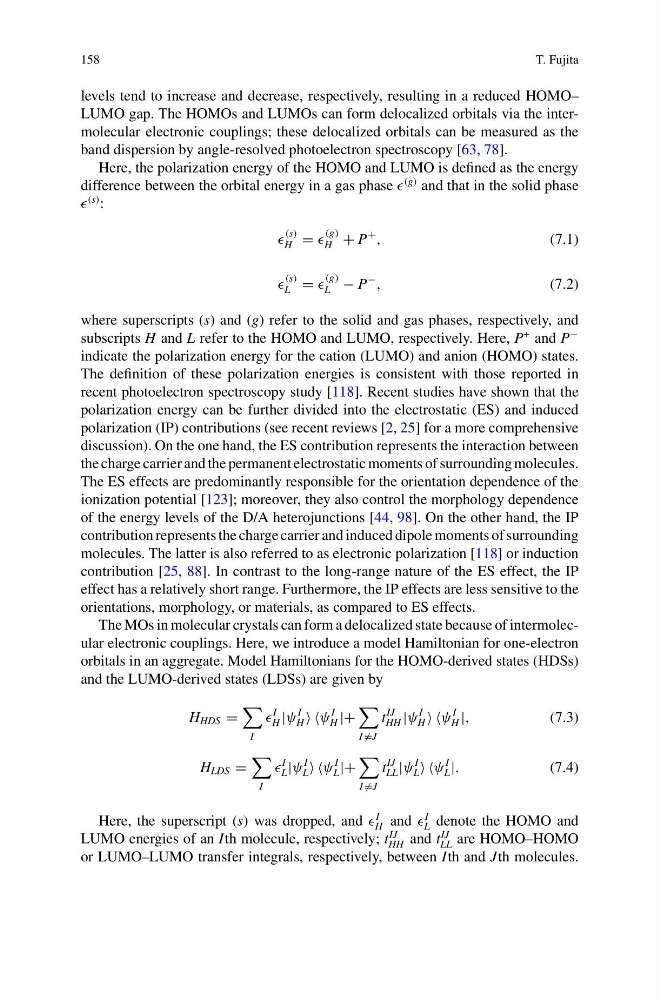
Here, the polarization energy of the HOMO and LUMO is defined as the energy
difference between the orbital energy in a gas phase
(g) and that in the solid phase
(s) :
(s)
H =
(g)
H + P
+
,
(7.1)
(s)
L =
(g)
L − P
−
,
(7.2)
where superscripts (s) and (g) refer to the solid and gas phases, respectively, and
subscripts H and L refer to the HOMO and LUMO, respectively. Here, P
+ and P
−
indicate the polarization energy for the cation (LUMO) and anion (HOMO) states.
The definition of these polarization energies is consistent with those reported in
recent photoelectron spectroscopy study [118]. Recent studies have shown that the
polarization energy can be further divided into the electrostatic (ES) and induced
polarization (IP) contributions (see recent reviews [2, 25] for a more comprehensive
discussion). On the one hand, the ES contribution represents the interaction between
the charge carrier and the permanent electrostatic moments of surrounding molecules.
The ES effects are predominantly responsible for the orientation dependence of the
ionization potential [123]; moreover, they also control the morphology dependence
of the energy levels of the D/A heterojunctions [44, 98]. On the other hand, the IP
contribution represents the charge carrier and induced dipole moments of surrounding
molecules. The latter is also referred to as electronic polarization [118] or induction
contribution [25, 88]. In contrast to the long-range nature of the ES effect, the IP
effect has a relatively short range. Furthermore, the IP effects are less sensitive to the
orientations, morphology, or materials, as compared to ES effects.
The MOs in molecular crystals can form a delocalized state because of intermolecular electronic couplings. Here, we introduce a model Hamiltonian for one-electron
orbitals in an aggregate. Model Hamiltonians for the HOMO-derived states (HDSs)
and the LUMO-derived states (LDSs) are given by
H HDS =
I
I
H |ψ
I
H ψ
I
H |+
I =J
t
IJ
HH |ψ
I
H ψ
I
H |,
(7.3)
H LDS =
I
I
L |ψ
I
L ψ
I
L |+
I =J
t
IJ
LL |ψ
I
L ψ
I
L |.
(7.4)
Here, the superscript (s) was dropped, and
I
H and
I
L denote the HOMO and
LUMO energies of an Ith molecule, respectively; t
IJ
HH and t
IJ
LL are HOMO–HOMO
or LUMO–LUMO transfer integrals, respectively, between Ith and Jth molecules.
T. Fujita
levels tend to increase and decrease, respectively, resulting in a reduced HOMO–
LUMO gap. The HOMOs and LUMOs can form delocalized orbitals via the intermolecular electronic couplings; these delocalized orbitals can be measured as the
band dispersion by angle-resolved photoelectron spectroscopy [63, 78].
Here, the polarization energy of the HOMO and LUMO is defined as the energy
difference between the orbital energy in a gas phase
(g) and that in the solid phase
(s) :
(s)
H =
(g)
H + P
+
,
(7.1)
(s)
L =
(g)
L − P
−
,
(7.2)
where superscripts (s) and (g) refer to the solid and gas phases, respectively, and
subscripts H and L refer to the HOMO and LUMO, respectively. Here, P
+ and P
−
indicate the polarization energy for the cation (LUMO) and anion (HOMO) states.
The definition of these polarization energies is consistent with those reported in
recent photoelectron spectroscopy study [118]. Recent studies have shown that the
polarization energy can be further divided into the electrostatic (ES) and induced
polarization (IP) contributions (see recent reviews [2, 25] for a more comprehensive
discussion). On the one hand, the ES contribution represents the interaction between
the charge carrier and the permanent electrostatic moments of surrounding molecules.
The ES effects are predominantly responsible for the orientation dependence of the
ionization potential [123]; moreover, they also control the morphology dependence
of the energy levels of the D/A heterojunctions [44, 98]. On the other hand, the IP
contribution represents the charge carrier and induced dipole moments of surrounding
molecules. The latter is also referred to as electronic polarization [118] or induction
contribution [25, 88]. In contrast to the long-range nature of the ES effect, the IP
effect has a relatively short range. Furthermore, the IP effects are less sensitive to the
orientations, morphology, or materials, as compared to ES effects.
The MOs in molecular crystals can form a delocalized state because of intermolecular electronic couplings. Here, we introduce a model Hamiltonian for one-electron
orbitals in an aggregate. Model Hamiltonians for the HOMO-derived states (HDSs)
and the LUMO-derived states (LDSs) are given by
H HDS =
I
I
H |ψ
I
H ψ
I
H |+
I =J
t
IJ
HH |ψ
I
H ψ
I
H |,
(7.3)
H LDS =
I
I
L |ψ
I
L ψ
I
L |+
I =J
t
IJ
LL |ψ
I
L ψ
I
L |.
(7.4)
Here, the superscript (s) was dropped, and
I
H and
I
L denote the HOMO and
LUMO energies of an Ith molecule, respectively; t
IJ
HH and t
IJ
LL are HOMO–HOMO
or LUMO–LUMO transfer integrals, respectively, between Ith and Jth molecules.