

7 First-Principles Investigations of Electronically …
157
surrounding molecules. In some manuscript, the polarization energy may include
reorganization energy arising from rearrangement of molecular structure between
the neutral and charged electronic states. However, in this manuscript, we use the
polarization energy to refer to the energy change arising from the electronic interactions. The latter indicates the delocalization of an MO or an electronic excitation
over multiple molecules. The interactions among localized states (e.g., MOs) can
result in the formation of a delocalized state (e.g., a Bloch orbital) that is a coherent
superposition of multiple localized states.
The present section is not intended to be a comprehensive review on this topic.
Readers may refer to existing reviews [2, 6, 21, 23, 25, 33, 54, 89, 110] for this
purpose. Our aim here is to focus on the intermolecular interaction on the electronic
states, which will be illustrated by numerical results for realistic structures of organic
semiconductors in the latter sections.
First, we present the polarization and delocalization effects, taking the energy
levels of highest occupied molecular orbital (HOMO) and lowest unoccupied molecular orbital (LUMO) as examples. The evolution of energy levels from a gas to a
solid phase illustrates the effects of polarization and delocalization. Next, we briefly
consider the polarization energies of electronically excited states. Finally, we classify
electronically excited states formed in molecular aggregates. We introduce a model
Hamiltonian for the excited states and discuss how exciton states can be derived as
an approximation of this model.
7.2.1 Ionization Potential and Electron Affinity from the Gas
to Solid Phase
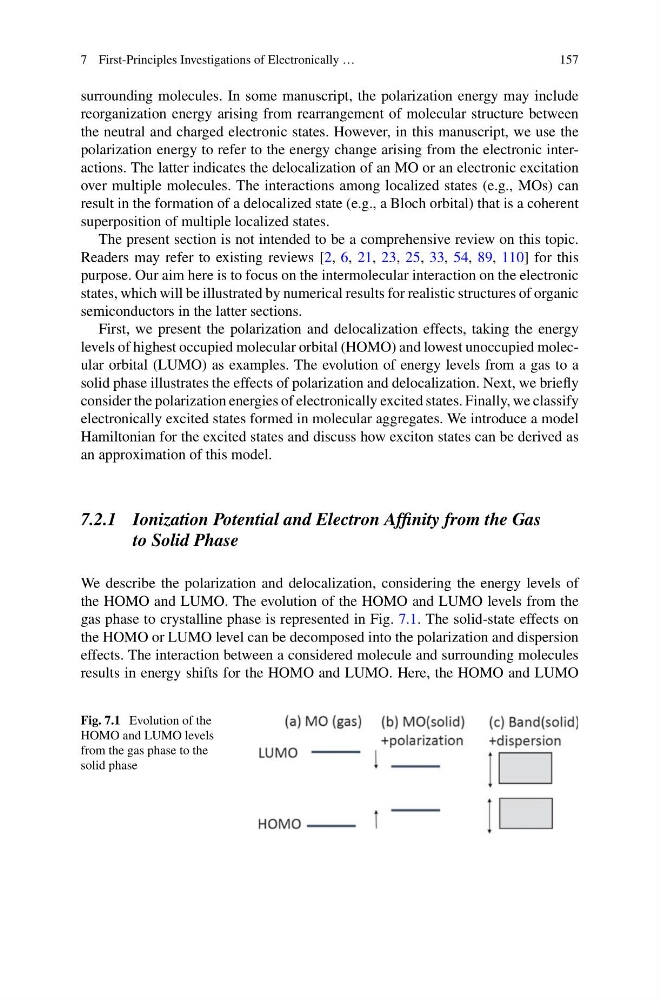
We describe the polarization and delocalization, considering the energy levels of
the HOMO and LUMO. The evolution of the HOMO and LUMO levels from the
gas phase to crystalline phase is represented in Fig. 7.1. The solid-state effects on
the HOMO or LUMO level can be decomposed into the polarization and dispersion
effects. The interaction between a considered molecule and surrounding molecules
results in energy shifts for the HOMO and LUMO. Here, the HOMO and LUMO
Fig. 7.1 Evolution of the
HOMO and LUMO levels
from the gas phase to the
solid phase
157
surrounding molecules. In some manuscript, the polarization energy may include
reorganization energy arising from rearrangement of molecular structure between
the neutral and charged electronic states. However, in this manuscript, we use the
polarization energy to refer to the energy change arising from the electronic interactions. The latter indicates the delocalization of an MO or an electronic excitation
over multiple molecules. The interactions among localized states (e.g., MOs) can
result in the formation of a delocalized state (e.g., a Bloch orbital) that is a coherent
superposition of multiple localized states.
The present section is not intended to be a comprehensive review on this topic.
Readers may refer to existing reviews [2, 6, 21, 23, 25, 33, 54, 89, 110] for this
purpose. Our aim here is to focus on the intermolecular interaction on the electronic
states, which will be illustrated by numerical results for realistic structures of organic
semiconductors in the latter sections.
First, we present the polarization and delocalization effects, taking the energy
levels of highest occupied molecular orbital (HOMO) and lowest unoccupied molecular orbital (LUMO) as examples. The evolution of energy levels from a gas to a
solid phase illustrates the effects of polarization and delocalization. Next, we briefly
consider the polarization energies of electronically excited states. Finally, we classify
electronically excited states formed in molecular aggregates. We introduce a model
Hamiltonian for the excited states and discuss how exciton states can be derived as
an approximation of this model.
7.2.1 Ionization Potential and Electron Affinity from the Gas
to Solid Phase
We describe the polarization and delocalization, considering the energy levels of
the HOMO and LUMO. The evolution of the HOMO and LUMO levels from the
gas phase to crystalline phase is represented in Fig. 7.1. The solid-state effects on
the HOMO or LUMO level can be decomposed into the polarization and dispersion
effects. The interaction between a considered molecule and surrounding molecules
results in energy shifts for the HOMO and LUMO. Here, the HOMO and LUMO
Fig. 7.1 Evolution of the
HOMO and LUMO levels
from the gas phase to the
solid phase