

128
H. Ohkita
For ultrafast measurements up to tens of nanoseconds, pump and probe techniques
are typically employed. In this technique, ultrashort laser pulses are split into two
pulsed light sources: one is employed as a pump light source for exciting the sample
and the other is employed as a probe light source for measuring transmittance of
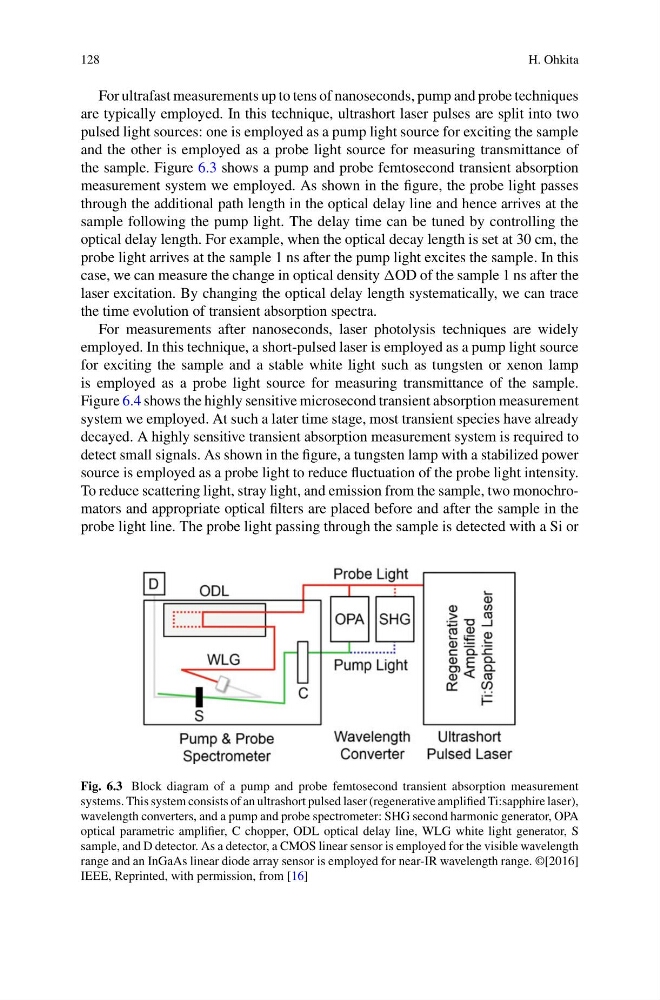
the sample. Figure 6.3 shows a pump and probe femtosecond transient absorption
measurement system we employed. As shown in the figure, the probe light passes
through the additional path length in the optical delay line and hence arrives at the
sample following the pump light. The delay time can be tuned by controlling the
optical delay length. For example, when the optical decay length is set at 30 cm, the
probe light arrives at the sample 1 ns after the pump light excites the sample. In this
case, we can measure the change in optical density OD of the sample 1 ns after the
laser excitation. By changing the optical delay length systematically, we can trace
the time evolution of transient absorption spectra.
For measurements after nanoseconds, laser photolysis techniques are widely
employed. In this technique, a short-pulsed laser is employed as a pump light source
for exciting the sample and a stable white light such as tungsten or xenon lamp
is employed as a probe light source for measuring transmittance of the sample.
Figure 6.4 shows the highly sensitive microsecond transient absorption measurement
system we employed. At such a later time stage, most transient species have already
decayed. A highly sensitive transient absorption measurement system is required to
detect small signals. As shown in the figure, a tungsten lamp with a stabilized power
source is employed as a probe light to reduce fluctuation of the probe light intensity.
To reduce scattering light, stray light, and emission from the sample, two monochromators and appropriate optical filters are placed before and after the sample in the
probe light line. The probe light passing through the sample is detected with a Si or
Fig. 6.3 Block diagram of a pump and probe femtosecond transient absorption measurement
systems. This system consists of an ultrashort pulsed laser (regenerative amplified Ti:sapphire laser),
wavelength converters, and a pump and probe spectrometer: SHG second harmonic generator, OPA
optical parametric amplifier, C chopper, ODL optical delay line, WLG white light generator, S
sample, and D detector. As a detector, a CMOS linear sensor is employed for the visible wavelength
range and an InGaAs linear diode array sensor is employed for near-IR wavelength range. ©[2016]
IEEE, Reprinted, with permission, from [16]
H. Ohkita
For ultrafast measurements up to tens of nanoseconds, pump and probe techniques
are typically employed. In this technique, ultrashort laser pulses are split into two
pulsed light sources: one is employed as a pump light source for exciting the sample
and the other is employed as a probe light source for measuring transmittance of
the sample. Figure 6.3 shows a pump and probe femtosecond transient absorption
measurement system we employed. As shown in the figure, the probe light passes
through the additional path length in the optical delay line and hence arrives at the
sample following the pump light. The delay time can be tuned by controlling the
optical delay length. For example, when the optical decay length is set at 30 cm, the
probe light arrives at the sample 1 ns after the pump light excites the sample. In this
case, we can measure the change in optical density OD of the sample 1 ns after the
laser excitation. By changing the optical delay length systematically, we can trace
the time evolution of transient absorption spectra.
For measurements after nanoseconds, laser photolysis techniques are widely
employed. In this technique, a short-pulsed laser is employed as a pump light source
for exciting the sample and a stable white light such as tungsten or xenon lamp
is employed as a probe light source for measuring transmittance of the sample.
Figure 6.4 shows the highly sensitive microsecond transient absorption measurement
system we employed. At such a later time stage, most transient species have already
decayed. A highly sensitive transient absorption measurement system is required to
detect small signals. As shown in the figure, a tungsten lamp with a stabilized power
source is employed as a probe light to reduce fluctuation of the probe light intensity.
To reduce scattering light, stray light, and emission from the sample, two monochromators and appropriate optical filters are placed before and after the sample in the
probe light line. The probe light passing through the sample is detected with a Si or
Fig. 6.3 Block diagram of a pump and probe femtosecond transient absorption measurement
systems. This system consists of an ultrashort pulsed laser (regenerative amplified Ti:sapphire laser),
wavelength converters, and a pump and probe spectrometer: SHG second harmonic generator, OPA
optical parametric amplifier, C chopper, ODL optical delay line, WLG white light generator, S
sample, and D detector. As a detector, a CMOS linear sensor is employed for the visible wavelength
range and an InGaAs linear diode array sensor is employed for near-IR wavelength range. ©[2016]
IEEE, Reprinted, with permission, from [16]