

126
H. Ohkita
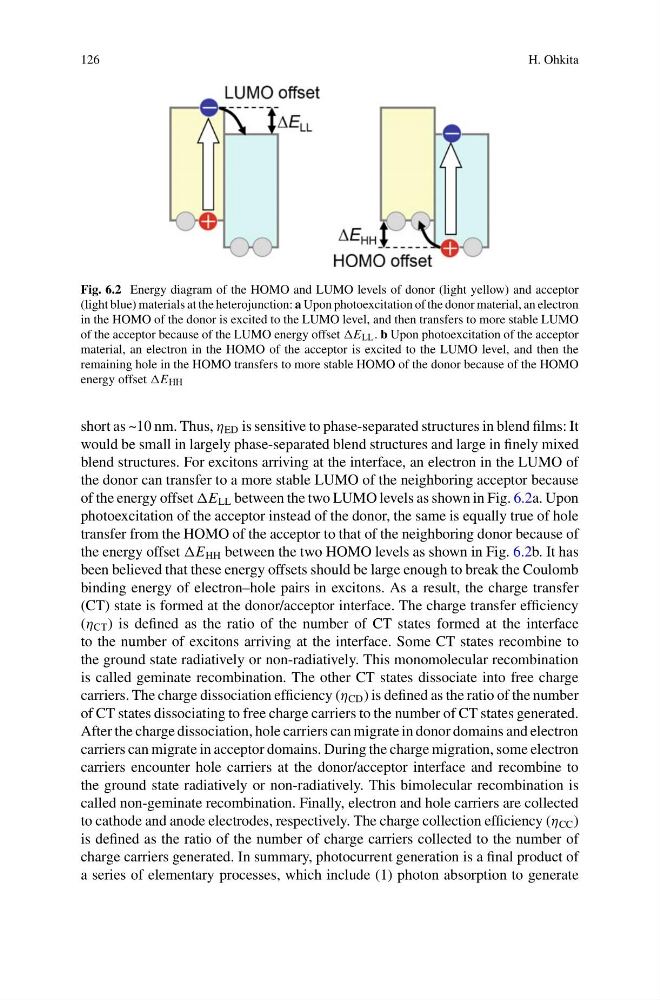
Fig. 6.2 Energy diagram of the HOMO and LUMO levels of donor (light yellow) and acceptor
(light blue) materials at the heterojunction: a Upon photoexcitation of the donor material, an electron
in the HOMO of the donor is excited to the LUMO level, and then transfers to more stable LUMO
of the acceptor because of the LUMO energy offset E LL . b Upon photoexcitation of the acceptor
material, an electron in the HOMO of the acceptor is excited to the LUMO level, and then the
remaining hole in the HOMO transfers to more stable HOMO of the donor because of the HOMO
energy offset E HH
short as ~10 nm. Thus, η ED is sensitive to phase-separated structures in blend films: It
would be small in largely phase-separated blend structures and large in finely mixed
blend structures. For excitons arriving at the interface, an electron in the LUMO of
the donor can transfer to a more stable LUMO of the neighboring acceptor because
of the energy offset E LL between the two LUMO levels as shown in Fig. 6.2a. Upon
photoexcitation of the acceptor instead of the donor, the same is equally true of hole
transfer from the HOMO of the acceptor to that of the neighboring donor because of
the energy offset E HH between the two HOMO levels as shown in Fig. 6.2b. It has
been believed that these energy offsets should be large enough to break the Coulomb
binding energy of electron–hole pairs in excitons. As a result, the charge transfer
(CT) state is formed at the donor/acceptor interface. The charge transfer efficiency
(η CT ) is defined as the ratio of the number of CT states formed at the interface
to the number of excitons arriving at the interface. Some CT states recombine to
the ground state radiatively or non-radiatively. This monomolecular recombination
is called geminate recombination. The other CT states dissociate into free charge
carriers. The charge dissociation efficiency (η CD ) is defined as the ratio of the number
of CT states dissociating to free charge carriers to the number of CT states generated.
After the charge dissociation, hole carriers can migrate in donor domains and electron
carriers can migrate in acceptor domains. During the charge migration, some electron
carriers encounter hole carriers at the donor/acceptor interface and recombine to
the ground state radiatively or non-radiatively. This bimolecular recombination is
called non-geminate recombination. Finally, electron and hole carriers are collected
to cathode and anode electrodes, respectively. The charge collection efficiency (η CC )
is defined as the ratio of the number of charge carriers collected to the number of
charge carriers generated. In summary, photocurrent generation is a final product of
a series of elementary processes, which include (1) photon absorption to generate
H. Ohkita
Fig. 6.2 Energy diagram of the HOMO and LUMO levels of donor (light yellow) and acceptor
(light blue) materials at the heterojunction: a Upon photoexcitation of the donor material, an electron
in the HOMO of the donor is excited to the LUMO level, and then transfers to more stable LUMO
of the acceptor because of the LUMO energy offset E LL . b Upon photoexcitation of the acceptor
material, an electron in the HOMO of the acceptor is excited to the LUMO level, and then the
remaining hole in the HOMO transfers to more stable HOMO of the donor because of the HOMO
energy offset E HH
short as ~10 nm. Thus, η ED is sensitive to phase-separated structures in blend films: It
would be small in largely phase-separated blend structures and large in finely mixed
blend structures. For excitons arriving at the interface, an electron in the LUMO of
the donor can transfer to a more stable LUMO of the neighboring acceptor because
of the energy offset E LL between the two LUMO levels as shown in Fig. 6.2a. Upon
photoexcitation of the acceptor instead of the donor, the same is equally true of hole
transfer from the HOMO of the acceptor to that of the neighboring donor because of
the energy offset E HH between the two HOMO levels as shown in Fig. 6.2b. It has
been believed that these energy offsets should be large enough to break the Coulomb
binding energy of electron–hole pairs in excitons. As a result, the charge transfer
(CT) state is formed at the donor/acceptor interface. The charge transfer efficiency
(η CT ) is defined as the ratio of the number of CT states formed at the interface
to the number of excitons arriving at the interface. Some CT states recombine to
the ground state radiatively or non-radiatively. This monomolecular recombination
is called geminate recombination. The other CT states dissociate into free charge
carriers. The charge dissociation efficiency (η CD ) is defined as the ratio of the number
of CT states dissociating to free charge carriers to the number of CT states generated.
After the charge dissociation, hole carriers can migrate in donor domains and electron
carriers can migrate in acceptor domains. During the charge migration, some electron
carriers encounter hole carriers at the donor/acceptor interface and recombine to
the ground state radiatively or non-radiatively. This bimolecular recombination is
called non-geminate recombination. Finally, electron and hole carriers are collected
to cathode and anode electrodes, respectively. The charge collection efficiency (η CC )
is defined as the ratio of the number of charge carriers collected to the number of
charge carriers generated. In summary, photocurrent generation is a final product of
a series of elementary processes, which include (1) photon absorption to generate